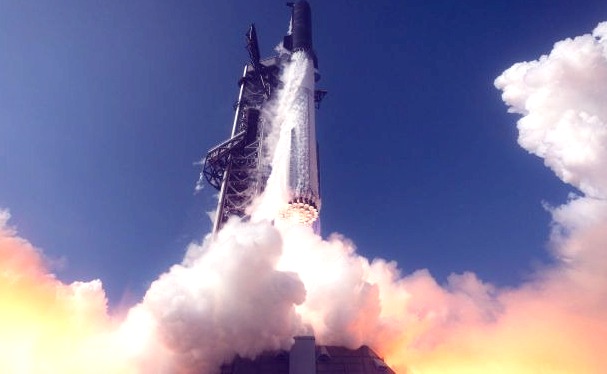
Space X Rocket Explodes In The Indian Ocean After Test Flight.

Texas; May 2026: After completing its test flight, SpaceX’s Starship V3 exploded in the Indian Ocean immediately after splashdown. Starship V3 launched from a new launch pad at the Starbase facility in Texas, just two days after Elon Musk announced SpaceX’s move toward an IPO. A previous launch attempt on Thursday was cancelled due to technical issues at the pad.
During the hour-long flight, which covered half the globe, the rocket deployed 20 Starlink satellite mock-ups. Two of them were equipped with cameras, marking the first time in the program’s history that video was recorded directly from the rocket in flight.
Not everything went perfectly: during the booster’s return, not all engines ignited. The spacecraft itself also operated with fewer active engines than planned but continued its trajectory at an altitude of 194 kilometres.
Starship entered the Indian Ocean vertically in line with the mission plan, but at the last moment tipped over and ignited. The splashdown in the ocean was part of the mission design. Nothing was intended to be recovered in this test flight — neither the booster in the Gulf of Mexico nor the spacecraft itself.
Starship V3, standing 124 meters tall, surpasses previous versions in both size and engine thrust. NASA is paying SpaceX billions of dollars to develop a lunar lander for the Artemis program, and Starship is intended to deliver astronauts to the Moon. NASA Administrator Jared Isaacman said the rocket is now one step closer to a lunar mission.
Earlier, yesterday (Saturday – 23rd May 2026) SpaceX conducted the first test flight of its upgraded Starship V3 rocket. Starship lifted off from SpaceX’s Texas base, with all 33 Raptor engines igniting successfully without issues. The spacecraft entered a suborbital trajectory and deployed 22 mock satellites, two of which were equipped with cameras to capture the performance of the thermal shield.
However, several issues occurred during the mission. The Super Heavy booster did not complete its full “boost-back” burn, which is required for a controlled landing. On the spacecraft itself, only five of six engines ignited, preventing it from reaching the intended orbit. Despite this, the trajectory remained within acceptable parameters. A second in-space engine relight was not conducted.

During landing, only two of the three engines were operating, but the atmospheric re-entry and splashdown proceeded as planned. SpaceX employees greeted the landing with applause.
Starship V3 is capable of delivering 150 to 250 tons of cargo into orbit. The cost of a single launch, according to financial reporting from a SpaceX customer, could be around $90 million, compared to $60–75 million for a Falcon 9 launch, which has a payload capacity of 22.8 tons. SpaceX plans to use Starship for satellite deployments, deep-space missions, and NASA astronaut landings on the Moon in 2028.
Team Maverick.






KL Rahul’s 60 Powers Delhi Capitals to 203/5 Against Kolkata Knight Riders at Eden Gardens
Kolkata, May 2026 : KL Rahul’s classy 30-ball 60 and a late burst from David Miller propel…

KL Rahul’s 60 Powers Delhi Capitals to 203/5 Against Kolkata Knight Riders at Eden Gardens
Kolkata, May 2026 : KL Rahul’s classy 30-ball 60 and a late burst from …