
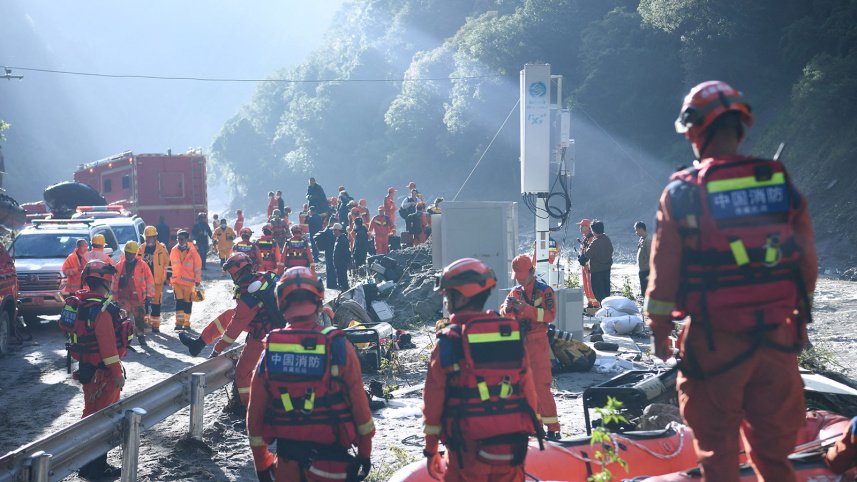
BEIJING, Aug 2026 : China said on Sunday that 261 foreign nationals from 23 countries were missing on the Tibetan side of a border crossing with Nepal after a massive mudslide swept through the Himalayan region, while the death toll in Tibet rose to 16.
Officials from China’s Tibet Autonomous Region said the largest number of missing foreign nationals were Nepalese citizens, with 104 people unaccounted for. The list also included 49 Indian nationals, 33 Latvians, 18 Americans and 15 British citizens. Chinese authorities said the respective foreign missions had been informed about the missing persons.
The nationality-wise figures are the first detailed account released by Chinese authorities since Wednesday’s glacier collapse triggered a devastating torrent of ice, rocks, mud and debris that surged through valleys and river systems along the China-Nepal border.
Authorities said 16 people had died in Gyirong County as of Saturday evening, while 546 people remained missing on the Tibetan side. The disaster has also caused extensive damage to infrastructure and disrupted movement through the strategically important border region.
The situation remained precarious in Nepal as rescue and relief operations continued. Nepal’s disaster management authorities reported at least 675 deaths, with 2,498 people still missing and 7,514 rescued so far.
Local police said residents and rescue personnel had moved to higher ground after the water level in the nearby Trishuli River increased over several hours. The development raised concerns about further flooding and complicated ongoing search and rescue operations.
China Links Disaster to Global Warming
Chinese authorities have attributed the disaster to the long-term impact of climate change and glacier instability. State broadcaster CCTV reported that the mudslide was “caused by glacier instability under the long-term effects of global warming”.
Chinese scientists described the event as an example of an increasingly significant form of cryosphere-related disaster affecting the Tibetan Plateau, where rising temperatures are contributing to changes in glaciers, snow and permafrost.
According to CCTV, scientists estimated that it took only six to seven minutes for the mudslide originating from the Nepalese side to reach the Gyirong border crossing.
Surveillance footage from the crossing showed huge volumes of water, mud and debris rushing through the area and engulfing buildings. People could be seen attempting to flee as the torrent swept through the border facility.
China’s Foreign Minister Wang Yi discussed the disaster with his Nepalese counterpart during a telephone conversation on Saturday. Wang described the incident as the most severe cross-border disaster between the two countries in recent years and said the scale and complexity of rescue operations were unprecedented.
Beijing has deployed more than 2,100 emergency rescue personnel and allocated at least 220 million yuan, or about $32.7 million, for relief and recovery operations.
China is also providing emergency financial assistance, relief supplies, satellite imagery and hydrological information to support rescue efforts. Tunnel rescue specialists have additionally been sent to assist teams working in difficult terrain.
Chinese and Nepalese authorities are coordinating efforts to locate missing people and identify foreign nationals affected by the disaster. The two countries are also working to strengthen cooperation on disaster prevention, emergency response and climate-change-related risks.
The International Federation of Red Cross and Red Crescent Societies estimated that more than 90,000 people could have been affected by the disaster.
The large number of missing foreign nationals has added an international dimension to the humanitarian crisis, with governments closely monitoring rescue efforts and seeking information about their citizens. Continued risks from unstable terrain, rising river levels and possible secondary flooding are expected to make the search and recovery operation particularly challenging.