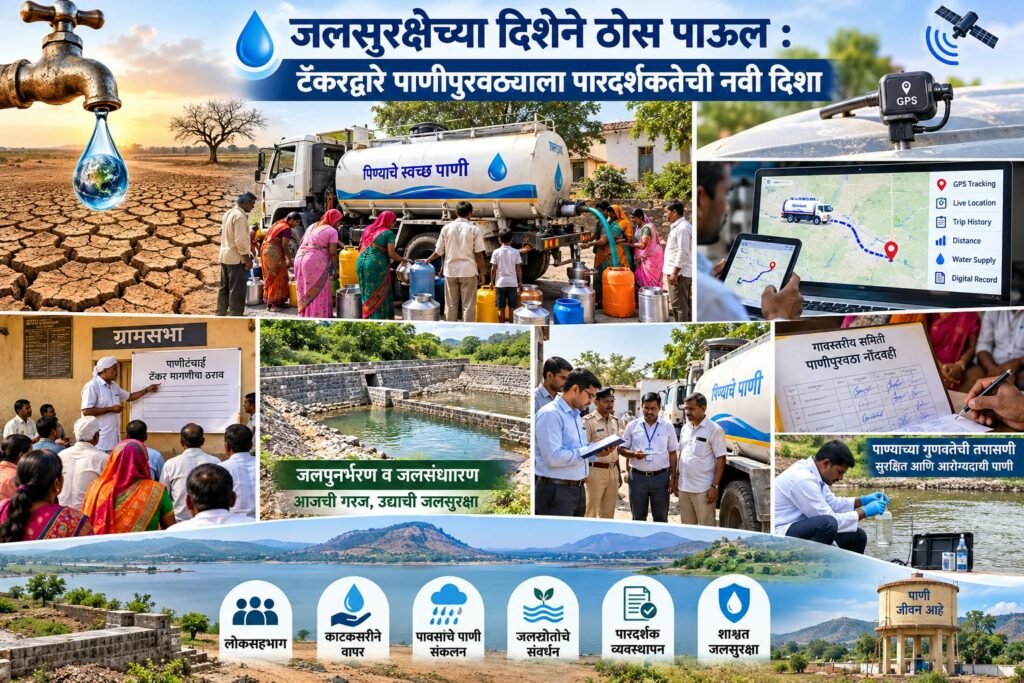
Chhatrapati Sambhajinagar district administration introduces comprehensive guidelines for water supply in scarcity-hit areas
October 2026 : Water is the foundation of life. From human well-being to agriculture, livestock and the rural economy, every sector depends on it. Uncertain rainfall and changing climatic conditions have made water scarcity not merely a natural challenge but also a test of effective planning and resource management. Ensuring that every citizen receives an adequate supply of safe drinking water is therefore a critical responsibility of the administration.
With this objective, the Chhatrapati Sambhajinagar district administration has established a comprehensive framework for supplying water through tankers in water-scarce areas.
District Collector and Chairman of the District Disaster Management Authority Vinay Gowda G.C. has constituted a district-level water tanker monitoring and physical inspection committee. The initiative aims to bring greater transparency, accountability and accuracy to the water supply system. The guidelines have been formulated keeping in view the anticipated water scarcity period from October 2026 to June 2027.
Water supply based on actual needs, with priority to planning
During periods of water scarcity, tanker-based supply provides vital relief to residents. However, to ensure that water is supplied according to actual requirements rather than demand alone, the administration has established clear criteria.
The quantity of water required will be calculated based on the population of the concerned village or settlement, using a norm of 20 litres per person per day. The water requirements of livestock will also be taken into account.
A formal resolution passed by the Gram Sabha will be mandatory before a request for tanker water supply can be submitted. This will increase community participation in planning and help the administration assess local requirements more accurately.
Technology opens a new chapter in transparency
The administration has emphasised the effective use of modern technology in tackling water scarcity. GPS devices will be installed on every authorised government or private water tanker. This will enable officials to verify each trip, the distance travelled and the actual delivery of water.
A digital log of tanker trips will be maintained. Once water reaches a village, its delivery must be confirmed through the signatures of members of the village-level committee. Payments to tanker operators will be released only after GPS records have been verified and the quantity of water actually delivered has been confirmed.
The system is expected to ensure the proper utilisation of public funds and prevent discrepancies between paperwork and actual water supply.
Conserving every drop of water
Increasing the number of tankers alone is not sufficient to overcome water scarcity. Protecting, replenishing and conserving existing water resources is equally important.
Gram Panchayats seeking tanker supplies will therefore be required to plan water-recharge measures. Emphasis will be placed on the Shivkalin water storage scheme and other groundwater-recharge initiatives.
The broader objective is not only to address the current shortage but also to build long-term water security. While tankers may be necessary as a temporary measure, water conservation is essential for a sustainable future. Integrating emergency water supply with conservation efforts is therefore a significant feature of the administration's approach.
Verification of water sources and monitoring of water quality
Approval for tanker supply will be considered only after confirming that existing public water sources have been exhausted. A resolution of the Gram Panchayat, along with a joint inspection report prepared by the village revenue officer and Gram Sevak, will be mandatory.
The capacity and availability of water sources used to fill tankers, as well as the quality of the water, will be assessed. The distance between the water source and the village will be determined using GPS or Google Maps. Clear instructions have also been issued to avoid unnecessary transportation costs.
Making drinking water available is not enough; it must also be safe and suitable for consumption. Accordingly, the administration will focus on regular water-quality testing, cleaning public distribution tanks and ensuring their disinfection.
Physical inspections to strengthen accountability
Effective implementation and regular monitoring are essential for any scheme to achieve its objectives. To strengthen oversight, the administration has decided to conduct surprise inspections of at least five per cent of the tankers operating in the district.
Senior officials will visit water-scarce villages to verify the number of approved tanker trips, actual water deliveries, the condition of water sources and records maintained at the Gram Panchayat level. These inspections are expected to help prevent irregularities in the supply system.
A district-level committee headed by the Additional District Collector will supervise the entire arrangement. The Additional Chief Executive Officer of the Zilla Parishad will serve as a member, while the Tehsildar (Planning and Disaster Management) will act as member secretary.
If irregularities in tanker trips, fabricated records or violations of official orders are detected, action will be taken against the officials, employees and contractors concerned under the relevant provisions of the Disaster Management Act, 2005, and the Bharatiya Nyaya Sanhita.
Community participation for sustainable water security
Addressing water scarcity is not solely the responsibility of the administration. Active participation by Gram Panchayats, local institutions and citizens is equally necessary.
Villages can strengthen their water security through the judicious use of water, protection of existing sources, rainwater harvesting and groundwater-recharge initiatives.
The comprehensive framework introduced by the Chhatrapati Sambhajinagar district administration represents more than an improvement in tanker management. It is an important step towards citizen-centric, technology-driven and accountable governance.
Every drop of water is precious. Ensuring that it reaches those in need at the right time, in the right quantity and in a safe condition is the true measure of effective water management.
Effective implementation of these guidelines is expected to provide relief to residents of water-scarce areas while strengthening public confidence in the water supply system.
Water conservation for water abundance, and transparent management for water security — this is the path towards a sustainable future.