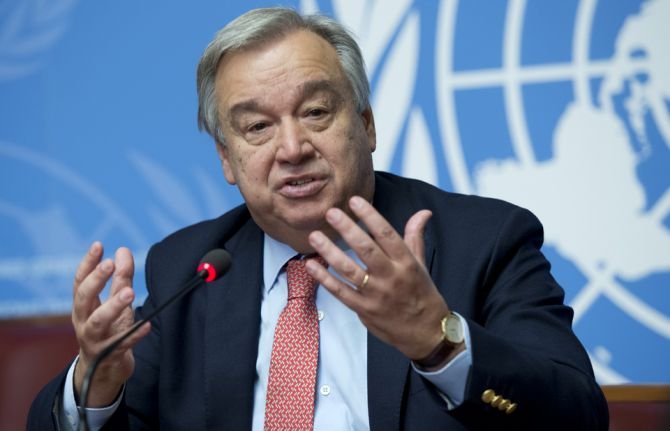
New York; September 2026: The United Nations Secretary-General Antonio Guterres has condemned mounting civilian casualties in southern Lebanon and called on Israel to withdraw its forces from Lebanese territory, as fighting intensifies in and around Nabatieh.
In a statement issued by his Spokesperson, Stéphane Dujarric, the Secretary-General said he was “deeply concerned” by the escalation of Israeli military operations in southern Lebanon, condemning “mounting civilian casualties, including women and children killed and injured in the intensifying attacks”, further pointing to the “distress and displacement caused by the evacuation orders” and “the scenes of massive destruction and devastation” now unfolding across the district.
The Secretary-General said he was particularly alarmed by reports of Israeli strikes affecting hospitals, healthcare workers and public institutions, along with restrictions on humanitarian access.
All parties, he said, must comply with their obligations under international law, including international humanitarian law, adding that “civilians and civilian objects must be protected at all times, and attacks directed against them are unacceptable”.
He appealed for an immediate cessation of hostilities, called on Israel to withdraw, and urged all sides to respect Lebanon’s sovereignty and territorial integrity and to fulfil their obligations under Security Council resolution 1701 (2006).
The UN, he said, remains committed to “supporting efforts to end the violence, protect civilians and advance a lasting solution to this conflict”.
Briefing journalists in New York, Dujarric said the UN was “very concerned by the sharp escalation” seen over the weekend and into the start of the week, particularly in Nabatieh, where humanitarian colleagues report that civilians, including children, have been among those killed and injured.
According to local authorities, around 5,000 families, about 20,000 people have left Nabatieh District last week, the UN humanitarian affairs office, OCHA, reports. Healthcare in the area is also under increased pressure.
Dujarric reiterated “the need for full respect for international humanitarian law, including the protection of civilians, healthcare and civilian infrastructure”, stressing that humanitarian access must be maintained to reach people affected by the renewed escalation.
While the reported incidents occurred outside the UN peacekeeping force’s area of operations, peacekeeping mission UNIFIL said it continues to monitor the broader deterioration of the security situation with concern.
Between Thursday (03rd September) and Monday (07th September) the Mission recorded a sharp rise in Israeli military activity within and around its area of operations, including ground operations, projectile fire, airstrikes and Lebanese airspace violations.
UNIFIL detected 528 projectiles fired by the Israel Defence Forces over that period, and on Sunday (06th September) for the first time since 21st June, one projectile has been fired by Hezbollah. On Sunday alone, UNIFIL recorded 62 Israeli airspace violations, among the highest daily totals since June, along with airstrikes in both sectors of its area of operations and north of the Litani River.
Peacekeepers also reported roadblocks and checkpoints hindering their movement, with the UN calling on all parties to respect the Mission’s freedom of movement. On the humanitarian side, UNIFIL facilitated 13 missions between Thursday and Monday in coordination with OCHA, all in its western sector.
Over the past weeks, UNIFIL peacekeepers ramped up support to communities affected by the recent hostilities – including through medical assistance, education support, veterinary support, and facilitating humanitarian missions – across south Lebanon, where damaged infrastructure and pressure on essential services continue to affect daily lives. Working with municipalities and community representatives, peacekeepers identified local needs and provided support within their means and capabilities.
Throughout the month of August 2026, UNIFIL medical teams provided medical care to hundreds of people across south Lebanon, including in communities where access to healthcare and specialized services remains limited. Peacekeepers also supported local health facilities with medicines and medical supplies, helping them respond to the needs of the communities they serve.
For families who depend on livestock, assistance took another form. UNIFIL veterinary teams treated animals, provided medicines and worked with shepherds in rural communities, helping protect an important source of livelihood. In Chebaa, for example, UNIFIL’s Indian peacekeepers provided veterinary assistance to the local shepherding community thereby supporting their livelihoods.
Vulnerable communities, particularly women and children who were disproportionately affected by the conflict, continued to benefit from UNIFIL’s support initiatives including psychosocial care. In Baraachit, for example, some 300 children took part recently in a psychosocial support programme, while UNIFIL peacekeepers provided 400 educational kits.
UNIFIL support extended to services that communities rely on every day. Peacekeepers helped repair damaged water networks and deep-well pumps, delivered drinking water to hospitals and communities, and worked with municipalities to repair vehicles and equipment used to provide essential services. On 25 August, a UNIFIL maintenance team from the mission’s Indian contingent repaired municipal equipment in El Hebbariye, including two firefighting trucks.
At the end of August, the mission’s Korean peacekeepers successfully completed the installation of a high-voltage solar battery system for the local water-pumping facility in Burj Rahhal – essential for a continued water supply in the area. More recently, they also supported a public library in Burj al-Shamali with wooden cabinets that would ensure an improved learning environment for young students.
“All these support initiatives run parallel to our core operational tasks”, said the UNIFIL Head of Mission and Force Commander, Major General Diodato Abagnara. “In particular, our liaison channels with the parties operate round-the-clock for necessary deconfliction of various humanitarian and life-saving missions”.
Despite a multitude of challenges on the ground, UNIFIL peacekeepers remain deployed across south Lebanon and along the Blue Line, monitoring and reporting developments, maintaining liaison with the parties, supporting the Lebanese Armed Forces and working to reduce tensions and prevent escalation.
As communities continue to deal with the consequences of conflict, UNIFIL’s engagement helps address immediate needs, preserve access to essential services and strengthen local resilience, complementing the Mission’s broader efforts to support stability in south Lebanon.
Team Maverick.