Vancouver; September 2026: Vide a gazette notification dated 29th August, the Government Of Canada has begun the 30 days consultation period on whether to list the port expansion as a project of national interest under the Building Canada Act.
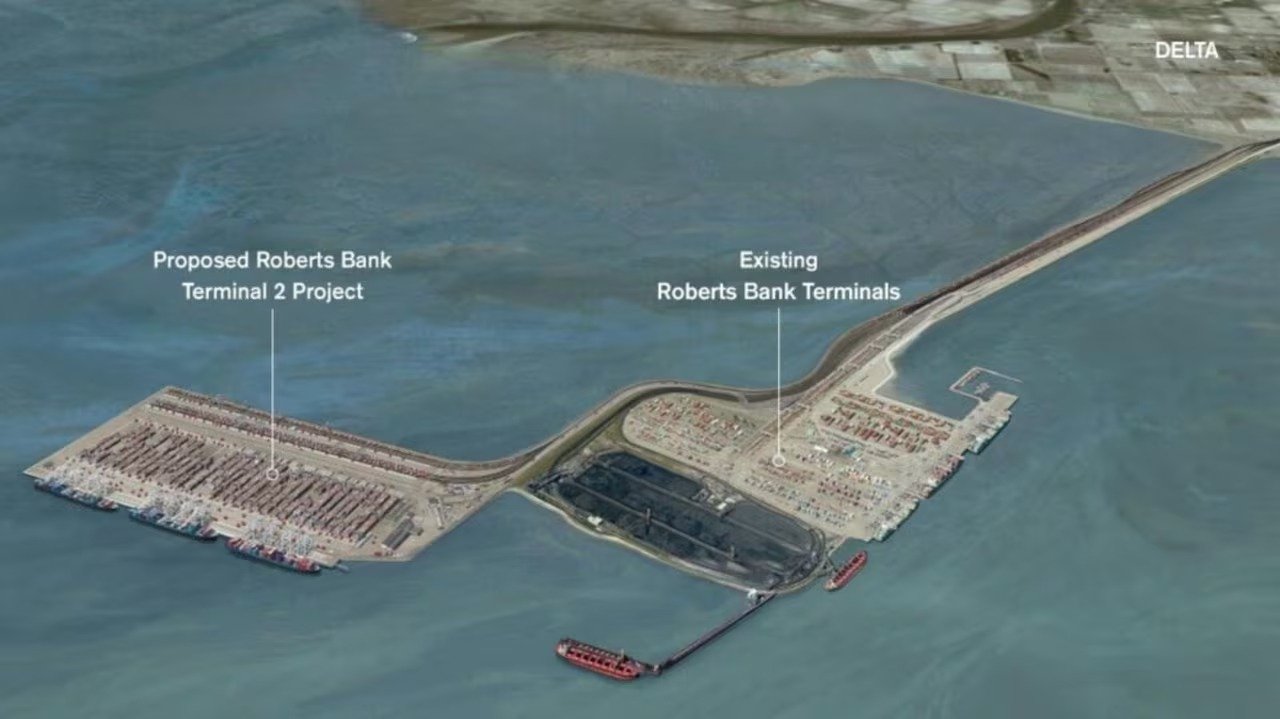
Roberts Bank Terminal 2 is a proposed container terminal project that would increase the Port of Vancouver’s container capacity by approximately 50%. It is a key pillar under the Port of Vancouver Gateway Strategy that would support Canada’s growth and trade diversification objectives, including doubling exports to non-United States markets by 2035. The project is being advanced by the Vancouver Fraser Port Authority, which is responsible for the shared stewardship of the lands and waters that make up the Port of Vancouver.
The project would be comprised of the following major components:
·A marine terminal landmass and wharf structure to host the terminal (approximately 120 hectares);
·A widened causeway for additional road and rail infrastructure (approximately 45 hectares);
·An expanded tug basin to support marine operations (approximately 3 hectares);
·Buildings, rail, equipment, and other on-land infrastructure to enable container handling operations.
The Act enables the government to streamline federal approval processes for projects determined to be in the national interest, helping such projects to move forward efficiently while protecting Canada’s environment and upholding the rights of Indigenous Peoples.
In deciding whether to list the project as a national interest project under the Act, the Governor in Council may consider any factor that the Governor in Council considers relevant, including the extent to which the project can
·strengthen Canada’s autonomy, resilience and security;
·provide economic or other benefits to Canada;
·have a high likelihood of successful execution;
·advance the interests of Indigenous peoples;
·contribute to clean growth and to meeting Canada’s objectives with respect to climate change.
The law allows projects deemed to be in the national interest to have their approval process, including environmental assessments, expedited. However, environmental groups are concerned that potentially fast-tracking the port expansion could allow the government to bypass environmental protections.
The Roberts Bank Terminal 2 (RBT2) port expansion project, led by the Vancouver Fraser Port Authority, is a proposed three-berth container terminal that would increase the port's capacity by nearly 50% and generate approximately $100 billion in annual trade capacity, according to the port authority.
The federal government approved the project in 2023, imposing 370 legally binding conditions intended to address environmental concerns. That same year, British Columbia (B.C.) has issued the project an environmental assessment certificate that included 16 additional conditions. In their decisions, both levels of government acknowledged that the project would likely cause significant adverse environmental effects, but were "justified in the circumstances".
The RBT2 project is still in the process of securing final environmental permits, including legal approval from Fisheries and Oceans Canada related to compliance with the Species at Risk Act (SARA). But, if the project is granted national-interest status, Carney's cabinet could obtain the discretionary power to grant it exemption from SARA. In July this year (2026), Prime Minister Mark Carney announced $10 billion in federal support for the expansion project as part of a broader agreement with British Columbia.
Meanwhile, Julia Levin, associate director of national climate with Environmental Defence, a Canadian environmental advocacy group has flagged grave concern that: "This is an incredibly important breeding ground ecosystem for over a hundred at-risk species. It's putting a mega port in the middle of that, destroying nearly 200 hectares of this really biodiverse estuary".
Last year, a Federal Court judge dismissed a lawsuit launched by multiple environmental groups who said the project would destroy vital chinook salmon habitat and threaten the survival of southern resident killer whales.
Southern resident killer whales, those which are also known as orcas, are among more than 600 wildlife species listed under the Species at Risk Act. Only 75 southern residents remain.
Chinook salmon, currently under consideration for listing under SARA, are one of the southern resident's main food sources. But the area has lost approximately 85 per cent of its salmon habitat due to development and infrastructure, according to a 2021 study.
In response to environmental concerns, the port authority has issued a press notification that it plans to restore 102 hectares of habitat in collaboration with First Nations to "support key species like juvenile Chinook salmon and Dungeness crab". The port authority said it is also advancing protections for southern resident killer whales, including requiring ships to participate in slowdown programs designed to reduce underwater noise.
B.C.'s Environmental Assessment office pointed to the legally binding conditions, saying in an emailed statement to CBC News that when construction begins, officers would "monitor the project for compliance with all provincial requirements over the life of the project".
Last spring, the federal government also proposed $258 million over five years to protect whales and their habitats, including $95 million over five years and $16.5 million annually thereafter specifically for the protection of southern resident killer whales. But Julia Levin and other environmental groups say the government's potential fast-tracking of these projects is a way to get them built at any cost, including at the southern resident's expense. "The federal government is clearly pursuing multiple avenues to bypass environmental safeguards", said Levin.
Along with potentially fast-tracking several major projects, including a new West Coast pipeline that would end in Roberts Bank, the Carney government is considering further changes to environmental regulations, including the Species at Risk Act, that it says would allow for quicker approval and construction of major projects. "All of this is about overriding environmental protections, environmental laws and species protections to get certain projects built at any cost", Levin said.
The changes the government is considering would render the Species at Risk Act, and the protection it provides, would become meaningless, wrote multiple scientists in a press release last month.
In May, two federal discussion papers proposed a number of possible changes, including exempting certain projects from the "jeopardy test" in the Species at Risk Act. Following criticism from First Nations and environmental groups, the government extended the engagement period, which ended in July.
"We're suggesting, rather strongly and bluntly to the minister, maybe this is not the way you want to do this", said David Green, a biologist and professor emeritus at McGill University who is one of the former COSEWIC chairs behind the letter. "You don't have to just give yourself carte blanche to do whatever you want without mulling it over".
Team Maverick.