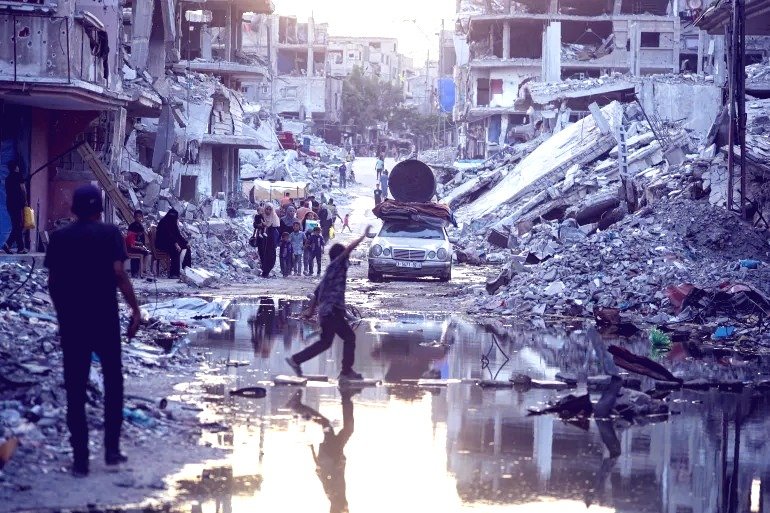
Gaza/Jerusalem; August 2026: Gaza shares the Mediterranean, coastal ecosystems and coastal aquifers with Israel. The destruction of its electric power and sanitation infrastructure forces over 100,000 cubic metres of raw, untreated sewage into the Mediterranean Sea or on land every day. Because in this part of the Mediterranean currents move primarily from south to north, this waste is carried straight up the coast into Israeli waters.
The Ashkelon desalination plant in southern Israel has been forced to shut down multiple times due to high faecal bacteria contamination from Gaza’s wastewater. Raw sewage also triggers toxic algae blooms blocking and damaging desalination filtration systems, as well as creating dead zones where fishing would normally happen.
Wastewater toxins, heavy metals and pathogens are absorbed by local marine life. Because fish migrate across maritime boundaries, contaminated seafood poses a direct health hazard to Palestinian as well as Israeli consumers. Raw sewage carries the same pathogens afflicting Gaza into the shared marine environment. Its northward drift directly impacts Israeli coastal cities.
Although pathogens can persist and migrate under certain conditions, pathogen contaminated groundwater is unlikely to feed into Israeli municipal water supplies, but can still affect the shared aquifer and surrounding environment. Salts and other chemical contaminants can travel much farther and are often a bigger long-term aquifer concern. They can contaminate a shared groundwater system and reduce the quality and usability of the aquifer over time for irrigation, agriculture and drinking.
Earlier this month (August 2026), Israeli Prime Minister Benjamin Netanyahu and representatives of the Board of Peace agreed to set up a working group on sanitation and public health affecting both Israel and Gaza. Its membership and detailed operating structure are yet to be made public.
It appears it has finally dawned on the Israeli authorities that the consequences of the unrelenting ecocidal destruction of Gaza were eventually going to hit Israel. The toxic leftovers of war, those which are the untreated sewage and contaminated rubbles, are now a problem for Israeli public health as well.
Israel has recently also begun moving some of the estimated 60 million tonnes of rubble from Gaza into undisclosed locations inside Israel and the West Bank, potentially transferring the pollutants in that rubble directly to disposal or storage sites. In recent weeks, Euro-Med Monitor tracked some 100 Israeli trucks daily leaving the Gaza Strip with debris.
Transferred pollutants may include heavy metals, such as lead, mercury, cadmium and traces of other metals or residues from specialised munitions, as well as white phosphorus particulates, unspent explosives, industrial chemicals, and widespread asbestos fibres from pulverised older buildings. Heavy metals present in dust and rubble may exhibit carcinogenic, mutagenic, teratogenic, neurotoxic, nephrotoxic and bio accumulative properties, posing long-term human health and environmental risks.
The rubble also contains biological matter, pathogens and fluids from decomposing human remains and accumulated organic waste, as well as insects, rodents, and other disease vectors. Airborne transmission of hazardous dust particles, asbestos fibres and particulate matter degrades the quality of the air while hidden unexploded ordnance in the debris can cause a detonation risk and soil toxicity.
When managing highly contaminated disaster debris, international agencies such as the UN Environment Programme (UNEP) and regional environmental authorities like the Gaza Debris Management Working Group (DMWG) stipulate transfers must follow strict protocols and operational procedures to isolate hazards, including an immediate freeze on all operations if human remains are detected. Moving these materials across borders or jurisdictions should also trigger legal frameworks and rigid groundwater protection standards.
Critics have pointed out that bulldozing sites that contain mass graves is destroying key evidence of genocidal crimes. But apart from that, this transfer of debris in disregard of international rules and regulations is putting at risk the health of people around collection and disposal sites.
Access to water is a daily challenge in Gaza, one of the most densely populated areas on earth. With no perennial streams and low precipitation, Gaza relies almost completely on the underlying coastal aquifer, but severe contamination from sewage and seawater intrusion has irreparably damaged the aquifer. Nearly 97% of the water of the Gaza aquifer is unsafe to drink, owing to high levels of salinity.
Gaza’s water crisis also extends to sanitation. The inadequate capacity and disrepair of many wastewater networks and facilities, limitations on repair and construction caused by Israeli import restrictions on materials classified as ‘dual use’, and insufficient power supply to operate the treatment plants, has led to a severe worsening of the pollution from the outflow of untreated wastewater in recent years into the Mediterranean.
Given that Gaza remains a protracted humanitarian crisis, the humanitarian sector and development community has sought to find ways to augment water supply, ranging from rainwater harvesting to large-scale desalination plants. The current situation, where many households must purchase expensive drinking water of uncertain quality from private vendors, is not a long-term viable solution for meeting society’s basic human needs.
The Coastal Aquifer supplies 95% of Gaza’s water, and is in a state of extreme overuse with water extraction rates more than three times the renewable supply. As a result, seawater infiltrates into the aquifer, and salinity levels have thus risen well beyond World Health Organization (WHO) guidelines for safe drinking water. This situation is compounded by contamination of the aquifer by nitrates from the untreated sewage of 1.8 million people.
Gaza’s residents are increasingly dependent on small-scale desalination of brackish water. While these small desalination plants reduce salinity, they do not remove the pollutants. The water is sold to the public mostly by private vendors for drinking and cooking purposes, with little supervision of health authorities.
The implications of a Gaza health crisis will not be confined to the Gaza but threaten regional stability. Some 90,000 cubic metres of raw sewage from Gaza flow into the Mediterranean Sea every day. Seawater currents carry this untreated wastewater along the Gaza coast towards Israeli beaches. Due to poor sanitary conditions in Gaza, an outbreak of pandemic disease is a matter of time. As is further witnessed by the current wave of Syrian refugees into Europe, desperate people will not be stopped by border fences. A recent UN report concluded that the Gaza Strip, in just 5 more years of further under development, will be uninhabitable with water, sanitation and energy issues of prime concern. This has dire implications not only for the Palestinian population of Gaza but to the region as a whole.
Israel therefore has a clear vested interest in cooperating with the Palestinian Authority and with the international community to alleviate the current situation.
As envisaged, the following measures are necessary:
·Double the volume of water sold by Israel to Gaza, from 10 to 20 mcm: In March 2015 the Israeli government committed to double the amount of water sold to Gaza from 5 to 10 mcm. The current capacity of water pipelines crossing into Gaza from Israel is reported to be 20 mcm. The imported water could be blended with groundwater, making 40 mcm of potable water available.
·Facilitate reservoir building and repair of network: Only 8 mcm of the 10 committed by Israel can presently be supplied due to lack of storage capacity. Additional storage capacity of up to 12 mcm (to accommodate the 20 mcm overall) is needed and urgent investment in network losses, estimated at up to 50%, are needed. The German Development Bank (KFW) is presently completing the refurbishment of the Al Muntar reservoir in Gaza City. Donors are considering an additional reservoir to accommodate water imported from Israel.
·Increase electricity supply for water and sanitation: In June 2016 Israel approved the supply of additional 6 MW of electricity to Gaza, in order to power a newly built World Bank led wastewater treatment plant in northern Gaza (the NGEST project). However, considering the state of the existing grid connection between Israel and Gaza and the inability to control the allocation of this additional electricity once it has cross the border, without the construction of a dedicated power line that would connect the Israeli provider to the plant, this additional supply may be dispersed and not reach its final destination. The construction of this power line is therefore fundamental for the efficient functioning of the plant. Nevertheless, the construction of a dedicated power line should be considered simply as an interim measure.
·In the long term, there is a need for a high voltage electricity line that would see an additional 100 MW of electricity (the planned 161 line) and a gas pipeline from Israel to Gaza to directly power the Gaza Power Plant as well as the proposed 55 mcm desalination plant.
Team Maverick.