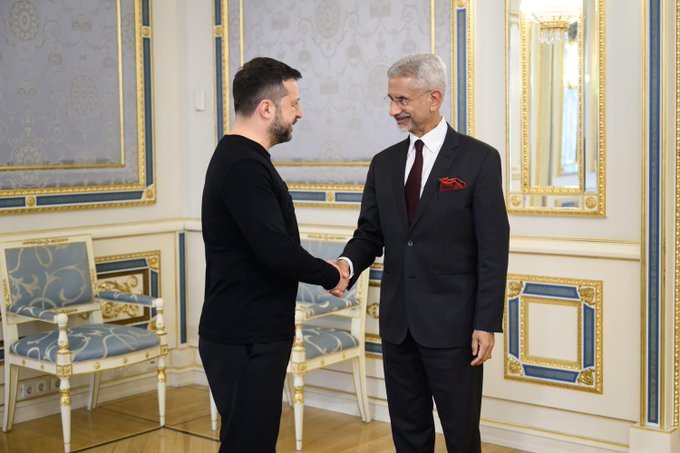
Kyiv, Sep 2026 : External Affairs Minister S. Jaishankar on Thursday said India remains ready to contribute in any way possible towards finding a peaceful end to the prolonged Russia-Ukraine conflict, underlining Prime Minister Narendra Modi’s recent call for an end to “endless war.”
Jaishankar made the remarks during his meeting with Ukrainian Foreign Minister Andrii Sybiha in Kyiv, where discussions focused on bilateral relations as well as the broader implications of the war that has continued since 2022.
“Just two days ago in Bishkek, Prime Minister Modi declared that endless war must now give way to the end of war. Every passing day of conflict only means more deaths and more destruction,” Jaishankar said.
He stressed that it ultimately remained the responsibility of the parties involved to find a way towards ending the conflict, but said India was prepared to assist if its contribution could help advance peace efforts.
“Understandably, it is for the parties involved to find a way. But if India can be of any help, in any manner, we are ready,” he said, adding that the issue was central to his discussions with Sybiha.
Jaishankar said his visit to Kyiv had a strong bilateral purpose but was taking place against the backdrop of the ongoing war. He also expressed condolences over the recent death of an Indian national in an attack in Kyiv.
“Only two days ago, an Indian national was also killed in an attack in Kyiv. We join in mourning every life lost and convey our deepest sympathy to every affected family,” he said.
The External Affairs Minister reiterated India’s longstanding position that the current global environment should not be defined by war and that lasting solutions cannot emerge from the battlefield.
He also highlighted specific consequences of the conflict, particularly attacks affecting commercial shipping. Jaishankar said Indian seafarers working aboard ships of different nationalities had been among those affected, while disruptions to maritime trade were having wider consequences for countries across the Global South.
According to Jaishankar, the impact on shipping has contributed to shortages and disruptions involving fuel, fertilisers and food in several countries.
The minister noted that he and Sybiha had maintained regular contact even before his current visit. Their previous meetings took place in Cyprus in May, France in March and Munich in February, as well as in Canada and New Delhi during 2025.
Jaishankar also pointed to regular engagement between Prime Minister Modi and Ukrainian President Volodymyr Zelensky. The two leaders most recently held discussions on the sidelines of the G7 Summit in Evian, France, in June this year.
India’s humanitarian assistance to Ukraine was another key aspect highlighted by Jaishankar. He said New Delhi had so far provided 19 consignments of humanitarian aid, amounting to around 160 tonnes. The assistance included generator sets, medicines and medical equipment.
The two ministers also discussed cooperation between universities and scientific institutions. Jaishankar noted that a significant number of Indian students continue to study in Ukraine and thanked Ukrainian authorities for their support and care for them.
Looking ahead, Jaishankar said there was considerable potential to deepen bilateral economic and technological cooperation. He noted that Ukraine possesses significant strengths and capabilities, while India is advancing rapidly in areas including digital technology, innovation and startups.
He invited Sybiha to visit India for the next meeting of the India-Ukraine Intergovernmental Commission, saying the two countries should continue to explore new areas of cooperation.
Jaishankar also said he would meet President Zelensky later on Thursday and convey Prime Minister Modi’s greetings.
The visit comes as India continues to maintain diplomatic engagement with both Kyiv and Moscow while advocating dialogue and diplomacy as the preferred route towards resolving the conflict.