
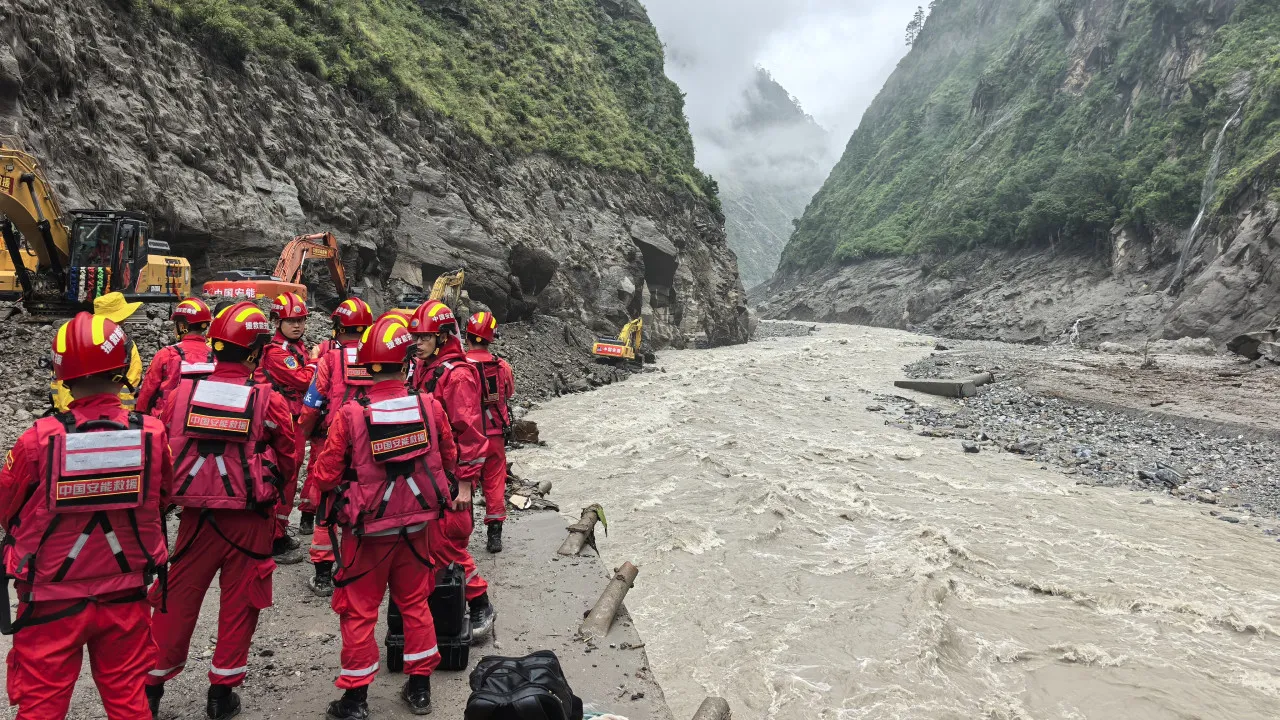
Brussels, August 2026 : The collapse of a glacier near Langtang Lirung peak, which reportedly triggered severe flooding across parts of Tibet and Nepal, has highlighted the growing vulnerability of communities living in the rapidly changing Himalayan region. The disaster has also renewed concerns over the lack of transparency surrounding major natural calamities in Tibet and the wider cross-border implications of climate-related events.
According to a report published by the European Times, the incident demonstrates that natural disasters can quickly transcend political boundaries, making timely information, early warnings and coordinated relief efforts essential. The report argued that the scale of the destruction caused by the glacier collapse could not be concealed despite what it described as restrictions on information coming from Tibet.
Khedroob Thondup, nephew of the Dalai Lama, wrote in the European Times that a section of the glacier high above Langtang Lirung broke away and plunged more than two kilometres into the valley. He claimed that the resulting ice avalanche generated seismic energy comparable to a magnitude 5.2 earthquake and triggered powerful flash floods that swept downstream towards communities along the Nepal-Tibet border.
Thondup alleged that information about the disaster has remained largely unavailable inside Tibet, accusing Chinese authorities of restricting official reporting and public discussion of the incident. He argued that the absence of transparent communication was particularly concerning because residents living downstream may need advance warnings to protect themselves from sudden flooding and related hazards.
The report further linked the incident to the broader environmental pressures facing the Himalayan region. According to Thondup, the Chinese government's emphasis on portraying Tibet as a stable and controlled region could make authorities reluctant to acknowledge the extent of disasters or discuss the impact of climate change on the fragile mountain ecosystem.
He also raised concerns about the vulnerability of large infrastructure and hydropower projects in the Himalayas. As glaciers retreat and mountain slopes become increasingly unstable, extreme events could pose risks to roads, settlements, dams and other infrastructure located along river systems originating on the Tibetan plateau.
The consequences of the latest disaster were reportedly felt most acutely downstream in Nepal, where flash floods affected villages and communities. The European Times said the cross-border nature of Himalayan rivers makes information sharing and disaster preparedness particularly important. It alleged that restrictions on reporting could hamper efforts to establish the condition of communities on the Tibetan side and complicate coordination between authorities across the border.
The report also claimed that local voices and accounts from affected border communities have faced restrictions, making it difficult to obtain a complete picture of the disaster. It argued that the absence of reliable information can increase uncertainty for families seeking information about relatives and communities located in remote mountainous areas.
The article described the Langtang Lirung incident as part of a wider pattern of disasters in Tibet, pointing to previous earthquakes, landslides and incidents involving dams and other infrastructure. It argued that natural disasters should be treated primarily as humanitarian emergencies requiring openness, accurate information and rapid response rather than solely as issues of political image.
Beyond the immediate destruction, the incident has underscored the broader risks confronting the Himalayas. Scientists have warned that rising temperatures are contributing to glacier retreat and increasing instability in some high-altitude environments. Rapid changes in glaciers and mountain terrain can increase the likelihood of ice avalanches, landslides, glacial lake outburst floods and sudden changes in river flows.
The Himalayan river systems connect Tibet with Nepal, India and Bangladesh, meaning that environmental changes in high-altitude areas can have consequences far beyond the location of the initial event. The latest disaster therefore serves as a reminder that climate and geological risks cannot be contained by political borders and require stronger regional cooperation, early-warning mechanisms and transparent disaster communication.