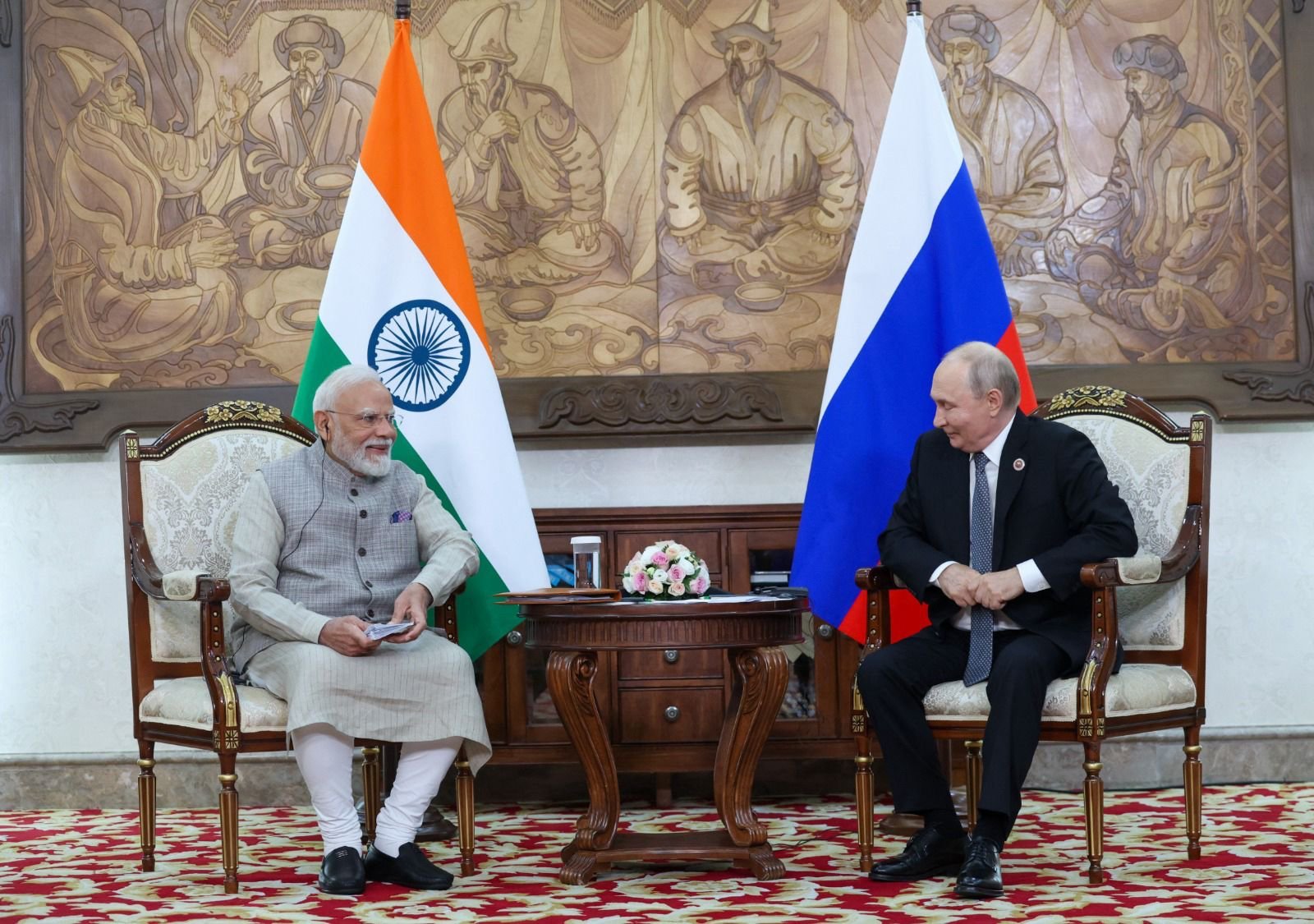
Bishkek, Aug 2026 : Prime Minister Narendra Modi on Monday reiterated India’s strong support for all efforts aimed at achieving peace in Ukraine during a bilateral meeting with Russian President Vladimir Putin on the sidelines of the Shanghai Cooperation Organisation (SCO) Summit in Bishkek, calling for a transition from an “endless war” towards a lasting resolution.
In his opening remarks, Modi said India had consistently advocated dialogue and diplomacy to resolve conflicts and stressed that the continuation of war carries consequences for humanity as a whole. He said India’s approach to the Ukraine conflict remained rooted in the pursuit of peace and the early resolution of outstanding issues.
“As you know, India supports all efforts towards peace and will continue to do so. Every day spent in war pushes humanity backwards, while every step taken towards peace fills humanity with a new hope and enthusiasm. We must move from an endless war towards an end to the war. This is essential for the well-being of humanity,” Modi said.
The Prime Minister described India’s message as a “call of humanity” and invoked the country’s philosophical traditions of non-violence and peaceful coexistence.
“The land of Gandhi and the land of Buddha has one message: to follow the path of peace. I look forward to discussing these matters with you today,” Modi told Putin.
The two leaders have previously discussed the Ukraine conflict, with Modi noting that Putin had briefed him in detail about various aspects of the situation during their earlier interaction. New Delhi has maintained that dialogue and diplomacy remain the only sustainable way to resolve the conflict while continuing its engagement with both Moscow and other international partners.
The Bishkek meeting also provided an opportunity for the two leaders to review the broader India-Russia relationship, which covers energy, trade, defence, fertilizers, nuclear cooperation, technology and other strategic areas.
Modi also highlighted the upcoming BRICS Summit in India and said the Russian President would receive a warm welcome in New Delhi.
“In a few days from now, India will host the BRICS Summit. All Indians are very eager to welcome you and your delegation to India. Your visit will further strengthen our bilateral relations and also enhance dialogue and cooperation within BRICS,” he said.
The meeting came days after External Affairs Minister S. Jaishankar held discussions with Putin in Moscow and conveyed a personal message from Modi. Jaishankar met the Russian President on August 24 during his visit to Russia.
“Pleased to call on President Vladimir Putin of Russia in Moscow today. Handed over a personal message from Prime Minister Narendra Modi,” Jaishankar said in a post on X following the meeting.
He also briefed Putin on discussions held during the 27th session of the India-Russia Inter-Governmental Commission on Trade, Economic, Scientific, Technological and Cultural Cooperation, or IRIGC-TEC. The talks reviewed cooperation across a wide range of sectors and included discussions on regional and global developments.
According to remarks released by the Kremlin, Putin said Jaishankar’s visit reflected the depth of relations that India and Russia had built over several decades. He noted that the two countries continued to cooperate across governmental, parliamentary and economic channels.
Putin also highlighted the growth in bilateral trade and credited Modi’s personal attention to strengthening relations between the two countries.
“We continue to work together in virtually all areas. This includes governmental ties, interparliamentary ties, and economic cooperation,” Putin said.
He added that bilateral trade had increased during the current year after registering a slight decline in the previous year. Putin also conveyed his greetings to Modi and expressed his expectation of meeting him during the SCO engagement.
Earlier, Jaishankar had co-chaired the 27th IRIGC-TEC meeting with Russian First Deputy Prime Minister Denis Manturov. The commission reviewed progress in several key areas of economic and strategic cooperation.
Energy, fertilizers and nuclear cooperation figured prominently in the discussions. Putin said Russia was working to increase fertilizer supplies to India and highlighted cooperation in nuclear energy, high-technology sectors and other areas.
“We are doing everything to address this issue for Indian farmers, for agriculture; we are increasing these supplies and are ready to do so further,” Putin said, referring to fertilizer supplies.
Jaishankar, meanwhile, said he had a positive report to share with Putin regarding economic cooperation, nuclear energy and fertilizers. He described the India-Russia relationship as a “strong, robust bilateral partnership” and said economic cooperation had grown significantly.
The Bishkek engagement underscored the continued importance both countries attach to their longstanding partnership, even as global geopolitical tensions remain high. For India, the meeting also reflected its effort to maintain strategic autonomy by engaging with Russia while consistently advocating peace and diplomacy in international conflicts.
Modi’s message on Ukraine, meanwhile, reaffirmed New Delhi’s position that the international community must move beyond prolonged confrontation and work towards a peaceful settlement that contributes to global stability and the broader well-being of humanity.