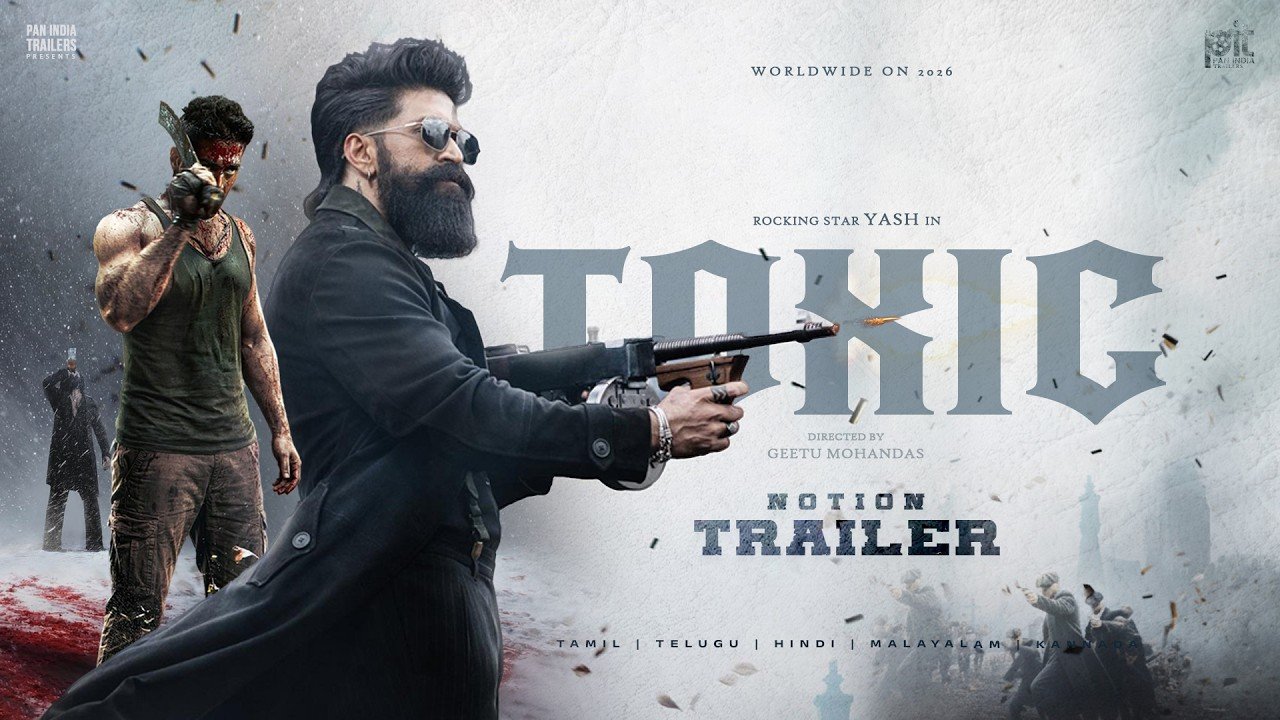
Yash has established himself as one of Indian cinema’s biggest action stars, thanks largely to the massive success of the KGF franchise. Naturally, expectations were sky-high for Toxic: A Fairy Tale for Grown-Ups, a lavish gangster action drama directed by Geetu Mohandas. Featuring Yash in the lead alongside Kiara Advani, Nayanthara, Huma Qureshi, Tara Sutaria and Rukmini Vasanth, the film arrived in theatres worldwide on August 26, 2026, promising a dark, stylish and larger-than-life cinematic experience.
The film certainly looks expensive and ambitious. However, beneath its striking visuals, powerful star cast and violent action sequences lies a screenplay that struggles to maintain clarity, emotional depth and narrative momentum.
The Story
Set against the backdrop of Goa between 1947 and 1967, Toxic takes audiences into a world dominated by organised crime, drugs, rival gangs and power struggles.
Yash plays Raya, a dangerous and ambitious gangster who lives with his elder sister Ganga, played by Nayanthara. The two share a deep bond, largely shaped by painful experiences from their past. Ganga wants her younger brother to rise to the top and establish himself as one of the most powerful figures in Goa's criminal underworld.
Raya is determined to create his own identity. As rival gangs battle for control, he finds himself increasingly drawn into a violent world where loyalty, ambition and survival are closely connected.
Rebecca, played by Tara Sutaria, is the daughter of powerful gang leader Salvador and develops feelings for Raya. However, Raya's life takes an unexpected turn when he meets Nadia, portrayed by Kiara Advani.
Nadia works with the Royal Circus, which travels across different locations for performances. Raya becomes instantly attracted to her and begins spending considerable time with her. Ganga senses the danger and attempts to caution him, but Raya refuses to listen.
Nadia eventually becomes pregnant with Raya's child, creating a major conflict. Rebecca is devastated when she learns about their relationship and reacts angrily. Her father, meanwhile, threatens Nadia and holds Raya responsible for the situation.
As tensions rise, Nadia begins blaming herself for the trouble surrounding Raya. Rebecca reaches a point of emotional desperation, while Ganga becomes increasingly concerned about the threat posed by Salvador.
The situation becomes even more complicated when Elizabeth, played by Huma Qureshi, and her group enter the conflict. Their objective is to weaken Raya and take advantage of the growing divisions around him.
From here, the film moves between gang rivalries, personal relationships, violent confrontations and revelations about Raya and Ganga's past. The central questions revolve around why the siblings chose such a violent life, what shaped Raya's personality and whether he can survive the enemies closing in around him.
What Works
The strongest aspect of Toxic is undoubtedly its scale.
The film attempts to create an expansive period gangster world, and the production design gives the story a distinctive visual identity. Goa is presented not merely as a location but as an important part of the film's atmosphere, with its criminal networks, rival factions and period setting adding texture to the narrative.
Yash also brings the kind of screen presence that his fans have come to expect. Raya is designed as an intense, unpredictable and physically imposing character, and Yash handles the larger-than-life moments with confidence.
The film also does not compromise on action. There are gun battles, knife fights, brutal confrontations and graphic violence throughout. Some action sequences have the visual impact expected from a major theatrical release.
However, the problem is that these strengths are not consistently supported by the screenplay.
Where the Film Falters
The biggest weakness of Toxic is its narrative structure.
The film has several potentially interesting ingredients: a period gangster story, a complicated brother-sister relationship, rival criminal groups, romance, betrayal and a traumatic past. But instead of bringing these elements together into a tightly constructed narrative, the screenplay often jumps between them without providing enough context.
The central power struggle gradually loses its impact. Rival gangs appear, disappear and return without always receiving sufficient development. Their objectives are not consistently clear, making it difficult for the audience to understand who is fighting whom and what exactly each faction hopes to achieve.
At the same time, the romantic and sexual aspects of Raya's life occupy considerable space. This sometimes comes at the cost of the gangster storyline, which should have been the film's strongest foundation.
Raya himself is also an inconsistent character. The film initially attempts to establish him as someone fiercely committed to power, his sister and his position in the criminal world. Yet his decisions in his personal relationships often appear disconnected from that carefully established personality.
The result is a protagonist who can be visually compelling without always being emotionally convincing.
Too Much Violence, Too Little Emotion
There is nothing inherently wrong with an action film being violent. In fact, audiences have embraced highly stylised violence when it is backed by strong characters and meaningful storytelling.
In Toxic, however, violence often feels like a substitute for emotional development.
Guns fire, knives clash and brutal confrontations unfold with considerable frequency. Yet the emotional stakes behind several of these moments are not developed strongly enough.
A powerful action sequence becomes memorable when the audience understands what the characters are fighting for. Here, that connection is often missing.
The film also expects viewers to keep track of several characters and alliances without always providing enough narrative guidance. Consequently, some scenes may leave audiences wondering about the identities, loyalties and motivations of the people involved.
A Complicated Screenplay
A screenplay should provide the connecting thread between individual scenes. Every major development should contribute to the larger narrative.
Unfortunately, Toxic sometimes feels like a collection of striking scenes rather than a seamlessly connected story.
The film introduces several ideas and characters but does not always give them enough room to develop. This affects the emotional impact of the central relationships, particularly the bond between Raya and Ganga.
The film also introduces a major twist as it approaches its climax. While the intention is clearly to surprise the audience and add another layer to Raya's story, the revelation arrives after the narrative has already become difficult to follow.
Instead of providing complete clarity, the twist adds another layer of complexity. By the final act, viewers may find themselves spending more time trying to understand the plot than becoming emotionally invested in it.
Performances
The casting is one of the film's positives.
Yash carries the film on his shoulders and has the charisma required for a larger-than-life gangster character. His body language, intensity and action sequences provide some of the film's most engaging moments.
Nayanthara is convincing as Ganga and brings dignity and emotional weight to her role. The relationship between Ganga and Raya could have been one of the film's strongest emotional elements, although the screenplay does not always explore it deeply enough.
Kiara Advani gets an important role as Nadia and fits comfortably into the film's dramatic world. Tara Sutaria's Rebecca and Huma Qureshi's Elizabeth add further dimensions to the story.
Rukmini Vasanth is also part of the principal cast.
Ultimately, the limitations are more evident in the writing than in the performances. Several characters have interesting premises, but their motivations are not developed sufficiently to create strong emotional arcs.
Technical Aspects
Technically, Toxic is clearly a big-screen production.
Rajeev Ravi's cinematography is among the film's highlights. The period setting, action sequences and darker visual palette are captured with considerable style. The film frequently looks grand and atmospheric.
The production design and overall visual presentation reinforce the sense that the makers have invested heavily in creating a distinctive world.
The background score, however, can be overpowering. Rather than consistently complementing the drama, the music sometimes becomes excessively loud, reducing the impact of quieter emotional moments. Ravi Basrur is among the credited music composers.
Editing is another weak point. The transitions between different storylines and characters are not always smooth, contributing to the feeling that the audience has to assemble parts of the narrative independently.
Final Verdict
Toxic: A Fairy Tale for Grown-Ups is a film that clearly aims high. It has a major star, an impressive supporting cast, lavish production values, stylish cinematography and plenty of action.
But ambition alone is not enough.
The film needed a stronger screenplay to bring its many elements together. The gangster world should have been more clearly established, the characters needed greater emotional depth and the central conflicts required stronger motivations.
Yash remains a compelling screen presence, but even his charisma cannot completely overcome the weaknesses in the writing.
For audiences looking primarily for spectacular visuals, intense action and Yash in a larger-than-life avatar, Toxic may offer moments worth experiencing on the big screen. However, viewers expecting a tightly written gangster drama with powerful emotional storytelling may find the film disappointing.
Ultimately, Toxic looks far more impressive than it feels. Its scale, cast and technical strengths are undeniable, but its confusing narrative, excessive violence and uneven characterisation prevent it from becoming the gripping gangster saga it aspires to be.
Toxic Rating: 2/5
Movie Details
Movie:Toxic: A Fairy Tale for Grown-Ups
Genre: Action / Gangster Drama
Release Date: August 26, 2026
Cast: Yash, Kiara Advani, Nayanthara, Huma Qureshi, Tara Sutaria, Rukmini Vasanth
Director: Geetu Mohandas
Music: Ravi Basrur
Banner: KVN Productions
Review: Peddinti
Rating: ⭐⭐ out of 5
Disclaimer: This review is based on the reviewer’s individual perspective. Audience opinions may vary.