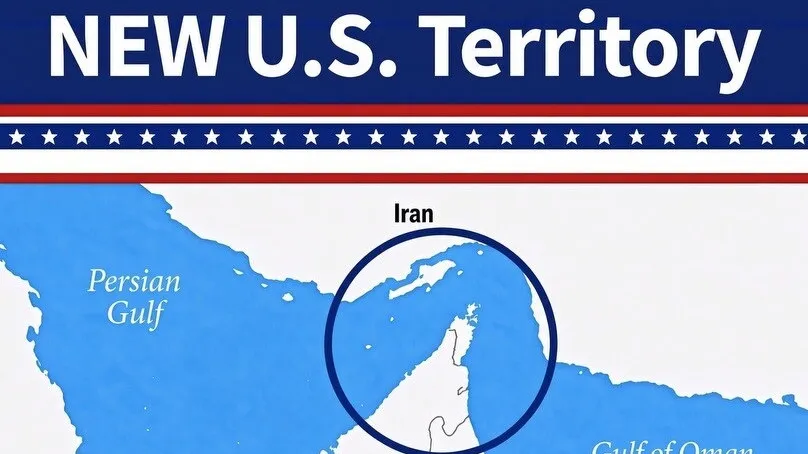
New York, Aug 2026 : US President Donald Trump has doubled down on his controversial plan to take control of the strategically vital Strait of Hormuz, posting a map on Truth Social that depicted the crucial global energy route as “New US Territory” amid escalating tensions with Iran.
Trump shared the map a day after a memorandum of understanding (MoU) between Washington and Tehran collapsed, bringing renewed uncertainty to efforts aimed at easing the crisis surrounding the waterway. He also claimed that the Strait of Hormuz had reopened and was fully operational.
“The Hormuz Strait is open and operating. All water mines have been removed or detonated,” Trump said in his post.
However, international maritime monitoring agencies indicated that shipping activity through the strait remained far below normal levels, contradicting the US President’s assertion that the waterway was operating normally.
Trump, who has faced mounting domestic pressure over rising prices linked to the disruption in the region, also said that the US naval blockade of Iranian ports remained “in full force and effect”. The combination of continued military pressure and disrupted shipping has raised concerns over the impact on global energy markets and international trade.
The security situation remained tense on Tuesday, with reports of another attack on a commercial vessel. The United Kingdom Maritime Trade Operations (UKMTO), which monitors maritime security incidents, said a bulk carrier had been struck by an unidentified projectile while transiting the Strait of Hormuz. The incident resulted in damage to the vessel and casualties among its crew.
UKMTO had reported a similar attack on Monday and advised vessels operating in the area to exercise caution.
Iran has strongly rejected Trump's proposal to take control of the waterway. Iranian Deputy Foreign Minister Kazem Gharibabadi described the US President's plan as a “fanciful delusion”, arguing that control over the strait could not be established simply through statements or social media posts.
Iranian Parliament Speaker Mohammad Baqer Qalibaf also said the Strait of Hormuz would not be reopened until Iran’s conditions were met, according to Tasnim news agency.
The crisis has also strained Washington’s relations with Oman, which has played a role in diplomatic efforts concerning the waterway. Trump on Monday issued a threat against Oman, warning that the United States would attack the country if it attempted to interfere with his plans for the strait.
“If Oman gets in the way, we’ll bomb the s--t out of them,” Trump said in an interview with Fox News.
Iran, meanwhile, has claimed that it was close to reaching an agreement with Oman on reopening the strategic waterway. Under the proposed arrangement, the route for vessels entering the strait would run through the Iranian side, while the exit route would be controlled by Oman on its side.
Such an arrangement would potentially reduce Washington’s influence over the waterway and undermine Trump’s stated ambition of establishing unilateral US control.
The 167-km-long Strait of Hormuz, located between Iran and Oman and adjacent to the United Arab Emirates, is one of the world's most important maritime energy corridors. Any attempt to establish unilateral control over the waterway would face opposition from regional states and raise serious questions under international law.
The United States would also face substantial military and logistical challenges in attempting to maintain continuous unilateral control of such a strategically sensitive waterway.
The latest escalation follows the collapse of the US-Iran MoU, which was signed with considerable political fanfare in June. The agreement had established a 60-day period during which Washington and Tehran were expected to maintain normal shipping conditions and pursue negotiations over Iran’s nuclear programme.
However, the arrangement deteriorated after Iran allegedly attacked two ships last month, prompting the United States to retaliate with strikes against Iran and impose a naval blockade on Iranian ports. Subsequent attacks on shipping and Iranian strikes against targets in the Gulf and elsewhere further intensified the crisis.
The 60-day period also provided a window for Washington and Tehran to negotiate over Iran’s nuclear programme, an issue Trump has repeatedly described as one of his top priorities.
Both sides have now said that no negotiations are taking place.
“There are no talks or conversations going on, or scheduled,” Trump said on Tuesday.
Iran’s Islamic Revolutionary Guard Corps spokesperson, Brigadier General Hossein Mohebbi, also told Tasnim that no negotiations were currently underway, reinforcing the growing uncertainty over the possibility of a diplomatic resolution to the Strait of Hormuz crisis.
(Disclaimer :The content of this article is sourced from a news agency and has not been edited by the Mavericknews30 team.)