Focus on complementing Natural Recovery through Scientifically-guided Interventions and Community Participation
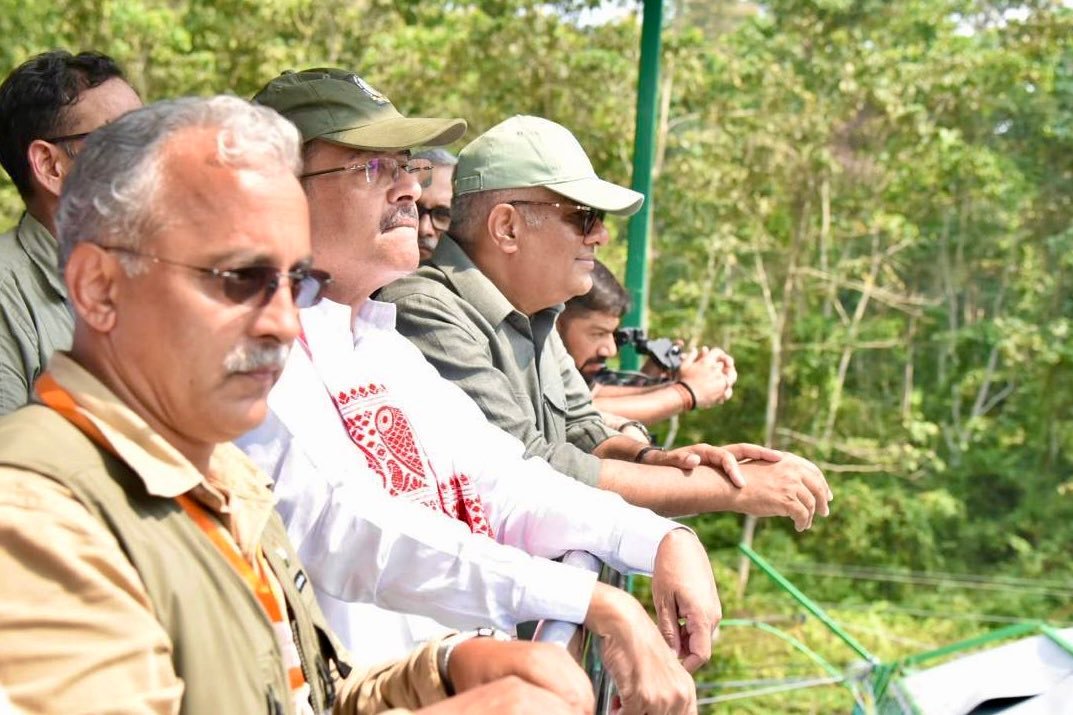
In a significant milestone for tiger conservation in India, a tigress was released in Buxa Tiger Reserve (W. Bengal) today, in the presence of the Union Minister for Environment, Forest and Climate Change, Shri Bhupender Yadav and Chief Minister (W. Bengal), Shri Suvendu Adhikari. It marks a fitting beginning of India's Wildlife Week 2026, with the initiation of a phased Tiger Reintroduction Programme aimed at restoring a viable and self-sustaining tiger population in this historically important tiger landscape.
In a social media post after the release, Shri Bhupender Yadav stated that inspired by Prime Minister Shri Narendra Modi’s push for landscape conservation and species protection, today the significant promise to reintroduce tiger in Buxa has been fulfilled. He thanked Bihar Chief Minister Shri Samrat Choudhary and West Bengal Chief Minister Shri Suvendu Adhikari for their support in this successful reintroduction.
Buxa has historically been an important tiger landscape of North Bengal. Declared a Tiger Reserve in 1983, it forms part of a larger ecological landscape with connectivity to forests and protected areas of Bhutan and Assam. Over the decades, however, habitat degradation and fragmentation, changes in land use and decline in prey availability affected the ecological conditions required to sustain a resident tiger population. The Reserve subsequently witnessed a prolonged absence of a stable resident tiger population.
The recovery of Buxa has been a sustained, science-based effort. The Tiger Augmentation and Recovery Project, initiated by the Government of West Bengal with support from the National Tiger Conservation Authority (NTCA) and Wildlife Institute of India (WII), has since 2018 been implemented collaboratively. The focus has been on rebuilding the ecological foundations necessary for tiger recovery through habitat improvement, prey-base augmentation, strengthening protection and monitoring, scientific assessment and capacity building. More than 800 chital have been released to supplement the prey base, while approximately 380 hectares of grassland have been restored or converted over the past eight years. Scientific monitoring has indicated a positive trend in prey abundance.
Long-term monitoring has also provided encouraging evidence of tiger movement through the landscape. Camera traps recorded tigers in 2021, 2023 and 2026. Notably, an individual photographed in 2023 was matched with a tiger from Manas Tiger Reserve in Assam, providing evidence of natural movement between adjoining tiger landscapes. The present augmentation programme seeks to complement natural recovery through carefully planned and scientifically guided interventions.
Today’s release of the tigress marks the first phase of a planned, phased and adaptive recovery programme. The feline was translocated from Valmiki Tiger Reserve (Bihar), which was undertaken following assessment of relevant ecological, veterinary and management parameters and in accordance with established protocols. The animal will be subject to intensive post-release monitoring using a combination of telemetry, camera trapping and field-based monitoring, enabling assessment of its movement, adaptation, health and behaviour.
The programme is not merely about bringing tigers back to Buxa. Its objective is to create the conditions in which a tiger population can establish, breed and ultimately become viable and self-sustaining. Further augmentation, wherever scientifically justified, will be undertaken in a phased manner based on habitat and prey availability, protection preparedness, population viability, monitoring outcomes and expert advice.
Community participation remains central to this recovery effort. The programme has engaged 64 Eco-Development Committees/Joint Forest Management Committees, with emphasis on community dialogue, livelihood opportunities, human-wildlife conflict mitigation and conservation-linked benefits. As tiger recovery progresses, continued community engagement and effective mechanisms for coexistence will remain an integral part of the programme.
The recovery of tigers in Buxa is also significant at the landscape level. Its ecological linkages with North Bengal, Assam and Bhutan provide opportunities for movement and dispersal of wildlife across a larger connected landscape. Strengthening Buxa therefore has implications not only for tiger conservation but also for the conservation of forests, grasslands, prey species and wider biodiversity.
The release today represents the beginning of a new chapter in Buxa’s conservation journey. The measure of success will not be the number of tigers released, but the establishment, over time, of a healthy, free-ranging and self-sustaining tiger population supported by secure habitat, adequate prey, effective protection, ecological connectivity, scientific monitoring and meaningful participation of local communities.