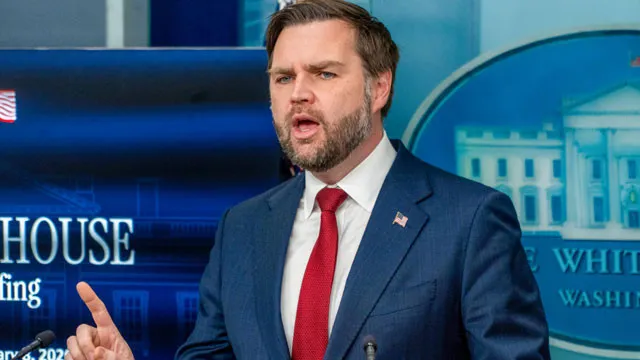
Washington, Sep 2026 : The United States will not resume negotiations with Iran until Tehran stops attacking commercial shipping, US Vice-President JD Vance said, warning that Washington could deploy economic, military, diplomatic and covert measures to protect global energy supplies and prevent Iran from rebuilding its nuclear capabilities.
Speaking at a White House press briefing, Vance said President Donald Trump had made Washington’s position clear and that negotiations with Tehran would remain off the table as long as Iranian forces continued targeting commercial vessels.
“The President's been very clear, we're not talking to them and we're not going to talk to them unless they stop shooting at commercial shipping,” Vance said.
Vance also declined to provide a timeline for the end of US military operations, saying the duration would depend largely on Iran’s actions in and around the Strait of Hormuz. He argued that setting a predetermined deadline would be irresponsible while Iranian forces continued to threaten oil and gas vessels operating through the strategic waterway.
“We're not going to set an artificial timeline,” the Vice-President said.
Vance rejected characterising the situation as an ongoing war, arguing that major combat operations were no longer underway. He said the immediate priority for Washington was ensuring the continued movement of energy supplies through the Strait of Hormuz, one of the world’s most important oil transit routes.
“The Iranians would like zero million barrels to come out of the Strait of Hormuz. Last night, 15 million barrels came out of the Strait of Hormuz,” Vance said, attributing the continued flow to US military efforts.
He argued that the absence of a wider global energy crisis demonstrated the effectiveness of American measures to safeguard commercial shipping. Vance maintained that no other country currently had the capability to perform the same role in protecting maritime energy routes.
The Vice-President declined to comment on whether the Trump administration was considering providing weapons or other assistance to Iranian dissidents. However, he stressed that the President retained a broad range of options for dealing with Tehran.
“Everything that could happen is on the table: Economic pressure, military pressure, diplomatic pressure, covert pressure,” Vance said.
He also indicated that China had responded to some US requests regarding Iran, although he said he did not know whether President Trump had directly spoken with Chinese President Xi Jinping about restricting financial services available to Tehran.
“I think the Chinese, the PRC, being willing to play ball here,” Vance said, while acknowledging that Beijing had not necessarily agreed to everything Washington had requested. He nevertheless described China as being more responsible than Iran in its response to the situation.
Vance said several regional countries were also helping Washington increase pressure on Tehran. He named Turkey, Azerbaijan, the United Arab Emirates, Saudi Arabia and Qatar, while noting that some governments were cooperating privately without publicly acknowledging their involvement.
According to Vance, the US pressure campaign has two principal objectives: protecting commercial shipping through the Strait of Hormuz and preventing Iran from obtaining the resources required to rebuild its nuclear capabilities.
“So far, we haven't seen them try to do so,” Vance said, referring to efforts by Iran to restore its nuclear programme. He added that after the US destroyed Iran’s nuclear enrichment capacity, Washington was seeking to ensure that Tehran could not rebuild it.
The Strait of Hormuz remains central to the confrontation because it connects major oil-producing Gulf states with international markets. A prolonged disruption to shipping through the waterway could increase freight and insurance costs and place upward pressure on global crude prices and broader energy markets.
Vance’s remarks underline Washington’s continued reliance on a combination of military and economic pressure while keeping the door to negotiations with Tehran closed unless Iran halts attacks on commercial shipping.