BJP Begins New Era in Bengal as Suvendu Adhikari Takes Charge as Chief Minister

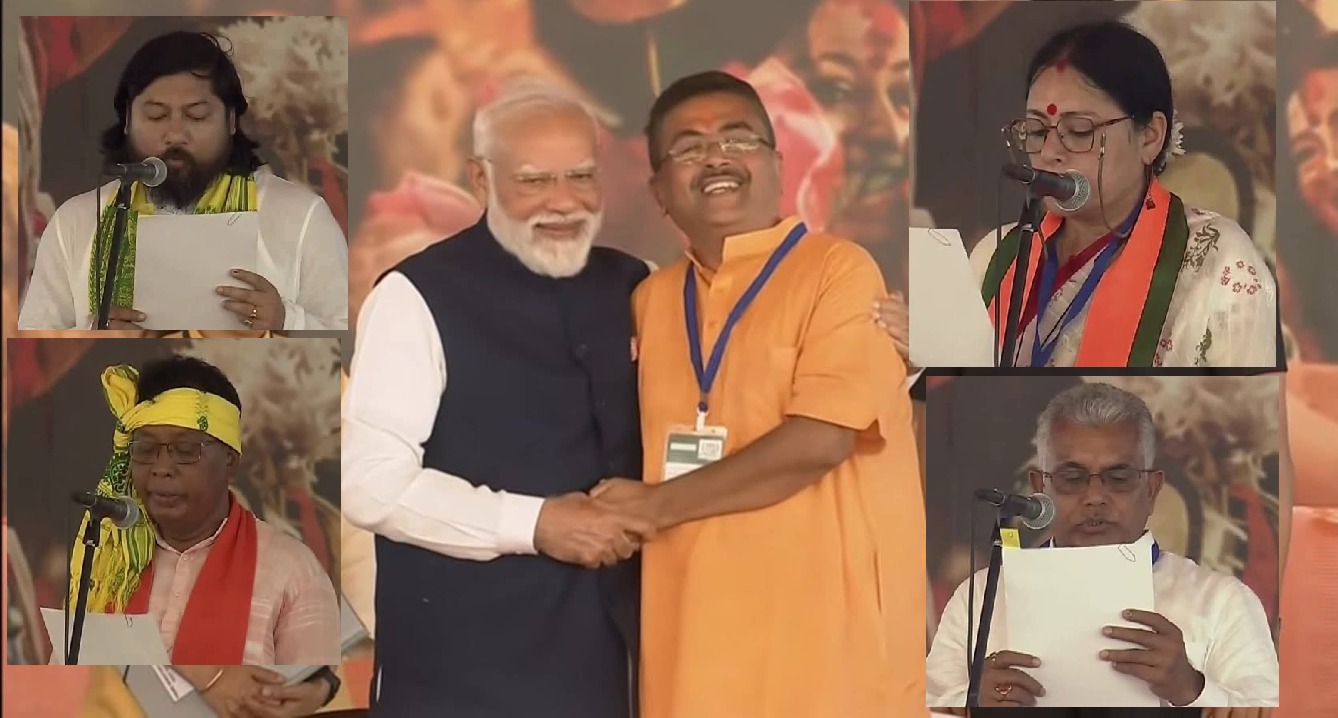
New Delhi, May 2026 : In a historic political transition for West Bengal, Bharatiya Janata Party leader Suvendu Adhikari on Saturday took oath as the state’s ninth Chief Minister at a grand ceremony held at Kolkata’s Brigade Parade Ground, ushering in the first BJP government in the state’s history.
The swearing-in ceremony marked the end of decades of political dominance by the Left Front and the Trinamool Congress, and also carried another historic distinction — it is the first time in 55 years that West Bengal will be headed by a Chief Minister from outside Kolkata.
Suvendu Adhikari, who hails from Purba Medinipur district, has built his political career largely around the coastal belt of the state. His rise to prominence began during the Nandigram movement against land acquisition by the then Left Front government, a protest that eventually became the turning point in West Bengal politics and paved the way for Mamata Banerjee’s rise to power in 2011.
The last Chief Minister from outside Kolkata was Ajoy Kumar Mukherjee, also from Purba Medinipur, whose tenure as head of the United Front government ended in June 1971. Since then, all Chief Ministers — Jyoti Basu, Buddhadeb Bhattacharjee and Mamata Banerjee — have hailed from Kolkata.
The oath-taking ceremony was attended by Prime Minister Narendra Modi, Union Home Minister Amit Shah, Defence Minister Rajnath Singh, BJP national president Nitin Nabin, several Union Ministers, and Chief Ministers from BJP-ruled states, besides senior party leaders and dignitaries.
Adhikari heads a compact but politically significant cabinet that reflects a careful balance of regional representation, caste equations, gender inclusion and organisational experience.
Among the prominent inductees was senior BJP leader Dilip Ghosh, whose inclusion is being seen as recognition of his long organisational work in West Bengal under difficult political circumstances. A former Rashtriya Swayamsevak Sangh organiser, Ghosh played a key role in expanding the BJP’s grassroots network in the state and transforming the party into a formidable political force.
Under his leadership, the BJP registered unprecedented gains in West Bengal, including winning 18 Lok Sabha seats in the 2019 Parliamentary elections. Ghosh later went on to secure electoral victories himself and emerged as one of the party’s strongest faces in the state.
Known for his daily morning walks and direct interactions with the public, Ghosh had launched the “Chai Pe Charcha” outreach campaign, where he interacted with ordinary citizens over tea. Though political observers had sensed some distance between him and sections of the current state leadership, BJP state president Samik Bhattacharya is believed to have played a role in bringing various factions together ahead of government formation.
Another notable inclusion in the cabinet was Agnimitra Paul, whose induction is being viewed as a recognition of the role women voters and women leaders played in the BJP’s electoral success. The 51-year-old fashion designer-turned-politician retained the Asansol Dakshin Assembly constituency with an increased margin.
Paul has earlier served as president of the BJP Mahila Morcha in West Bengal and also held the post of state general secretary. Her rise within the party reflects the BJP’s growing emphasis on women leadership in Bengal politics.
The BJP also attempted to consolidate support among Scheduled Caste communities through the induction of Nisith Pramanik and Ashok Kirtania. The two leaders represent influential social groups that have become electorally decisive in several districts of the state.
Pramanik belongs to the Rajbanshi community, one of West Bengal’s largest Scheduled Caste groups with a population spread across districts such as Cooch Behar, Jalpaiguri, Darjeeling, Malda and Murshidabad. The community has emerged as a key electoral bloc in North Bengal politics.
The 40-year-old Pramanik had earlier served as Union Minister of State for Home Affairs and Youth Affairs between 2021 and 2024. Although he lost the subsequent Lok Sabha election, he returned strongly in the Assembly polls by winning from the Mathabhanga constituency in Cooch Behar district.
Ashok Kirtania, meanwhile, represents the influential Matua community, whose socio-religious movement traces its roots to the Namasudra reform movement led by Harichand Thakur in the 19th century. The Matuas, many of whom migrated from East Pakistan and later Bangladesh during Partition, remain politically influential in districts such as North 24 Parganas and Nadia.
Kirtania retained the Bangaon Uttar Assembly seat located in the politically sensitive Matua belt near the Bangladesh border, reinforcing the BJP’s hold over the community.
The saffron party also performed strongly in the tribal-dominated western belt of West Bengal, stretching across forested regions bordering Jharkhand, Bihar and Odisha. Representing this region in the cabinet is Kshudiram Tudu, a leader from the Santhal tribal community who defeated the sitting Trinamool Congress candidate in the Ranibandh Assembly constituency of Bankura district.
In a symbolic gesture highlighting tribal identity and inclusion, Tudu took oath in his native language.
Despite the current ministry being relatively small, constitutional provisions allow Chief Minister Suvendu Adhikari to induct up to 39 more ministers in the future, leaving room for further expansion and political accommodation as the new BJP government settles into office in West Bengal.


Wimbledon 2026: Linda Noskova Overcomes Heartbreak to Defeat Karolina Muchova, Wins Maiden Grand Slam Title
Score: Linda Noskova beat Karolina Muchova 6-2, 5-7, 6-3 London, July 2026 : Czech star Li…

Wimbledon 2026: Linda Noskova Overcomes Heartbreak to Defeat Karolina Muchova, Wins Maiden Grand Slam Title
Score: Linda Noskova beat Karolina Muchova 6-2, 5-7, 6-3 London, July 2026 : Czech …