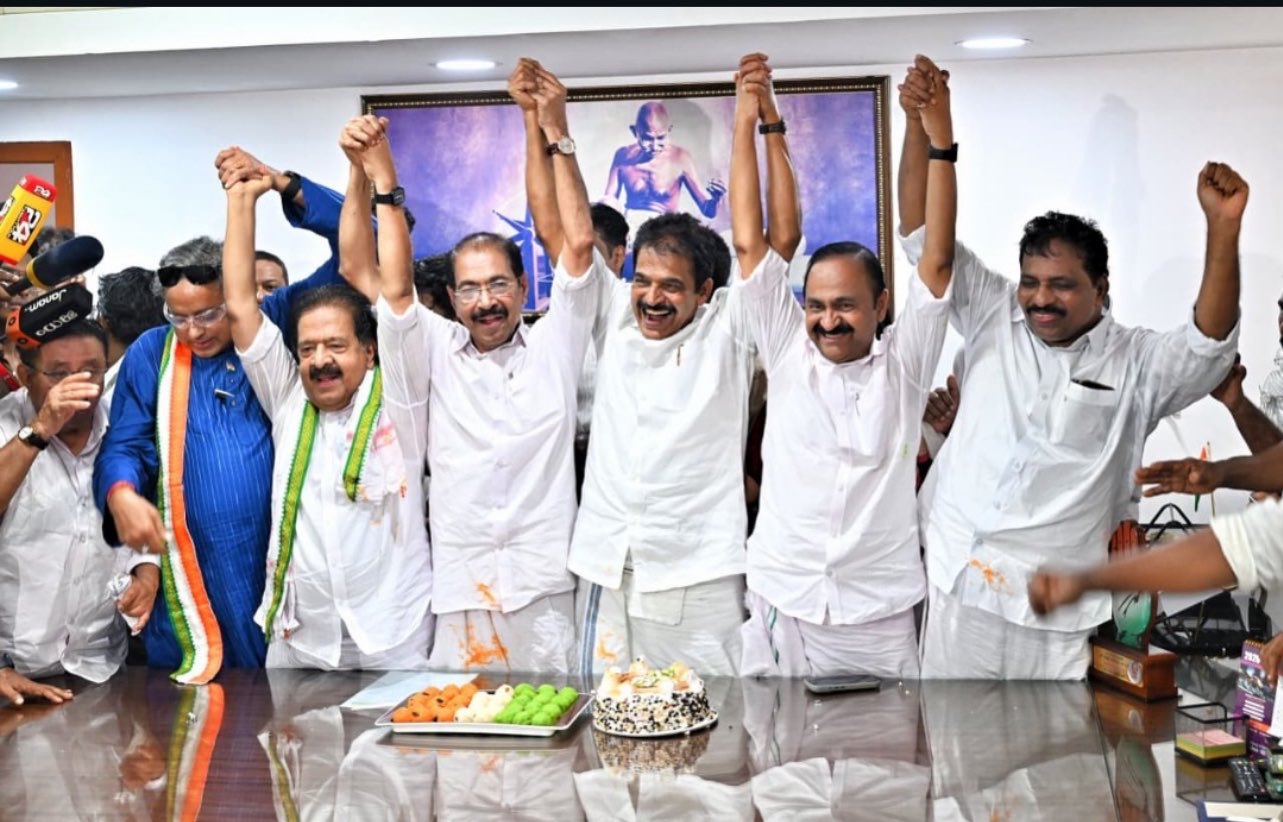
Congress Faces Tough Leadership Choice in Kerala as CM Race Intensifies Between Venugopal, Satheesan and Chennithala

New Delhi, May 2026 : The Congress high command is currently engaged in one of its most sensitive and politically complex leadership negotiations in recent years as it struggles to decide who will lead the newly elected United Democratic Front (UDF) government in Kerala.
What initially appeared to be a routine post-election exercise after the UDF’s emphatic return to power has evolved into a delicate balancing act involving legislative strength, public sentiment, organisational control, factional equations, coalition management and the authority of the Congress central leadership itself.
At the centre of the high-stakes contest are three senior Congress leaders — K. C. Venugopal, V. D. Satheesan and Ramesh Chennithala — each representing a different power centre within the party.
While Venugopal currently appears to enjoy the strongest support among newly elected Congress MLAs, Satheesan has emerged as the face of the UDF’s electoral resurgence and commands considerable public goodwill. Chennithala, meanwhile, continues to remain relevant because of his seniority, administrative experience and acceptability across factions.
Senior Congress leader P. J. Kurien has confirmed that there is no fourth contender in the race and that one among the three leaders will head the state government for the next five years.
The Congress observers appointed by the All India Congress Committee (AICC) have already completed consultations with newly elected MLAs in Kerala and submitted their report to Congress president Mallikarjun Kharge.
However, sources indicated that along with the formal report, the observers also conveyed verbally that Kerala’s political situation could not be addressed through the conventional formula often adopted in other states, where the preference of the majority of MLAs alone determines the leadership issue.
That observation has become the central point of discussion in Delhi.
KC Venugopal’s Legislative Edge
According to party sources, K.C. Venugopal enjoys overwhelming support within the Congress Legislature Party. More than 40 MLAs are believed to have openly backed his candidature during consultations with the observers.
Several other MLAs reportedly told the observers that they would abide by whatever decision the high command takes, though some among them are privately said to favour Satheesan or Chennithala.
The Venugopal camp has projected this legislative support aggressively in Delhi. Leaders close to him claim he now has a “99 per cent chance” of becoming Chief Minister and insist that he has no intention of withdrawing from the contest.
Supporters of Venugopal argue that his claim goes far beyond numbers. As one of the Congress party’s most influential national organisers, they say he played a key behind-the-scenes role in stabilising the Kerala Congress unit, managing internal factional tensions, ensuring discipline during candidate selection and coordinating election strategy.
According to them, the MLA support reflects years of organisational work rather than temporary political excitement.
Yet this is also where the Congress high command’s dilemma begins.
Venugopal is not merely a Kerala politician but a key member of the national leadership structure. Elevating him as Chief Minister could trigger criticism that the high command imposed its preferred candidate despite visible public support for another leader.
This concern has reportedly gained prominence within Congress circles over the last two days.
Satheesan Emerges as Public Favourite
If Venugopal dominates the legislative arithmetic, political momentum outside the Assembly appears to strongly favour V.D. Satheesan.
Within the Congress, there is broad acknowledgement that the UDF’s massive comeback after ten years in opposition owes significantly to Satheesan’s role as Leader of the Opposition.
His aggressive campaigns against the Left Democratic Front government, strong interventions on public issues and ability to energise demoralised Congress workers are widely viewed as crucial factors behind the alliance’s victory.
The observers’ report is also believed to have acknowledged that public sentiment appears to lean heavily in Satheesan’s favour.
That support became dramatically visible late Friday night in Delhi.
When Satheesan arrived at Kerala House shortly after midnight, he was greeted by enthusiastic crowds of youth and student activists, including supporters associated with the National Students’ Union of India and the Muslim Students Federation.
Supporters raised slogans declaring that “the one who led the battle should lead the government,” creating a charged political atmosphere that immediately drew attention within Congress circles.
What particularly stood out was that the mobilisation extended beyond Kerala-based networks. Student activists from institutions such as Jawaharlal Nehru University, Jamia Millia Islamia and the University of Delhi were also reportedly present.
At the same time, demonstrations in favour of Satheesan have spread across Kerala. Torchlight marches, flex-board campaigns and public gatherings have emerged in several districts, with party workers openly arguing that the leader who revived the Congress organisation and led the UDF to victory should now head the government.
This growing public mobilisation has significantly complicated the calculations of the Congress leadership.
Senior leaders privately admit that ignoring visible public sentiment immediately after such a major electoral victory could create avoidable resentment within the party rank and file.
Some leaders are even drawing parallels with the CPI(M)’s handling of veteran leader V. S. Achuthanandan, where public sympathy eventually became politically significant.
Chennithala Remains in the Race
Amid the sharp contest between Venugopal and Satheesan, Ramesh Chennithala continues to quietly position himself as a consensus candidate.
His supporters argue that Kerala is currently facing serious financial and administrative challenges, and therefore experience should not be overlooked.
Chennithala’s long political career — spanning organisational leadership, ministerial roles and opposition politics — is being projected as an advantage in a politically sensitive environment.
There is also another strategic calculation working in his favour.
If the Venugopal and Satheesan camps continue to harden their positions, the high command may eventually look for a compromise candidate capable of minimising factional damage. Leaders close to Chennithala believe such a possibility still remains open.
Interestingly, the district of Alappuzha has emerged as an emotional centre of the leadership battle because both Venugopal and Chennithala have strong political roots there.
Venugopal currently represents Alappuzha in the Lok Sabha, while Chennithala is MLA-elect from Harippad. The district has witnessed intense social media mobilisation and public demonstrations by supporters of both leaders.
Yet even in Alappuzha, some of the earliest public demonstrations after the election results emerged in support of Satheesan, especially in places like Kayamkulam.
By-Election Concerns Add Pressure
One practical issue now troubling the Congress leadership is the possibility of multiple by-elections if Venugopal becomes Chief Minister.
Since he is currently a Lok Sabha MP from Alappuzha and not a member of the Kerala Assembly, he would have to resign from Parliament and enter the Assembly within six months. That would also require an existing MLA to vacate a seat for him.
Several MLAs and even coalition partners are reportedly uncomfortable with the prospect of forcing newly elected legislators to resign immediately after the UDF’s massive victory.
Attention has especially focused on first-time MLA A.D. Thomas, who secured a strong victory in Alappuzha. Some leaders fear that the social and coastal support base that helped him win may not automatically transfer during a by-election.
The Venugopal camp, however, has dismissed such concerns, insisting that the popularity of the new government would ensure victory in any by-election.
Factional Tensions Resurface
What has particularly alarmed the Congress leadership is the speed with which old factional rivalries have resurfaced.
The Venugopal camp has accused Satheesan supporters of attempting to pressure the high command through orchestrated public campaigns. Complaints regarding the tearing down of flex boards carrying Venugopal’s photographs in Thiruvananthapuram have reportedly reached Delhi.
Some leaders have also alleged that images of former Chief Minister Oommen Chandy were damaged during protests.
Satheesan supporters, however, insist that their mobilisation reflects genuine grassroots sentiment rather than factional theatre.
Meanwhile, another leadership issue is also quietly taking shape — the race for the next Kerala Pradesh Congress Committee (KPCC) president.
With current KPCC chief Sunny Joseph likely to join the ministry, the party will require a new organisational head. Leaders such as Benny Behanan, Kodikunnil Suresh, Shafi Parambil and Anto Antony are already being discussed for the post.
That decision too is expected to depend heavily on who eventually becomes Chief Minister.
The Congress high command is expected to hold another crucial round of discussions at Kharge’s residence in Delhi later on Saturday, where all three contenders may be consulted again.
For now, the observers’ report appears to deliberately avoid recommending any single name. Instead, it underlines the complexity of Kerala’s political landscape: MLAs strongly favour Venugopal, public sentiment leans toward Satheesan, while coalition partners appear more comfortable with continuity under the Opposition leader.
The final decision now rests entirely with the Congress high command.
With the UDF securing a commanding mandate of 102 seats in the Kerala Assembly, Congress leaders know that the first major decision after returning to power could shape not only the government’s stability but also the party’s credibility in one of India’s most politically aware states.


South Africa Midfielder Jayden Adams Dies at 25, Nation Mourns Rising Football Star
Johannesburg, July 2026 : South African football has been plunged into mourning following …

South Africa Midfielder Jayden Adams Dies at 25, Nation Mourns Rising Football Star
Johannesburg, July 2026 : South African football has been plunged into mourning following the …