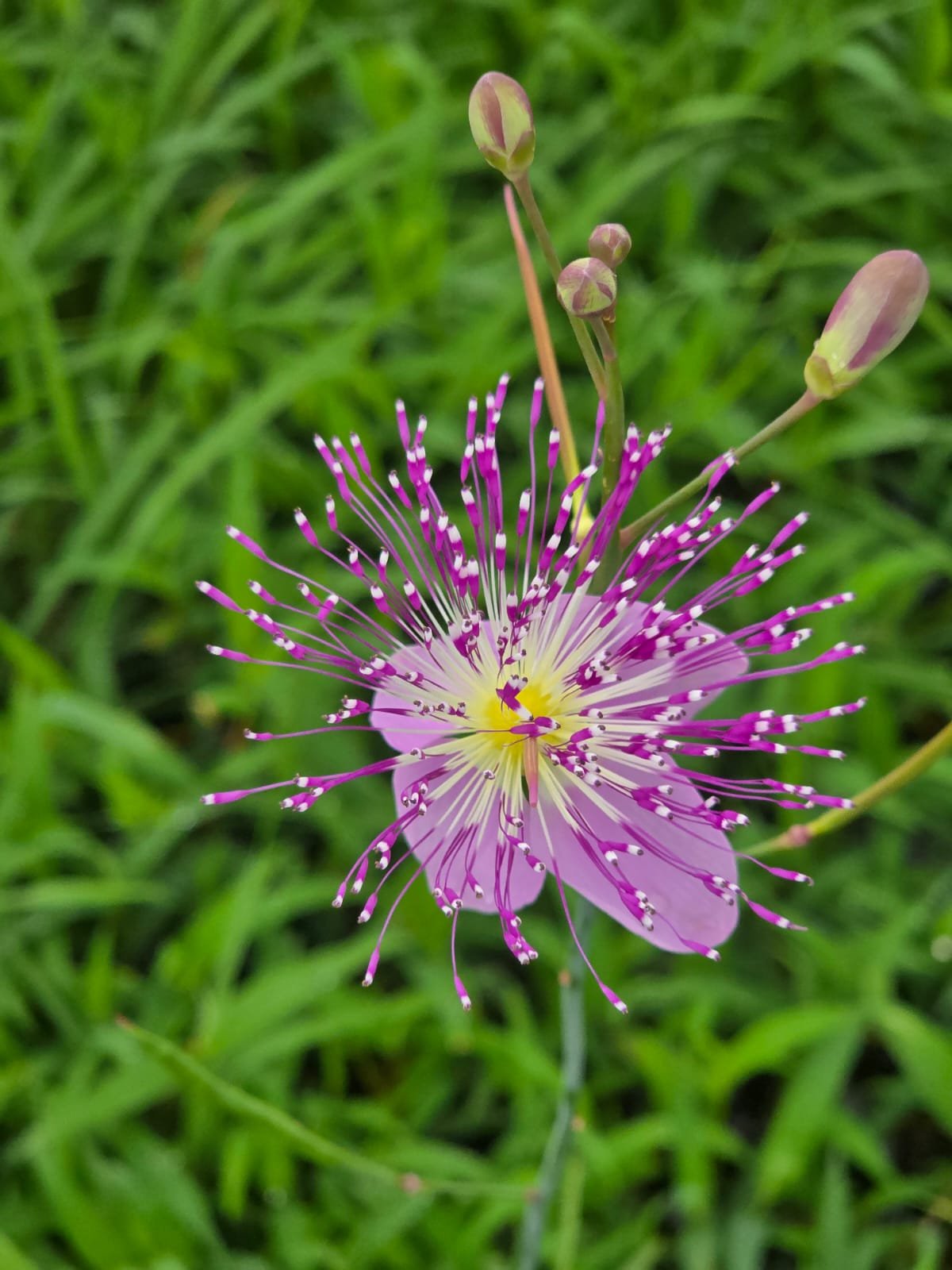
“Colourful, delicate little wildflower,
O little grass flower...!”
The vivid natural landscape evoked by these lines from poet Indira Sant’s poetry has now come alive across the laterite plateaus, locally known as sadas, in several villages of Ratnagiri district. As intermittent monsoon showers recede, the red laterite plateaus appear to have draped themselves in a green shawl, beautifully decorated with a colourful embroidery of wildflowers.
Satara’s Kaas Plateau and Kolhapur’s Masai Plateau have long attracted tourists with their spectacular seasonal blooms. Now, the plateaus around Ratnagiri are also inviting nature lovers to discover their unique beauty. More than 20 to 22 laterite plateaus, including those at Sadavli, Jaitapur, Deogad? Wait — Devache Gotane and Nate, are currently witnessing a remarkable burst of wildflowers in a variety of colours.
These plateaus are presently covered with numerous species, including Dipcadi, lantern flowers, lilies, wild turmeric, different varieties of orchids, Chohala, attractive parasitic flower spikes and Kena, among several other seasonal wildflowers.
Pratik More, Executive Director of Sahyadri Sankalp Society, explains the floral diversity found at Sadavli.
“At the Sadavli plateau, Dipcadi concanense, a bulbous plant, is currently in bloom. A new variety of the species, known as devrukhensis, has also emerged. These plants display their enchanting beauty for one or two months during the monsoon before becoming dormant underground once the flowering season ends,” he said.
Chohala: A Rare Wildflower
Chohala (Curcuma scaposa), a member of the ginger family, is currently blooming along the edges of streams and water channels. The plant is known for its medicinal properties and is now considered a rare and threatened species.
Pink Kapri Lotus
The Pink Kapri Lotus (Cleome angulata) can be seen across the plateaus surrounding Jaitapur, Nate, Dhaoulvalli and around 10 to 12 other villages.
The beautiful plant was identified by Dr Arun Chandore and Dr Shrirang Yadav. Also known as Pani Tilvan, it produces delicate pink flowers that sway gently in the breeze. The flowers appear to tremble as they move, creating an enchanting spectacle.
As the flowers bloom together in large clusters, entire stretches of the laterite plateaus appear to be covered in a pink carpet.
Pink Bhui Chakra
Dr Pratap Naikwade, head of the Department of Botany, says that Pink Bhui Chakra (Iphigenia devrukhensis) can be found on the plateaus of Sadavli and Amboli.
These striking flowers bloom before the Dipcadi and spread across the laterite landscape like a pink blanket. The plant has now gained a distinct identity of its own among the region’s seasonal flora.
However, this natural spectacle is not merely something to admire; it is also something that needs to be protected.
With this objective, Sahyadri Sankalp Society has been organising a Phulotsav, or flower festival, for several years. The initiative aims to educate students about the scientific characteristics of the flowers and the importance of conserving their natural habitats.
The laterite plateaus of Ratnagiri represent a fragile ecosystem that supports a remarkable diversity of seasonal plant life. The rare wildflowers that emerge during the monsoon survive for only a brief period each year, making their conservation especially important.
As visitors pause to admire this extraordinary beauty, the noise and stress of everyday life seem to fade away. The sight of colourful flowers swaying in the monsoon breeze naturally brings to mind another sentiment from Indira Sant’s poetry — the desire to become smaller than even these delicate flowers and remain with them on the plateau, forgetting the worries of school, home and the world beyond.
The wildflower season in Ratnagiri is therefore not merely a visual celebration of nature. It is a reminder of the region’s rich ecological heritage and of our collective responsibility to preserve these fragile landscapes for future generations.