Washington, Aug 2026 : US President Donald Trump has signed two executive orders aimed at restricting the scope of birthright citizenship in the United States, reviving one of the administration’s key immigration policies after the Supreme Court blocked his earlier attempt to end automatic citizenship for certain children born on American soil.
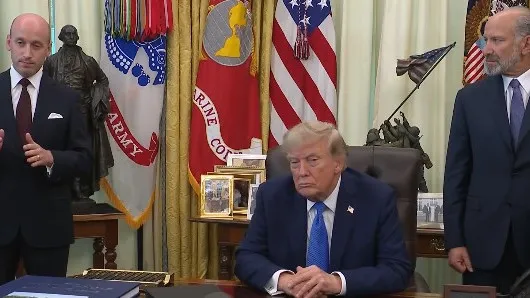
Trump signed the orders in the Oval Office, saying his administration was making adjustments following what he described as a close Supreme Court decision on the issue. The new measures seek to address what the administration considers loopholes surrounding birthright citizenship while targeting practices such as “birth tourism.”
According to the White House, one of the executive orders specifically targets birth tourism, referring to situations in which foreign nationals enter the United States on nonimmigrant visas with the intention of giving birth in the country so that their children can potentially obtain US citizenship.
The administration has also sought to broaden the categories of children it considers ineligible for birthright citizenship. The new order reportedly includes children of foreign government employees, children of members of organisations designated by the US government as Foreign Terrorist Organizations, and children of individuals accused of using fraudulent means to obtain citizenship.
The move comes against the backdrop of a long-running constitutional and legal debate over birthright citizenship. The 14th Amendment to the US Constitution, ratified in 1868, provides that all persons born or naturalised in the United States and subject to its jurisdiction are citizens of the country and the state in which they reside.
Trump first attempted to change the interpretation of the constitutional provision on January 20, 2025, the day he began his second presidential term. His executive order sought to deny US citizenship to children born to individuals who were either unlawfully present or temporarily present in the country.
The order argued that such children were not sufficiently “subject to the jurisdiction” of the United States to qualify for citizenship under the 14th Amendment and relevant immigration law.
The policy immediately faced legal challenges. Several parents and advocacy groups filed lawsuits, including cases brought on behalf of children who could have been affected by the order. Federal courts subsequently blocked its implementation, preventing the policy from taking effect.
The issue eventually reached the US Supreme Court. On June 30, the court ruled 6-3 against Trump's executive order seeking to deny birthright citizenship to children of undocumented immigrants and temporary residents. The ruling preserved the existing interpretation of birthright citizenship, although the court's decision also focused on the scope of nationwide injunctions issued by lower courts.
Trump's latest executive orders represent a renewed effort to restrict birthright citizenship within the limits of the administration's interpretation of existing law. The measures are expected to face fresh legal challenges, potentially setting the stage for another major constitutional battle over immigration and citizenship rights in the United States.
The administration has maintained that stricter immigration controls are necessary to protect the integrity of the US immigration system. Critics, however, argue that attempts to limit birthright citizenship could conflict with the constitutional guarantee established under the 14th Amendment.
The latest developments are therefore likely to keep birthright citizenship at the centre of America's broader immigration debate, with the courts once again expected to determine how far the executive branch can go in changing the rules governing citizenship for children born in the United States.
(The content of this article is sourced from a news agency and has not been edited by the Mavericknews30 team.)