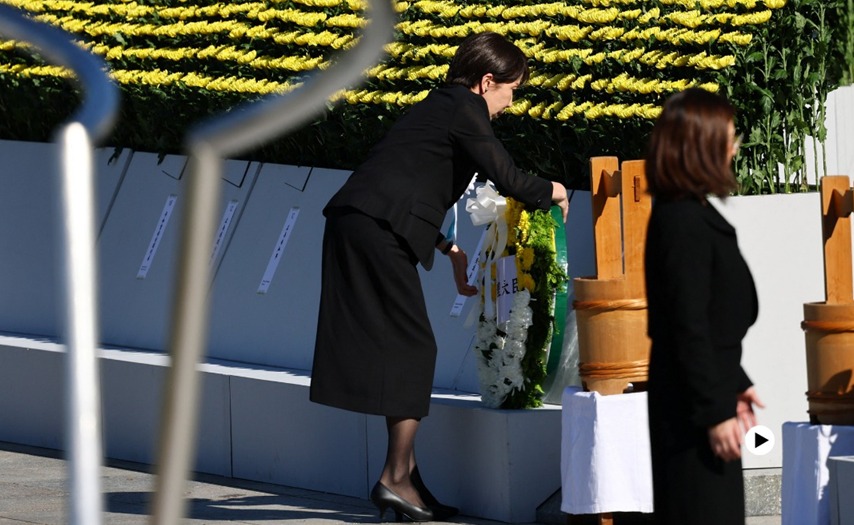
Tokyo, Aug 2026 : Hiroshima on Thursday marked the 81st anniversary of the United States atomic bombing of the Japanese city, with prayers for the victims accompanied by growing concerns over rising global tensions, nuclear threats and renewed debate in Japan over its long-standing non-nuclear policy.
From before dawn, mourners gathered at the Hiroshima Peace Memorial Park to remember those who died in the world's first wartime use of an atomic bomb. As the anniversary unfolded, many visitors expressed a common hope that future generations would never experience the devastation caused by nuclear weapons.
At precisely 8:15 a.m., the time the atomic bomb detonated over Hiroshima on August 6, 1945, participants observed a minute of silence in memory of the victims. The bombing killed an estimated 140,000 people by the end of that year, while countless others suffered injuries and the long-term effects of radiation.
Among those visiting the memorial park was 64-year-old Hitomi Takeuchi, whose grandparents and mother, who was 18 when the bombing occurred, survived the attack. Takeuchi recalled that her late mother would become emotional every August 6 while watching the annual memorial ceremony on television.
“The world today is unstable, with fears of nuclear war,” Takeuchi said, adding that she had come to pray for her mother and all those who lost their lives.
For 41-year-old office worker Sachiko Umehara, the anniversary carried a particular urgency this year. She took a day off work for the first time in three years to visit the Atomic Bomb Memorial Mound.
Umehara said she was increasingly concerned about discussions surrounding a possible review of Japan's Three Non-Nuclear Principles, which prohibit the country from possessing, producing or permitting the introduction of nuclear weapons into its territory.
Global Nuclear Concerns Dominate Ceremony
The annual Peace Memorial Ceremony attracted representatives from a record 121 countries and regions, underlining the international significance of Hiroshima's message of peace and nuclear disarmament.
The presence of relatives of a child killed in a recent conflict provided another stark reminder that civilian suffering from war remains a contemporary reality. Among the attendees were the parents of a seven-year-old boy reportedly killed in a US missile strike on an elementary school in Minab, southern Iran, earlier this year.
In his Peace Declaration, Hiroshima Mayor Kazumi Matsui warned that the international community was facing a dangerous environment in which military force and nuclear weapons continued to influence global security calculations.
Matsui criticised military invasions, the use of nuclear weapons as instruments of intimidation and what he described as the disregard of international law by major powers. Referring to the failure of the recent Nuclear Non-Proliferation Treaty review conference, he warned that the current trajectory could ultimately result in another Hiroshima or Nagasaki.
The mayor urged world leaders to visit Hiroshima, witness the consequences of nuclear warfare and strengthen international efforts towards nuclear abolition.
He also called on younger generations to assume a greater role in building global support for nuclear disarmament, particularly as the number of atomic bomb survivors continues to decline.
Hiroshima Governor Mika Yokota separately criticised the concept of nuclear deterrence, arguing that reliance on nuclear weapons can fuel mistrust, arms races and instability among nations.
Japan's Non-Nuclear Policy Under Scrutiny
Prime Minister Sanae Takaichi also attended the ceremony and paid tribute to the victims and survivors of the atomic bombing. She said Hiroshima's recovery from destruction continued to remind the world of the vulnerability of human life and dignity and the importance of peace.
“The catastrophe brought by the atomic bombs to Hiroshima and Nagasaki, and the indescribable suffering of so many people, must never be repeated,” Takaichi said.
She reaffirmed Japan's commitment to the Three Non-Nuclear Principles and stressed the country's unique responsibility as the only nation to have suffered atomic bombings during wartime.
“Our country firmly upholds the Three Non-Nuclear Principles,” she said, reiterating Japan's stated commitment to working towards a world without nuclear weapons.
However, the principles have come under increasing political scrutiny amid changing security conditions in East Asia and growing calls within sections of Japan's ruling bloc for a reassessment of the country's defence posture.
Reports have suggested that the government could reconsider the principle barring the introduction of nuclear weapons into Japanese territory. The issue has generated concern among peace groups, survivors and sections of Japanese society.
According to a report by The Tokyo Shimbun, at least 128 local assemblies across 36 prefectures had submitted written opinions to the Diet urging the government to retain the Three Non-Nuclear Principles. The figure was described as a record high.
Asked after the ceremony whether the principles could be revised during an upcoming security policy review, Takaichi declined to speculate on the wording of any future policy. However, she stressed that the government's position of firmly upholding the principles remained unchanged.
Following the ceremony, the Prime Minister visited the Hiroshima Peace Memorial Museum and a nursing home for atomic bomb survivors, where she presented residents with flowers and a condolence gift. She also met representatives of seven survivor organisations and praised their efforts to rebuild their lives after the devastation of 1945.
A Warning for Future Generations
The Hiroshima anniversary comes at a time when fears over nuclear escalation have returned to the centre of global security debates. The city's annual ceremony therefore served not only as a remembrance of the dead but also as a warning about the consequences of allowing nuclear weapons and military confrontation to become normalised.
As the generation that directly experienced the bombing grows smaller, Hiroshima's leaders and survivors are increasingly urging younger people to preserve the memories of August 6, 1945.
The message from the city remains consistent: the destruction witnessed in Hiroshima and Nagasaki must not be repeated. Yet amid renewed geopolitical tensions and debate over nuclear deterrence, the challenge of translating that message into concrete global disarmament efforts remains as urgent as ever.
(The content of this article is sourced from a news agency and has not been edited by the Mavericknews30 team.)