Mumbai, Nov 2026 : November 15 is being celebrated as ‘Janjatiya Gaurav Diwas’ (Tribal Pride Day) to mark the 151st birth anniversary of Bhagwan Birsa Munda. In addition, several public welfare initiatives are being organised across Maharashtra from November 11 to 18, 2026, as part of the Bhagwan Birsa Munda Gaurav Diwas Seva Saptah. Against this backdrop, this article highlights the life, struggle and historic contributions of the revolutionary tribal leader Bhagwan Birsa Munda.
Bhagwan Birsa Munda is revered as a deity by people across the country, particularly among tribal communities. He is widely remembered as a courageous leader who fought for tribal development and the rights of indigenous people. His service to the nation and remarkable contribution, despite his short life, have ensured that he remains etched in the country's collective memory.
Birsa Munda was born on November 15, 1875, into a tribal family in Ulihatu village, in the then Ranchi district and present-day Khunti district of Jharkhand. His father was Sugana Munda and his mother was Karmi Munda. Birsa received his primary education at a missionary school. During that period, Indians were subjected to oppression under British rule. Witnessing these injustices, he resolved from his school days to fight against the British government.
A Revolutionary Struggle for Rights
At just 25, Birsa Munda, a young man from Ulihatu village in present-day Jharkhand, emerged as a powerful symbol of resistance against colonial exploitation. British officials and local landlords were exploiting tribal communities, forcibly taking over their lands and subjecting them to oppression. Birsa raised his voice against these social and economic injustices and inspired people to fight for their rights.
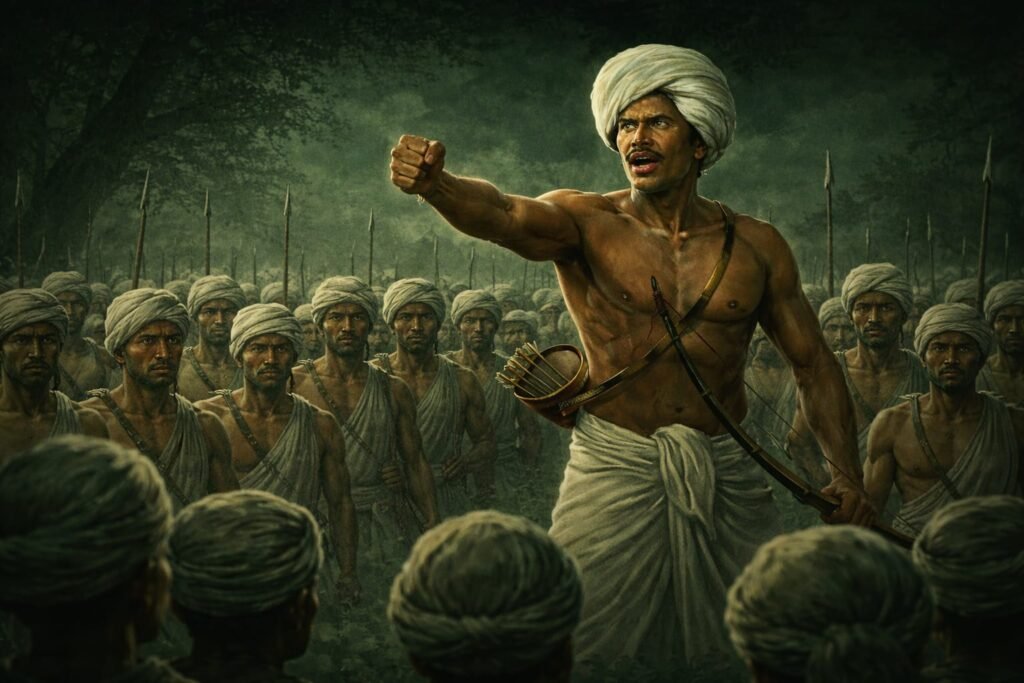
Revered as ‘Dharti Aaba’ (Father of the Earth), Birsa Munda led the ‘Ulgulan’, or Munda Rebellion, against British oppression in the late 1890s. Unable to tolerate the injustice inflicted on people by the British, he devoted his life to resisting colonial rule.
Ulgulan was much more than an uprising. It was a struggle for justice as well as cultural identity. Through Birsa Munda's leadership, tribal communities asserted their right to own and cultivate their ancestral lands without interference. At the same time, the movement reinforced the importance of tribal customs and social values. Like Mahatma Gandhi, Birsa's struggle was inspired by the pursuit of justice and truth.
Serving sick people was another important mission in Birsa's life. He had received training in administering medical treatment, and several successful cases helped him earn the trust of local communities. He urged people to bring sick persons to him for treatment, assuring them that he would personally visit those who could not be brought to him.
He travelled from village to village, meeting patients and treating many of them through his knowledge and skills. During periods of drought and epidemics, when people faced severe hardships, Birsa Munda rendered extensive service to the affected communities.
Two Years in Prison
As people continued to suffer from hardship and British oppression, Birsa launched a direct movement against the colonial administration, demanding the waiver of taxes imposed on the people. His growing popularity became a concern for the British authorities. In 1895, they arrested him and sent him to Hazaribagh jail, where he remained imprisoned for nearly two years.
Between 1897 and 1900, several clashes took place between the British forces and the Munda community.
In August 1897, a battle broke out between Birsa Munda and the British at Khunti. Birsa and around 400 of his associates displayed extraordinary courage and attacked the Khunti police station with bows and arrows.
In 1898, another major confrontation took place between the Mundas and British forces on the banks of the Tanga River. The British army suffered a humiliating defeat in the battle. However, the colonial administration retaliated by launching action against the tribal community and arresting several tribal leaders.
Another major battle took place at Dombari Hill in 1900. Several innocent people, including women and young children, lost their lives in the conflict.
Breathed His Last in Ranchi
Birsa Munda's resistance had put the British authorities under considerable pressure. In February 1900, the British arrested him at Chakradharpur and lodged him in Ranchi jail.
It was here that Birsa Munda breathed his last on June 9, 1900. The British government stated that he had died of cholera. However, many people maintained that he had not displayed any symptoms of the disease at the time of his death. Birsa Munda was only 25 years old.
Those who follow the path shown by Bhagwan Birsa Munda are known as ‘Birsaits’. Even today, his followers continue to uphold the ideology and principles he propagated.
Birsa Munda dedicated his entire life to the development and welfare of tribal communities. He raised the banner of resistance against British oppression and fought aggressively against injustice.
A progressive thinker and social reformer, Birsa Munda sought to create awareness among tribal communities against superstition and substance abuse. He believed that killing animals and sacrificing them was wrong. He advocated compassion towards animals and birds and opposed the consumption of alcohol among tribal people. He also emphasised the need to unite all tribal communities.
Apart from Jharkhand, Birsa Munda is revered in tribal regions of Bihar, Odisha, Chhattisgarh and West Bengal. His memorial is located at Kokar in Ranchi. Every year, large numbers of Birsaits and other followers visit the site to pay tribute to the legendary leader.
Janjatiya Gaurav Diwas to Be Celebrated
The Union Government has declared November 15 as ‘Janjatiya Gaurav Diwas’ to commemorate Bhagwan Birsa Munda's struggle to protect the tribal community's traditional rights over jal, jungle and zameen (water, forests and land).
The initiative aims to recognise and preserve the contributions, culture, traditions, history, languages and identity of tribal freedom fighters and pass this rich heritage on to future generations.
Remembering Birsa Munda's legacy is also an effort to bring the history of tribal communities, which remained neglected for a long time, into the mainstream narrative of India's history. The day is observed across the country to recognise the invaluable contributions of tribal communities.
Tribal communities made supreme sacrifices while fighting British rule through revolutionary movements. Several tribal uprisings across the country became part of India's wider freedom struggle and inspired people throughout the nation.
Special Programmes Across Maharashtra
As part of the Bhagwan Birsa Munda Gaurav Diwas Seva Saptah, several public welfare initiatives are being organised across Maharashtra from November 11 to 18, 2026.
The week-long programme will focus on ensuring that tribal communities receive the benefits of government schemes and have easier access to public services. Special emphasis will be placed on their educational, economic, social and healthcare empowerment, along with the delivery of scheme benefits and services to eligible beneficiaries.
A major national-level government programme will be organised in Gadchiroli, Maharashtra, on November 15, 2026, to mark the 151st birth anniversary of Bhagwan Birsa Munda. Prime Minister Narendra Modi will address the programme through video conferencing.
The Governor, Chief Minister, both Deputy Chief Ministers, the Tribal Development Minister and other dignitaries are expected to attend the event.
On the occasion, tributes will be paid to Bhagwan Birsa Munda and other great tribal leaders at district headquarters and the headquarters of talukas with substantial Scheduled Tribe populations across Maharashtra.
Tribal personalities who have received Padma Awards, social leaders, social workers, intellectuals, tribal saints and other individuals and groups who have made notable contributions in various fields will also be felicitated.
Initiatives will be undertaken to name parks, squares and roads after great tribal personalities and preserve sites and monuments associated with their historical legacy.
The names of Bhagwan Birsa Munda and several other such inspiring personalities were once not widely known. In recent years, however, their courage and sacrifices for the motherland have increasingly received recognition and appreciation.
During the celebrations of the Azadi Ka Amrit Mahotsav, the country revisited and celebrated its rich cultural heritage and achievements. This helped citizens, particularly the younger generation, understand the courageous contributions of great patriots who fought for the nation.
There is little doubt that the bravery, courage and exemplary leadership of Bhagwan Birsa Munda will continue to inspire generations to come.