Raipur, October 12026 : Tourism is a journey or excursion undertaken for the purpose of recreation or enjoying leisure time. Atithi Devo Bhava (the guest is equivalent to God) has been a part of Indian tradition since ancient times. In Chhattisgarh, approximately 138 sites have been prioritised as tourist destinations on the basis of their national and international significance. These include 58 monuments, 11 sanctuaries and three national parks that have been declared protected areas.
Tourism is an ancient and fundamental human tendency. It increases knowledge and provides recreation by allowing people to observe geographical and human differences and diversity. Chhattisgarh is a major destination for natural and cultural tourism. Its natural beauty and cultural heritage have helped it develop into an important tourist destination.
The Chhattisgarh government has launched the Shaktipeeth Project, on the lines of Uttarakhand’s Char Dham, to connect the state’s major religious sites. Under this project, a spiritual and religious tourism corridor stretching approximately 1,000 kilometres is being developed. The state’s major Shaktipeeths and important places of worship will be developed and beautified, and basic facilities will be expanded. Essential amenities such as convenient access roads, drinking water, lighting, sanitation, resting places and security arrangements will be developed for devotees visiting the Shaktipeeths.
The Chhattisgarh government is going to launch the Chhattisgarh Aastha Path (Shaktipeeth Pilgrimage) Scheme, under which devotees will be taken to visit and seek blessings at all five Shaktipeeths. For this purpose, the government has made a provision of ₹5 crore in the 2026–27 Budget.
A budgetary provision has been made to develop the state’s five Shaktipeeths—Kudargarh, Dongargarh, Ratanpur, Chandrapur and Dantewada—as a Shaktipeeth Circuit. Under this project, Maa Mahamaya Temple in Ratanpur, Maa Chandrahassini Temple in Chandrapur, Maa Bamleshwari Temple in Dongargarh, Maa Danteshwari Temple in Dantewada and Kudargarh Temple in Surajpur were to be developed as a religious circuit.
After the formation of the government, Chief Minister Shri Vishnu Deo Sai also made a provision of ₹5 crore in the Budget for this purpose. This was expected to give a new direction to religious tourism in the state. The objective is to connect all five Shaktipeeths through better roads, pilgrim facilities, resting places and security infrastructure. The Chhattisgarh Tourism Board and district administrations are rapidly undertaking beautification work and improving facilities for devotees at these temples.
Under the Central Government’s PRASHAD (Pilgrimage Rejuvenation and Spiritual Heritage Augmentation Drive) scheme, a comprehensive development plan worth ₹200 crore has been prepared for Maa Mahamaya Temple in Ratanpur, located in Bilaspur district of Chhattisgarh. The plan has been submitted to the Union Ministry of Tourism. Once it receives approval, an implementing agency will be selected and work will begin.
The temple is believed to have been built during the 11th–12th centuries by Kalachuri King Ratnadeva I and is dedicated to Maa Mahalakshmi and Maa Mahasaraswati. She is worshipped as the presiding deity of the Dakshin Koshal region and the family deity of the Ratanpur kingdom. In addition, the preparation of Comprehensive Project Reports (CPRs) for the Shaktipeeths at Dongargarh, Kudargarh, Chandrapur and Dantewada is in progress.
Under the PRASHAD scheme, the Central Government selected 26 religious pilgrimage sites across the country in the first phase. These are being developed from a tourism perspective so that visitors from India and abroad can reach them, tourism can be promoted, and the reputation of these places can be expanded. Proposals have been prepared and sent to the Central Government for the inclusion of two major goddess pilgrimage sites—Mahamaya Temple and Danteshwari Temple—in the PRASHAD scheme.
Facilities to Be Developed
Facilities to be developed at all five Shaktipeeths include gardens, accommodation, lighting, havan and worship areas, railings, water facilities, community toilets, seating arrangements, ropeways, Tourism Board centres, CCTV cameras, security arrangements and homestays.
Essential facilities such as improved road connectivity, clean drinking water, modern toilets, organised parking, tourist assistance centres, digital information systems, first aid and security will be developed on a priority basis. While developing these sites, special attention will also be paid to preserving local architecture, culture and the natural environment, keeping in mind the unique characteristics of each destination.
1. Maa Bamleshwari Temple, Dongargarh
Maa Bamleshwari Devi, situated amidst the picturesque hills of Dongargarh in Chhattisgarh’s Rajnandgaon district, is a major centre of deep faith for millions of devotees from across the country and abroad. Located on a hill approximately 1,600 feet above sea level, this sacred temple holds a special place among the holy manifestations of Maa Shakti.
The history of Maa Bamleshwari Temple in Dongargarh, Chhattisgarh, is believed to date back approximately 2,200 years. It is a famous Shaktipeeth. Around 2,200 years ago, the area was known as Kamakhya Nagari, present-day Dongargarh, where King Veersen ruled. As he had no children, he worshipped Lord Shiva and Goddess Durga. By the grace of the goddess, he was blessed with a son, after which he established this temple.
In the 11th century, Kalachuri King Karnadeva redeveloped the temple. Later, during the 15th and 16th centuries, the Gond kings expanded the region and the temple. Maa Bamleshwari Temple in Dongargarh is a centre of faith for devotees not only from Chhattisgarh but also from across India and abroad. The history of the temple is also said to be more than 2,500 years old. The Central Government has announced an international-level project here under the PRASHAD scheme.
2. Maa Mahamaya Temple, Ratanpur
Ratanpur Mahamaya Temple is a famous and historic Siddha Shaktipeeth situated in Ratanpur in Chhattisgarh’s Bilaspur district. Located along the Bilaspur–Korba road, the temple of Goddess Mahamaya is believed to have been built in 1050 AD. The temple, established by King Ratnadeva I, is associated with the region that served as the capital of the Kalachuris. It is the historic temple of the Kalachuri kings’ family deity, and according to religious belief, the shoulder of Goddess Sati fell here.
The temple was constructed during the 11th–12th centuries, or approximately the 12th–13th centuries, by Ratnadeva I of the Kalachuri dynasty. Later, in 1492 AD (Vikram Samvat 1552), King Bahar Sai renovated and rebuilt the present temple.
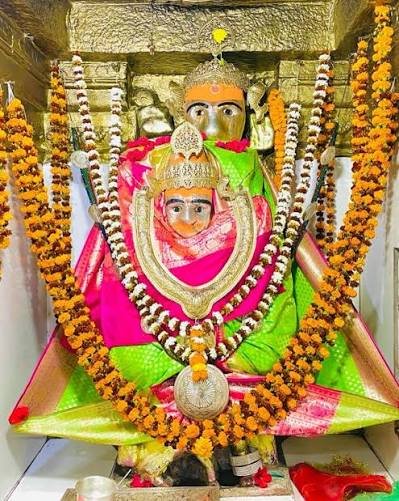
The sanctum houses a rare dual image of Maa Mahamaya. Mahishasuramardini is depicted at the front, while an image of Goddess Saraswati is present at the back. According to popular belief, the right hand of Goddess Sati fell at this site.
3. Maa Danteshwari Temple, Dantewada
Maa Danteshwari Temple, situated in the Bastar region of Chhattisgarh, is not merely a religious site but also a major symbol of the remarkable confluence of local tribal traditions and Sanatan faith.
The temple is situated in Dantewada on the sacred banks of the confluence of the Shankhini and Dankini rivers. For centuries, it has been a centre of profound devotion for tribal communities and the general public. According to religious beliefs, the teeth of Goddess Sati fell here, giving the sacred place its name, Dantewada, and the goddess her name, Danteshwari.
Built in the 14th century, the temple’s presiding deity was regarded as the family goddess by the Kakatiya kings of Bastar. The sanctum houses a magnificent six-armed black-stone idol of Mahishasuramardini.
The temple’s importance reaches its peak during the world-famous Bastar Dussehra festival. During the celebration, the goddess’s ceremonial umbrella and palanquin are taken from Dantewada to Jagdalpur. Thousands of tribal devotees and other worshippers travel long distances on foot to participate in the event. The procession reflects the region’s cultural unity and spirit of brotherhood.
4. Maa Bageshwari Kudargarh Dham
Maa Bageshwari, situated in the Odgi development block of Surajpur district, is known for the destruction of demons and is regarded as a symbol of power and courage.
The temple stands on hills approximately 1,500 feet high and is surrounded by dense forests. According to popular belief, the Kudargarh region was a place of penance for Maa Bhagwati Parvati, where the goddess assumed her powerful form and destroyed demons.
Later, around 400 years ago, King Baland, a devotee of the goddess, installed Maa Bageshwari at this location. Subsequently, a king of the Chauhan dynasty defeated Baland in battle, after which the same dynasty took responsibility for looking after the temple. Since then, the descendants of the Chauhan dynasty have performed the first morning aarti during Navratri every year.
In the 18th century, the Chauhan kings entrusted the indigenous Baiga tribal community of Chhattisgarh with the responsibility of maintaining and worshipping the goddess. Since then, members of the Baiga community have continued to perform the worship.
5. Maa Chandrahassini Temple, Chandrapur
Maa Chandrahassini Temple, situated on the banks of the Mahanadi River in Chandrapur in Chhattisgarh’s Sakti district, formerly part of Janjgir-Champa district, is a famous Siddha Shaktipeeth. The temple is located near the confluence of the Mahanadi and Mand rivers.
According to popular belief, King Chandrahass of Sambalpur constructed the temple, giving the place its name, Chandrapur, and the goddess her name, Chandrahassini. In 1522, Gond King Dhundhya Ram Sah Atram of Chandrapur renovated the temple. The Gond kings regarded the goddess as their family deity and continued the tradition of Shakti worship.
The history of Maa Chandrahassini Temple in Sakti district is considered ancient. Situated on a hill in Chandrapur, the temple’s beautiful architecture reflects its antiquity. Devotees have immense faith in the goddess. The temple is regarded by some as one of the 52 Shaktipeeths, and according to belief, the left ear of Goddess Sati fell here.
In 1935, the Mahanadi experienced severe flooding. At that time, Thakur Shashibhushan, a descendant of King Chandrahass, offered a goat sacrifice to the goddess and prayed for relief. Following the prayer, the river’s water level receded and people’s lives were saved. Even today, the footprints of the goddess on a stone near the river are worshipped.
The objective is to promote tourism that is sustainable from the perspective of the state’s economic, cultural and social environment; strengthen the quality of tourism experiences and attractions in Chhattisgarh; preserve, enhance and publicise the state’s rich and diverse cultural heritage; and increase tourism’s contribution to economic development and related sectors.
Efforts will also be encouraged to promote private investment in tourism infrastructure, facilitate the role of the government, and encourage new concepts in tourism such as timeshares, ecotourism and adventure tourism. The intellectual property and rights of local communities will be respected.
Tourism will be accorded the status of an industry in Chhattisgarh, creating opportunities for employment for unemployed people.