New Delhi, October 2026 : The Delhi Police have imposed a 24-hour suspension of mobile internet services within a four-kilometre radius of the Janpath-Kartavya Path crossing and announced the closure of 57 Delhi Metro stations as part of heightened security arrangements ahead of the proposed CJP protest at Jantar Mantar on Saturday.
The internet restrictions came into effect at 10 p.m. on Friday and will remain in force until 10 p.m. on Saturday, a police official said. The measures have been introduced alongside preventive restrictions in the New Delhi area to maintain public order and ensure public safety during the planned demonstration.
The Delhi Police have maintained that permission for the proposed CJP demonstration was denied because the organisers allegedly failed to comply with legal directions and undertakings given during an earlier protest.
Following approval from the Union Home Ministry for the temporary suspension of internet services, Manishi Chandra, Deputy Commissioner of Police, Special Cell (Headquarters), wrote to nodal officers of telecom companies, asking them to implement the restrictions.
According to the communication sent to telecom operators, Union Home Secretary approval was granted under sub-rule (1) of Rule 3 of the Telecommunications (Temporary Suspension of Services) Rules, 2024, read with Section 20(2)(b) of the Telecommunications Act, 2023.
The telecom companies were directed to suspend mobile internet services in the specified area around the Janpath-Kartavya Path crossing for the 24-hour period. The restrictions form part of a broader security plan to manage the anticipated gathering and prevent possible disruptions.
The internet suspension comes in addition to the closure of 57 Delhi Metro stations, which began at 9 p.m. on Friday. Police officials said the proposal to close the stations had been communicated to the Delhi Metro Rail Corporation (DMRC).
Among the stations listed for closure are Rajiv Chowk, Janpath, Patel Chowk, Central Secretariat, Lok Kalyan Marg, Supreme Court, Mandi House, Barakhamba Road, ITO, Delhi Gate, Kashmere Gate, Sarai Kale Khan-Nizamuddin, Lajpat Nagar, Jangpura, Vishwavidyalaya, Civil Lines, Okhla Vihar, Jamia Millia Islamia, Ashram, Rohini West, Welcome, Shalimar Bagh, Adarsh Nagar and Hauz Khas.
The police said Section 163 of the Bharatiya Nagarik Suraksha Sanhita (BNSS) was in force in the New Delhi area, allowing preventive restrictions to be imposed to maintain public order and safety.
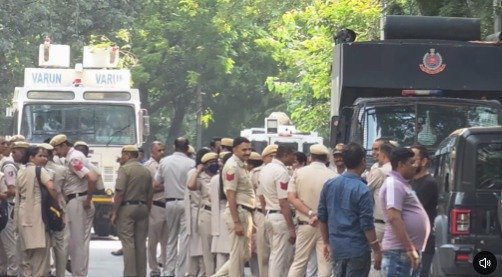
Security has also been strengthened at railway stations to manage the arrival of demonstrators travelling to the national capital by train. Deputy Commissioner of Police (Railways) B. Bharat Reddy said 334 Government Railway Police (GRP) personnel had been deployed, while the police had sought 14 companies of the Central Armed Police Forces (CAPF) to reinforce security arrangements.
Reddy said the CJP had called for a protest at Jantar Mantar on October 10 and that special arrangements were being made at major railway stations to manage passenger movement and prevent security-related disruptions.
“For protesters coming to Delhi by train to participate in the demonstration, we have deployed 334 GRP personnel and sought 14 companies of the Central Armed Police Forces (CAPF). The deployment will be round-the-clock,” he said.
He noted that Delhi has seven major railway stations that handle a large number of trains and experience heavy passenger footfall. Security personnel would remain deployed at these stations throughout the day and night to monitor the situation and respond to any eventuality.
Addressing concerns about possible travel disruptions, Reddy said passengers would not face inconvenience if their trains had not been diverted and were scheduled to arrive at their designated stations.
With the protest scheduled for Saturday, the Delhi Police have stepped up security across key public transport hubs and sensitive locations. The internet suspension, metro station closures and additional deployment of personnel are intended to help authorities manage the expected gathering and maintain law and order in the capital.