UN chief also criticises fossil fuel industry, urging major polluters to do more to address climate change and support developing nations
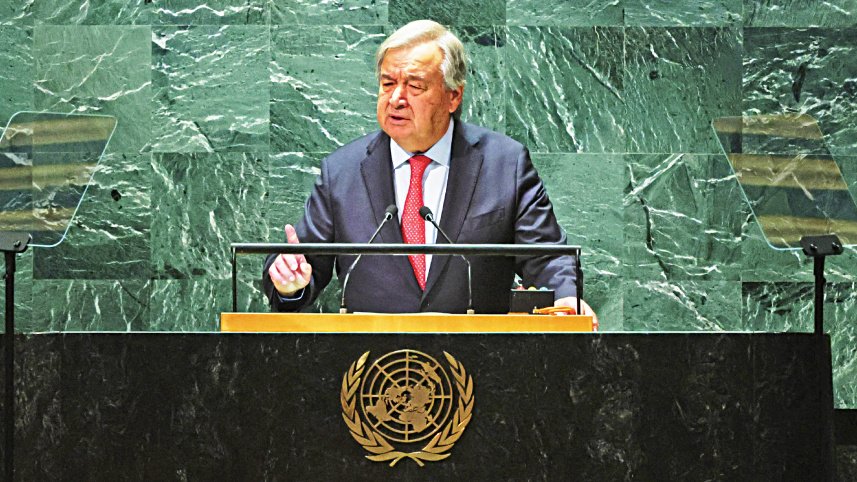
New York, September 2026 : United Nations Secretary-General António Guterres has called on the United States and China to establish dialogue on artificial intelligence, while warning that the expansion of Israeli settlements in the occupied West Bank is undermining prospects for a two-state solution and raising the “spectre of ethnic cleansing”.
Addressing the opening of the 81st session of the UN General Assembly on Tuesday, Guterres outlined what he described as major global challenges involving peace and security, inequality, climate change and artificial intelligence. He urged governments to strengthen international cooperation at a time of widening geopolitical divisions.
On AI, Guterres said countries with the greatest technological capabilities also carried the greatest responsibility to ensure that the rapidly developing technology was governed responsibly. He called for channels of dialogue, transparency, trust and cooperation between major AI powers.
Referring to the Cold War, Guterres said strategic rivals had eventually recognised the need to manage shared risks despite their broader political differences. He argued that a similar approach was needed today as AI capabilities expand rapidly.
His remarks came amid growing international efforts to establish mechanisms for managing AI-related risks. The United States and China have already been holding discussions on AI safety and emergency communication protocols, with officials expected to continue those talks.
Guterres also devoted significant attention to the conflict in the Middle East and the Israeli-Palestinian issue. He said violence, displacement and settlement expansion by Israel in the occupied West Bank were “bulldozing the path to peace” and raising the spectre of ethnic cleansing.
“We cannot allow the two-State solution to disappear before our eyes,” Guterres said, according to the UN transcript of his address. He also reiterated calls for compliance with international law and relevant orders of the International Court of Justice.
On climate change, Guterres sharply criticised the fossil fuel industry, arguing that companies that have benefited substantially from the energy crisis must do more to address the consequences of climate change.
He said major oil companies had made hundreds of billions of dollars in profits since Russia’s invasion of Ukraine, while developing countries continued to face significant gaps in financing needed to adapt to a warming climate. He argued that those responsible for a larger share of pollution should contribute more towards addressing its consequences.
Guterres also warned that ordinary people were facing higher costs for energy, food and insurance as climate-related pressures intensified. His comments came ahead of a UN Climate Summit scheduled for September 23, where governments, energy producers and consumers are expected to discuss accelerating the global energy transition and strengthening climate finance.
The UN chief’s address was delivered with roughly 100 days remaining in his tenure. He described the widening divisions among nations as a major challenge to international cooperation and called for stronger global rules to manage emerging technologies, conflicts and climate risks.
His appeal for cooperation on AI, climate action and international peace formed a central part of his final General Assembly address as UN secretary-general, with the organisation continuing to seek common ground among major powers on issues carrying global consequences.
(Disclaimer :The content of this article is sourced from a news agency and has not been edited by the Mavericknews30 team.)