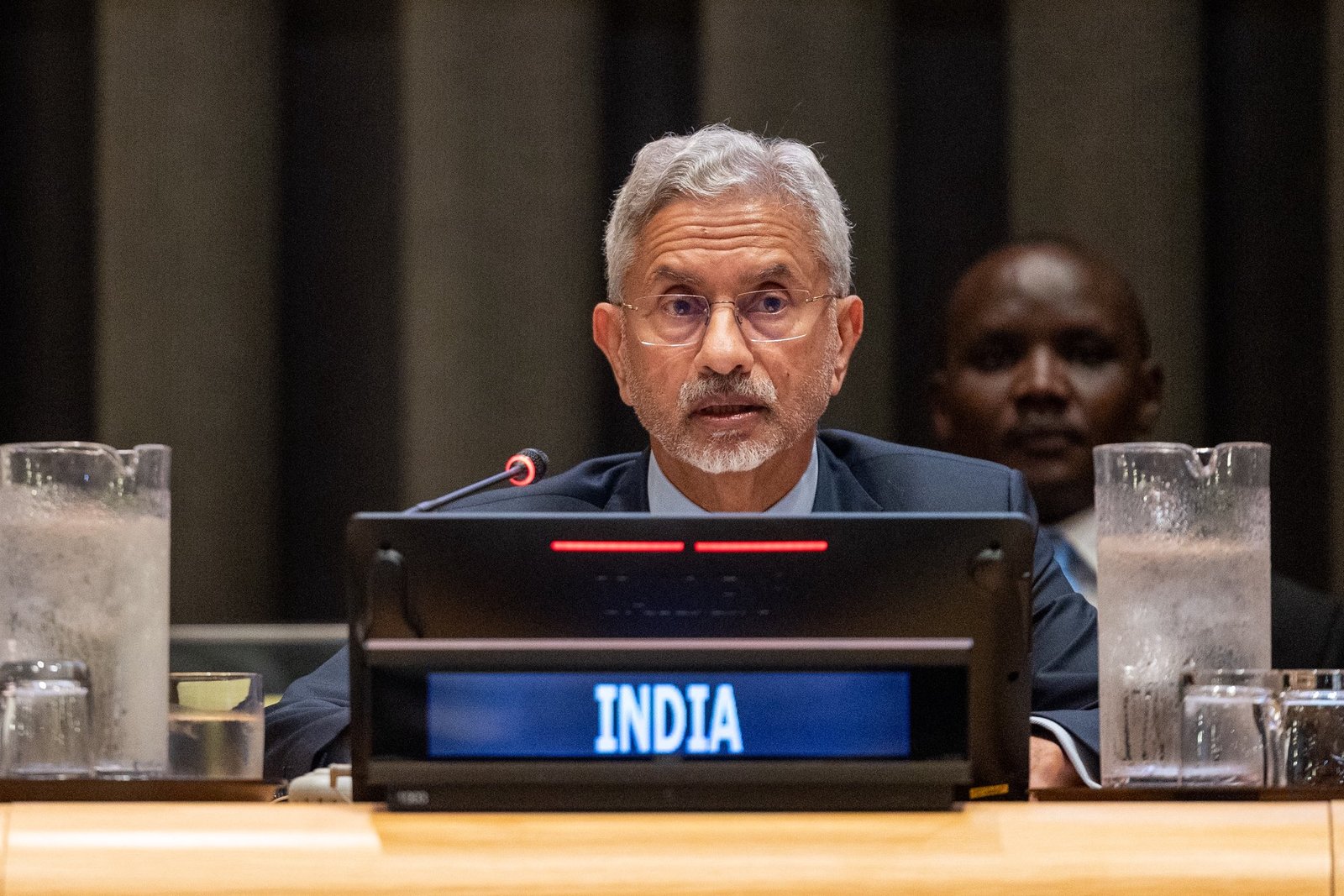
New Delhi, Oct 2026 : External Affairs Minister S Jaishankar has expressed optimism over the progress of India’s trade negotiations with the United States, efforts to normalise relations with China and the proposed free trade agreement with the European Union. He also defended India’s longstanding partnership with Russia and called for appropriate safeguards to ensure the responsible development and use of artificial intelligence (AI).
In a wide-ranging interview with Bloomberg Editor-in-Chief John Micklethwait on Tuesday, Jaishankar discussed India’s foreign policy priorities amid changes in the global geopolitical and economic landscape. He emphasised that New Delhi would continue to engage with major powers while safeguarding its strategic autonomy and national interests.
The minister said the changing approach of the United States towards international engagement had prompted countries to reassess their relationships with Washington. However, he maintained that India’s partnership with the US was based on strategic cooperation rather than a formal military or political alliance.
On economic relations, Jaishankar indicated that negotiations for the proposed India-US trade agreement were moving in the right direction, with both sides working to resolve outstanding differences. He also highlighted the importance of maintaining stability along the India-China border, improving bilateral relations and ensuring fair economic competition.
India-US Relations and Trade Negotiations
Jaishankar said Washington had significantly changed the way it engaged with the international community, requiring countries to reassess their approaches to bilateral relations.
“The reality is, the United States has repositioned itself. It’s changed the manner in which it engages the world, the basis on which it engages the world. So I think every country, in a way, has to recalculate and reset its relationship with the United States,” he said.
The minister stressed that India’s relationship with the US was a strategic partnership that allowed both countries to cooperate on areas of mutual interest without being bound by the obligations of a formal alliance.
“We are a country which has a strong strategic partnership with the US. But a strategic partnership is a partnership. It’s not an alliance,” he said.
His remarks highlighted New Delhi’s approach of maintaining close engagement with Washington while retaining the flexibility to pursue independent decisions on international affairs.
On the proposed bilateral trade agreement, Jaishankar expressed encouragement over the progress of negotiations. He said officials from both countries, including trade representatives and India’s Commerce and Industry Minister, were working to address the remaining differences.
“We’re very encouraged by it,” he said, indicating that the discussions were approaching a stage where the outstanding issues could be resolved.
The proposed agreement is expected to play an important role in strengthening economic engagement between the two countries. However, its finalisation will depend on the outcome of negotiations and agreement on the issues that remain unresolved.
India and the US have sought to expand cooperation across trade, technology, investment, defence and supply chains. Jaishankar’s remarks suggested that New Delhi remained committed to advancing economic ties while ensuring that the terms of any agreement served India’s interests.
India and China Explore Ways to Normalise Relations
Turning to China, Jaishankar said the two countries were exploring possibilities for incremental progress on their longstanding boundary dispute. He underlined that peace and stability along the border were essential for improving the broader relationship.
According to the minister, conditions in the border areas had improved considerably since 2024, creating scope for both countries to gradually move towards normalisation.
“If you want a normal relationship, if the rest of the relationship is to move, then it makes common sense. It’s a no-brainer that the boundary has to be stable,” he said.
Jaishankar clarified that India was not demanding a complete settlement of the boundary dispute as a precondition for conducting business with China. Instead, New Delhi expected both sides to maintain peace and tranquillity along the border.
The distinction is significant because the boundary dispute remains a longstanding source of tension between the two neighbouring countries. India has consistently maintained that stability along the border is necessary for the development of other aspects of bilateral relations.
While acknowledging signs of improvement, Jaishankar pointed out that economic relations continued to face challenges, particularly regarding market access and the conditions under which Indian businesses compete in China.
“We do believe today that we are not getting a level playing field in China, in the manner in which we have given a level playing field to them,” he said.
His comments indicated that progress on the border issue would not automatically result in a change in India’s approach to trade and investment. Economic concerns, including market access and fair competition, would continue to be considered independently.
‘Early Harvest’ Approach to the Boundary Dispute
Jaishankar also referred to discussions on an “early harvest” approach to resolving parts of the boundary dispute.
Under this approach, the two countries could seek agreement on certain sections of the disputed boundary before attempting to settle more complicated areas. The idea would allow progress on specific issues without requiring an immediate comprehensive settlement.
The minister said proposals had been exchanged and discussions were continuing, although the outcome remained uncertain.
Any progress would depend on the willingness of both sides to reach mutually acceptable arrangements. The approach reflects an effort to explore practical steps towards managing the dispute while keeping the possibility of a broader settlement open.
Jaishankar’s remarks made clear that India would continue to distinguish between the requirements for maintaining border peace and its separate economic policy considerations in dealing with China.
Jaishankar Defends India’s Longstanding Partnership With Russia
The external affairs minister also defended India’s relationship with Russia, arguing that Moscow should maintain a broad network of strategic and economic partners rather than become increasingly dependent on China.
He acknowledged that the war in Ukraine had altered Russia’s international relationships and encouraged it to turn more towards Asia. Within the region, China had emerged as a major focus of Moscow’s engagement.
“The result of what has happened because of the Ukraine war is that Russia perforce has turned much more to Asia, and in Asia, obviously much of that is towards China,” Jaishankar said.
He argued that India remained a natural partner for Russia because of the longstanding relationship between the two countries. New Delhi, he said, was reassuring Moscow that their partnership remained stable and continued to serve the interests of both sides.
India has maintained its engagement with Russia despite the geopolitical consequences of the Ukraine conflict. The relationship has historically covered defence cooperation, energy, trade and diplomatic engagement.
Jaishankar’s comments also reflected India’s view that a more diversified network of international partnerships would benefit Russia and the wider global community.
He said it was in the interests of both Russia and the international community for Moscow to sustain meaningful relationships with countries across Europe and Asia.
The position underscores India’s preference for maintaining independent relationships with major powers, even when their interests and policies differ. New Delhi has continued to engage with Russia while expanding its strategic partnership with the US and strengthening cooperation with other countries.
India-EU Free Trade Agreement: Hopes for Early Implementation
On relations with Europe, Jaishankar expressed hope that the proposed India-European Union free trade agreement could enter into force in the coming months, potentially by the end of the year or early next year.
He welcomed Europe’s increasing emphasis on strategic autonomy, a concept that broadly involves countries retaining the ability to make independent decisions on security, economic and foreign policy matters.
According to Jaishankar, this approach was consistent with India’s preference for independent decision-making in international affairs.
The proposed trade agreement is expected to provide a framework for expanding commercial engagement between India and European countries. Greater market access and closer economic cooperation could create opportunities for businesses on both sides, depending on the final terms of the agreement.
However, the timeline for implementation will depend on the completion of negotiations and the necessary approval and procedural requirements.
For India, stronger economic ties with Europe would form part of a broader effort to diversify trade relationships, attract investment and deepen engagement with major global markets.
Jaishankar’s remarks suggested that New Delhi viewed the proposed agreement as an important component of its economic diplomacy, alongside efforts to advance trade negotiations with the United States and address challenges in its economic relationship with China.
AI Regulation and Safeguards Needed
Jaishankar also addressed the growing influence of artificial intelligence, describing it as one of the most consequential technological developments of the modern era.
“AI is, in that sense, mother of all technologies that we know so far,” he said.
He warned that AI would have far-reaching implications for everyday life and affect people across different sections of society. As the technology becomes increasingly integrated into economic activity, public services and daily routines, questions surrounding its regulation, accessibility and responsible use are likely to become more significant.
Jaishankar said there was considerable agreement on the need to introduce appropriate regulatory frameworks and safeguards.
“I think there’s a pretty good consensus on this, that yes, there should be regulation, there should be guardrails,” he said.
The minister also emphasised the importance of making AI widely accessible so that its benefits could reach ordinary people rather than remain concentrated among a limited number of powerful organisations.
His comments highlighted the need to balance technological innovation with public interest. While AI offers opportunities to improve productivity and support new applications across sectors, its growing influence also raises questions about accountability, access and oversight.
Jaishankar’s remarks pointed to the importance of ensuring that the development of AI is accompanied by safeguards that promote responsible use without unnecessarily restricting its potential benefits.
Strategic Autonomy at the Centre of India’s Approach
Across the issues discussed in the interview, Jaishankar emphasised India’s preference for maintaining working relationships with major global powers while protecting its freedom to make independent decisions.
Whether dealing with Washington, Beijing, Moscow or European capitals, New Delhi’s approach involves pursuing cooperation where interests converge while addressing differences through negotiations and diplomatic engagement.
The proposed India-US trade agreement and India-EU FTA represent opportunities to expand economic ties, while efforts to stabilise relations with China remain linked to the need for peace along the border and fairer economic engagement.
At the same time, India intends to preserve its longstanding relationship with Russia despite changes in the international balance of power.
On artificial intelligence, Jaishankar highlighted another dimension of India’s global engagement: ensuring that emerging technologies remain accessible and are governed by appropriate safeguards.
His remarks outlined a foreign policy approach centred on strategic autonomy, diversified partnerships, economic opportunities and cooperation on issues that increasingly shape the international order.
(Disclaimer :The content of this article is sourced from a news agency and has not been edited by the Mavericknews30 team.)