Patna, November 2026: Bihar Chief Minister Samrat Choudhary said a historic agreement between the Ministry of Road Transport and Highways and the Bihar government under the ‘Nadi Sanjivani’ programme would accelerate river silt management, rejuvenation of water resources and national highway construction in the state.
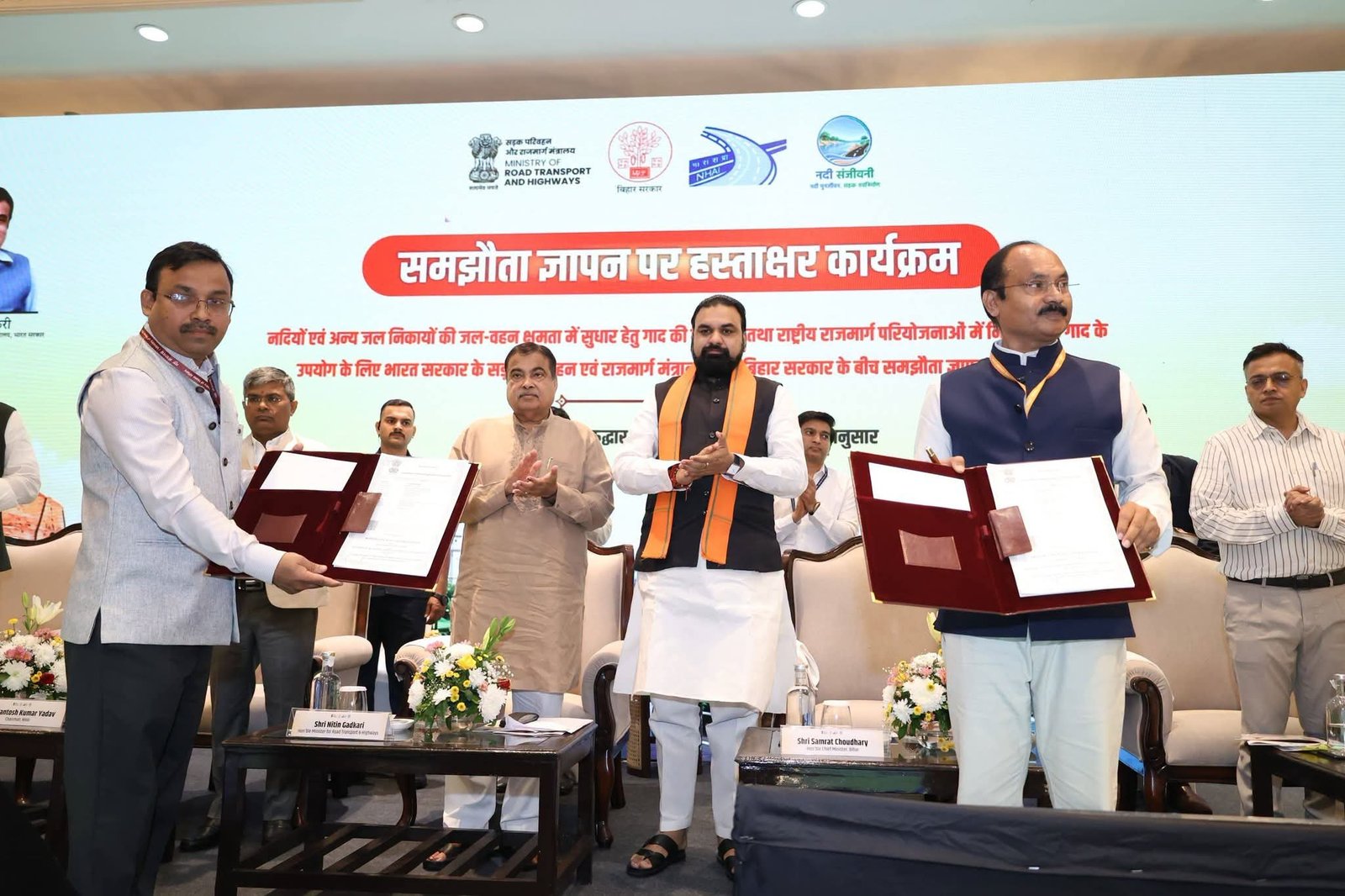
The agreement was signed in the presence of Chief Minister Samrat Choudhary and Union Minister for Road Transport and Highways Nitin Gadkari. It provides for the scientific removal of accumulated silt from rivers and other water bodies and its utilisation in national highway and other road infrastructure projects.
Under the arrangement, silt extracted from rivers will be used as an alternative construction material for road development. Wherever the National Highways Authority of India (NHAI) requires silt for its projects, the Bihar government will facilitate the issuance of mining licences in accordance with applicable rules.
The initiative is expected to improve the water-holding and water-flow capacities of rivers while providing a productive use for the material removed from riverbeds.
The agreement has been signed under the Bihar Water Resources Rejuvenation and Silt Management Policy, 2026. Bihar is the first state in the country to introduce a dedicated policy for managing silt and rejuvenating water resources.
Key highlights of the initiative include:
Scientific removal and utilisation of river silt in national highway and other road construction projects.
Rejuvenation of rivers, improved water-holding capacity and better water availability for irrigation.
Reduction in the impact of floods and improved management of water resources.
No financial burden on the Bihar government for the proposed initiative.
Utilisation of 243 lakh cubic metres of free silt in 16 ongoing highway projects.
NHAI has 39 projects covering 1,561 km under construction in Bihar, involving an investment of ₹58,340 crore. Another 11 projects covering 1,982 km, with an estimated cost of ₹1,85,200 crore, have been proposed.
Silt removal to help control floods and strengthen agriculture
Addressing the programme, Union Minister Nitin Gadkari said the removal of silt from Bihar's rivers would be undertaken along the lines of the successful Buldhana model in Maharashtra. He said the initiative would help rejuvenate rivers and promote water conservation.
Gadkari assured that the project would not impose any financial burden on the Bihar government and that the Centre would not take any money from the state for the initiative.
He said removing accumulated silt would improve the water-holding and water-flow capacities of rivers, help make water available to farmers for irrigation and reduce the damage caused by annual floods. The initiative would strengthen the agricultural sector and improve the economic condition of farmers.
Chief Minister Choudhary said Bihar had become the first state in the country to formulate a separate policy for silt management. Through the Bihar Water Resources Rejuvenation and Silt Policy, 2026, the government aims to improve the management of accumulated silt in rivers and other water bodies.
He said Bihar's two major challenges—its large population and uncontrolled water flow—could be transformed into opportunities for development through effective resource management. Silt extracted from rivers, he added, would become a valuable resource for the state and strengthen its economy.
The Chief Minister pointed out that Bihar faces recurring floods because of heavy rainfall in Nepal and water flowing into the state from neighbouring regions. The accumulation of silt in the Ganga, particularly due to the Farakka Barrage, has also emerged as a serious concern.
He said scientific silt removal and river rejuvenation would help reduce the impact of floods and improve water management. The extracted material would be used in national highway and other road construction projects, giving infrastructure development an additional boost.
Chief Minister seeks better water availability for Bihar
Choudhary said Bihar was not opposed to sharing water with Bangladesh, but the state's own requirements must also be taken into account.
He pointed out that under the existing arrangement, Bihar gets an opportunity to utilise Ganga water for only four months of the year—July, August, September and October. A state like Bihar needs adequate water throughout the year for agriculture, industries and drinking water requirements.
The Chief Minister also made a special request to Gadkari for the construction of a four-lane road along both banks of the Ganga. He said several new townships were being developed in the state and better road connectivity and infrastructure would accelerate Bihar's economic growth.
He described the Nadi Sanjivani programme as an initiative that would turn Bihar's natural challenges into opportunities for development. It would simultaneously promote environmental conservation, better management of water resources, flood control and infrastructure expansion.
Nearly one lakh acres of land expected to become available
The Chief Minister said that removal of silt from rivers could make approximately one lakh acres of additional land available. This land could be used to develop residential colonies and townships on the lines of Mumbai and Delhi.
He said development work was progressing on 12 new townships across approximately 80,000 acres in the state. These include Patliputra in Patna, Magadh in Gaya, Ang in Munger, Vikramshila in Bhagalpur, Kosi in Saharsa, Mithila in Darbhanga, Tirhut in Muzaffarpur and Sitapuram at Sitamarhi, the birthplace of Goddess Sita.
The other proposed townships are also part of the state's broader infrastructure development plans.
Choudhary said the silt extracted from rivers would be extensively utilised in these infrastructure projects, the construction of 10 new airports and 32 medical colleges, besides road development.
NHAI projects to receive a boost
According to the agreement, approximately 243 lakh cubic metres of free silt will be made available for use in 16 ongoing highway projects. The arrangement is expected to support construction activities and improve regional connectivity.
At present, 39 NHAI projects covering a total length of 1,561 km, with an investment of ₹58,340 crore, are under construction in Bihar. In addition, 11 new projects covering 1,982 km, with an estimated investment of ₹1,85,200 crore, have been proposed.
The Bihar government will assist NHAI in obtaining mining licences wherever silt is required, subject to applicable rules and regulations.
The Chief Minister expressed gratitude to Prime Minister Narendra Modi and Union Minister Nitin Gadkari for supporting the initiative. He expressed confidence that cooperation from the Central government would help Bihar achieve new milestones in development and make a significant contribution to the vision of a developed India.
Senior officials present at the programme included Bihar Chief Secretary Pratyaya Amrit, Road Transport and Highways Ministry Secretary V. Umashankar, NHAI Chairman Santosh Kumar Yadav, Bihar Road Construction Department Secretary Pankaj Kumar Pal, Ministry of Road Transport and Highways Joint Secretary (Highways) Udit Agarwal and NHAI Member (Projects) Anil Chaudhary, along with other senior officials.