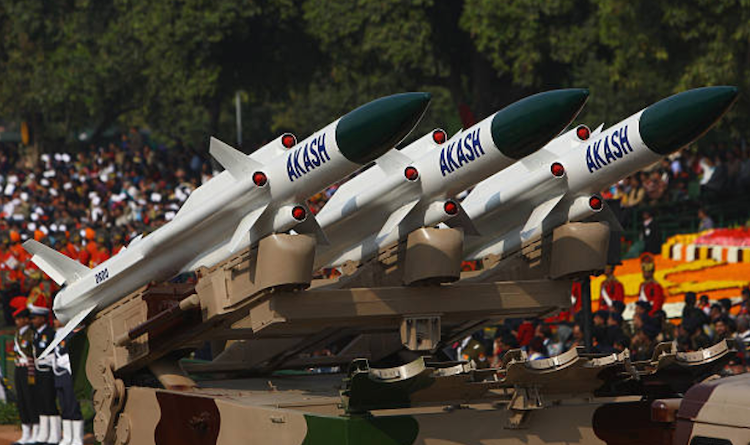
Aug 2026 : India’s indigenously developed Akash surface-to-air missile system is increasingly being viewed as a credible and affordable alternative to the US-made Patriot air-defence system, particularly as prolonged conflicts in Ukraine and the Middle East place growing pressure on Western interceptor stocks. While the two systems serve different operational requirements, Akash is gaining attention for its combination of affordability, scalability and combat experience.
According to a WION report, Operation Sindoor in May 2025 provided significant battlefield validation for Akash, after Indian forces deployed the system against Pakistani drones and missile threats. Its reported performance demonstrated the system’s ability to counter aerial threats in a real combat environment, strengthening India’s pitch to countries seeking cost-effective layered air defence.
Developed as a medium-range surface-to-air system, Akash is designed to protect military formations, strategic installations and other critical assets. Since its induction into the Indian Armed Forces in 2009, the system has been produced in substantial numbers. Its reported production scale gives India an important advantage at a time when many countries are concerned about the availability and replenishment of sophisticated air-defence interceptors.
Akash has a reported range of around 45 km, a maximum speed of approximately Mach 2.5 and carries a 60-kg warhead. Its radar-based guidance enables it to engage targets such as aircraft, drones and cruise missiles. Most significantly, its reported missile cost of around $0.5 million makes it considerably cheaper than the approximately $7 million cost cited for a Patriot PAC-3 interceptor.
The Patriot, particularly the PAC-3 family, remains a more capable high-end system for demanding threats, including ballistic missiles. It offers a substantially longer reported range of around 160 km, speeds of up to Mach 5 and a larger warhead. Its advanced guidance architecture combines radar and infrared technologies, giving it strong capabilities against sophisticated missile threats.
Akash vs Patriot PAC-3: Key Comparison
| Parameter | Akash | Patriot PAC-3 |
|---|---|---|
| Primary role | Medium-range air defence | Advanced long-range air and missile defence |
| Reported range | Around 45 km | Around 160 km |
| Maximum speed | Around Mach 2.5 | Around Mach 5 |
| Warhead | Around 60 kg | Around 90 kg |
| Guidance | Active radar homing | Advanced dual-mode guidance |
| Approx. missile cost | Around $0.5 million | Around $7 million |
| Key strength | Affordability and scalability | Long-range and ballistic-missile defence |
The battlefield experience of Akash has also given India's defence industry an important boost. Armenia, Brazil and the Philippines have shown interest in the system, while several countries in Southeast Asia and Africa are examining Indian air-defence solutions. For nations facing large numbers of drones and cruise missiles, the ability to deploy substantial interceptor inventories without the financial burden associated with premium systems can be particularly attractive.
India is also expanding the Akash family. Akash Prime has undergone successful high-altitude testing, including trials at around 15,000 feet, demonstrating its suitability for challenging terrain and Himalayan conditions. The newer Akash-NG is designed to offer improved reaction times, an AESA radar and an extended range reportedly reaching 70–80 km. These improvements are intended to strengthen its ability to counter low-radar-cross-section drones, aircraft and precision-guided weapons.
The wars in Ukraine and the Middle East have highlighted the strategic importance of maintaining sufficient stocks of air-defence interceptors. Expensive missiles can be difficult to replenish when they are fired in large numbers against waves of relatively inexpensive drones and missiles. This has increased interest in systems that can provide an economical layer of defence without sacrificing battlefield effectiveness.
India’s defence companies, including BEL, BDL, L&T and TATA Advanced Systems, are helping expand domestic manufacturing capabilities and support the country’s growing defence-export ambitions. Akash is consequently becoming one of the most prominent examples of the Make in India programme translating into an export-oriented defence product.
The strategic comparison, however, should not be interpreted as suggesting that Akash can replace Patriot across every mission. Patriot retains a major advantage in range and advanced ballistic-missile defence, while Akash’s principal appeal lies in providing a relatively inexpensive, scalable and combat-tested layer against drones, aircraft and cruise missiles.
As countries reassess their air-defence requirements amid sustained conflicts and rapidly evolving drone warfare, Akash’s combination of cost, domestic production and operational experience could make it an increasingly important player in the global missile-defence market. For India, its success abroad could also strengthen the country’s position as an emerging major defence exporter.
(Disclaimer :The content of this article is sourced from a news agency and has not been edited by the Mavericknews30 team.)