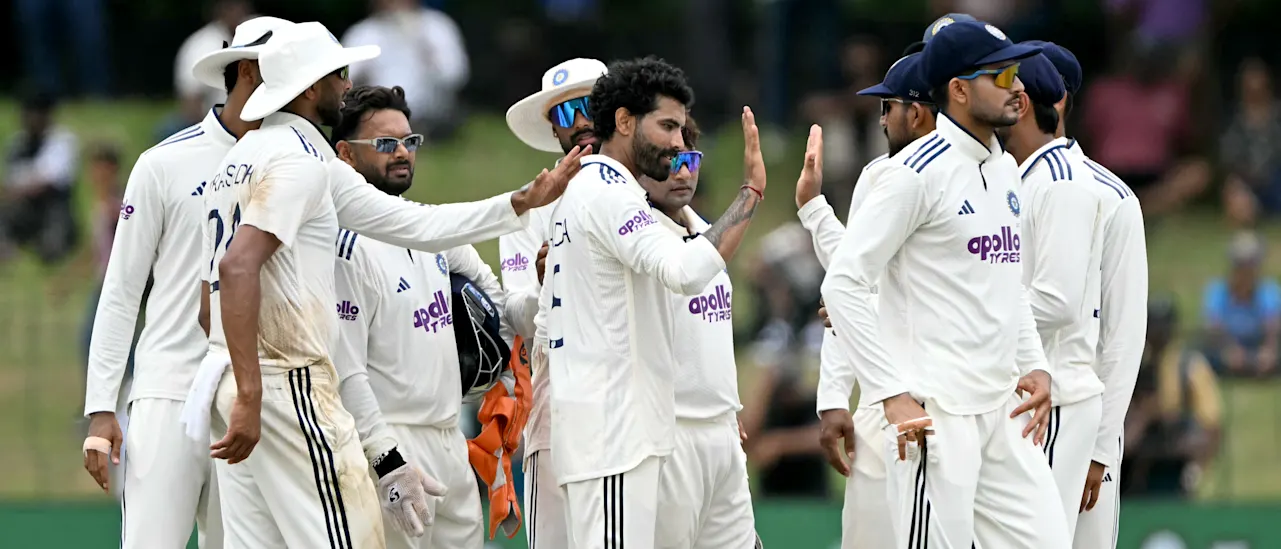
Colombo, Aug 2026: India’s decision to enforce the follow-on briefly threatened to backfire before their bowlers fought back with a crucial late burst on the fourth day of the second Test against Sri Lanka at the Sinhalese Sports Club Ground. With the hosts reduced to 229 for six in their second innings, India remain within touching distance of victory, although persistent rain has emerged as a major obstacle.
Sri Lanka began the day at 265 for eight in their first innings and were eventually bowled out for 290, giving India a commanding 213-run advantage over their first-innings declaration of 503 for nine. India immediately opted to send Sri Lanka back to the crease, hoping to exploit the tiring batting line-up and secure a decisive victory without having to bat again.
The strategy initially appeared to be working. Mohammed Siraj struck early, removing Lahiru Udara for just three, while Ravindra Jadeja dismissed Kamil Mishara for 32. Sri Lanka were soon under pressure, but their response thereafter provided the strongest resistance of the match.
Pasindu Sooriyabandara once again proved to be the key figure for the home side. After scoring a patient 80 in Sri Lanka’s first innings, the right-hander produced another determined performance, combining attacking strokes against India’s spinners with disciplined defence. His approach allowed Sri Lanka to recover from 63 for two and build a substantial partnership with Kamindu Mendis.
The third-wicket pair added 115 runs, taking the hosts to 178 for three and substantially reducing the deficit. For a significant period, Sri Lanka’s resistance raised questions over India’s decision to enforce the follow-on. The hosts were suddenly threatening to erase the deficit altogether and potentially force India to bat again.
Both Sooriyabandara and Mendis reached their half-centuries, with Mendis looking particularly fluent. His strokeplay put pressure on India’s bowlers, while Sooriyabandara provided the stability at the other end. As the partnership grew, India’s fielders appeared increasingly frustrated and the momentum shifted towards the home side.
India eventually found the breakthrough through a combination of smart bowling and outstanding fielding. Prasidh Krishna delivered a short ball to Mendis, who attempted to pull it towards the leg side. Instead, the ball ballooned towards square leg. Shubman Gill reacted quickly, running backwards and across the field before completing an excellent catch.
Mendis departed for 55 from 92 deliveries, ending a partnership that had placed Sri Lanka firmly back in the contest.
At tea, Sri Lanka were 199 for three, still 14 runs behind India, with Sooriyabandara unbeaten on 90. The hosts had managed to survive the first two sessions with considerable determination, but India’s bowlers began to apply greater pressure after the break.
Manav Suthar produced another important breakthrough when Sri Lankan captain Dhananjaya de Silva was dismissed for 23. The batter inside-edged a flatter delivery onto his thigh pad, with Devdutt Padikkal completing the catch from the resulting deflection.
The crucial wicket of Sooriyabandara followed soon after. The batter, who had again fallen agonisingly short of a maiden Test century, was dismissed for 92 from 173 balls.
There was an element of smart wicketkeeping in the dismissal. Sooriyabandara had survived an LBW review after an inside edge, but he attempted to charge Suthar off the very next delivery. The bowler responded with a slower ball, beating the batter’s charge, and Rishabh Pant completed the stumping.
Pant’s awareness was particularly important as he had sensed that Sooriyabandara was becoming increasingly restless after spending a long period at the crease. The wicket finally ended Sri Lanka’s most productive resistance of the innings.
Sri Lanka slipped further when Saransh Jain trapped Niroshan Dickwella leg before wicket for six. At 218 for six, the hosts were once again in danger of being bowled out quickly.
Sonal Dinusha and Keshara Nuwantha then attempted to stabilise the innings, but India had regained control. The Sri Lankan batters adopted a more defensive approach as India’s spinners tightened their lines and made scoring increasingly difficult.
However, India’s bowling performance was not entirely clean. Their spinners repeatedly overstepped, giving Sri Lanka additional opportunities through no-balls. India’s spin attack bowled 10 no-balls during the innings, highlighting an area of concern despite their strong comeback in the final session.
Ravindra Jadeja and Saransh Jain were both guilty of overstepping, while Jadeja’s three no-balls took his career tally to 88 in Test cricket. The figure places him among the most prolific no-ball offenders among spinners in recent years.
Just as India appeared capable of removing the remaining Sri Lankan batters, rain interrupted proceedings. Play was stopped at 227 for six, with the players leaving the field at 4.37 pm local time.
The rain subsequently intensified, while the square remained completely covered. With conditions showing little sign of improving, the umpires eventually called off play for the day.
The interruption means Sri Lanka will resume with a narrow lead of just 16 runs and four wickets still in hand. India’s bowlers are now within sight of completing the job, while the second new ball is less than eight overs away.
For Sri Lanka, the challenge is to extend the lead sufficiently to put India under pressure in a potential fourth-innings chase. The lower order will have to contribute significantly if the hosts are to create a competitive target.
India’s decision to enforce the follow-on therefore remains a calculated gamble that has not yet been fully resolved. Sri Lanka’s 115-run third-wicket partnership initially made the decision appear risky, but India’s late wickets have restored the visitors’ advantage.
The biggest threat to India now may not come from Sri Lanka’s batting but from the weather. Forecasts suggest further rain could affect the final day. If sufficient playing time is available, India will look to dismiss the remaining four wickets quickly and chase what should remain a manageable target.
Sri Lanka, meanwhile, will hope their lower order can prolong the innings and give their bowlers a realistic chance of defending a challenging total.
After a day of dramatic momentum shifts, India remain favourites to complete a victory, but the weather could ultimately have the final say.
Brief scores: India 503/9 declared; Sri Lanka 290 and 229/6 in 72.4 overs (Pasindu Sooriyabandara 92, Kamindu Mendis 55; Manav Suthar 2-81, Mohammed Siraj 1-11, Ravindra Jadeja 1-48). Sri Lanka lead by 16 runs with four wickets remaining.