New Delhi, Aug 2026 : India’s private space industry is preparing for a major expansion, with more than eight commercial rocket launches expected during FY 2026-27 and FY 2027-28, signalling a significant shift in the country’s launch ecosystem and a growing role for private companies alongside ISRO.
The government informed Parliament on August 13 that private companies could undertake two commercial launches in FY 2026-27, followed by more than six launches in FY 2027-28. The projected launch pipeline marks an important milestone as Indian space startups move from technology development and demonstration missions towards sustained commercial operations.
Union Minister Jitendra Singh, citing data from the DPIIT Start-up India Portal, said India currently has 440 registered space technology startups. Of these, 18 have received authorisation from the Indian National Space Promotion and Authorisation Centre (IN-SPACe) to undertake space-related activities.
IN-SPACe functions as a single-window agency under the Department of Space, facilitating and regulating non-government space activities. So far, it has granted 113 authorisations to 52 Non-Government Entities, including the 18 startups. The approvals cover activities involving satellites, launch vehicles, space services and infrastructure.
The authorised companies include Agnikul Cosmos, Akshath Aerospace, Azista BST, Bellatrix Aerospace, Cosmoserv Space India, Dhruva Space, Digantara Research and Technologies, GalaxEye Space Solutions, HEX20Labs India, Inorbit Space Telecommunications, Manastu Space Technologies, NSpace Tech India, OrbitAID Aerospace, PierSight Space, PixxelSpace India, Skyroot Aerospace, Space Kidz India and TakeMe2Space Technologies.
These companies are developing technologies across multiple segments of the space economy, ranging from launch vehicles and satellite platforms to propulsion, Earth observation and space situational awareness.
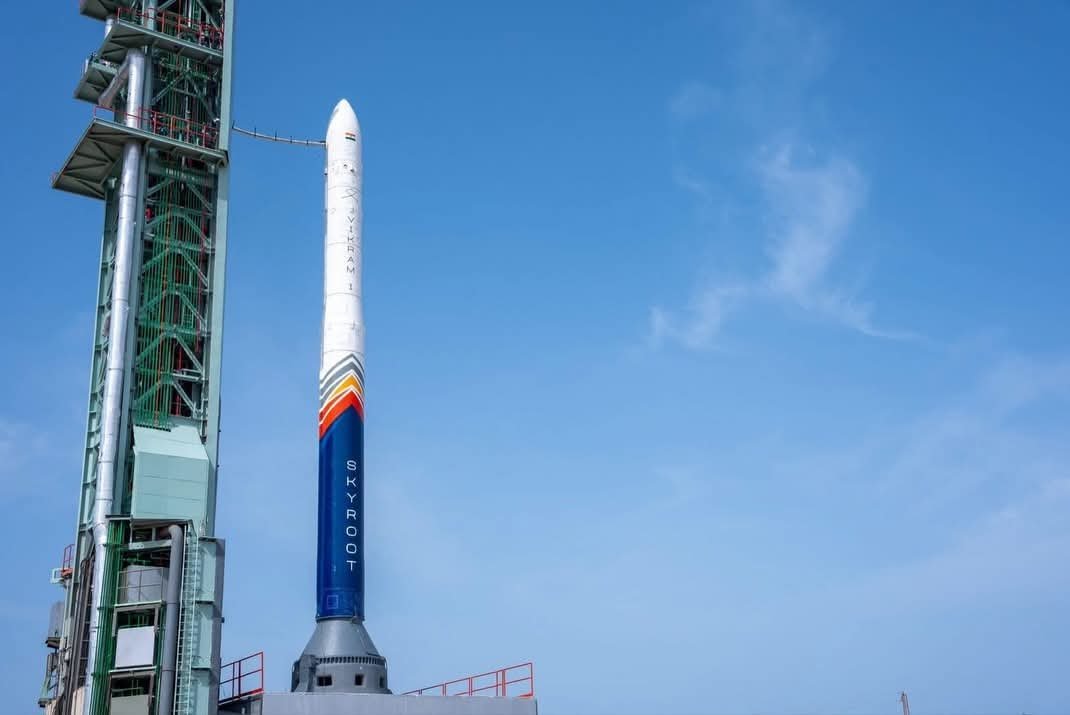
Skyroot Aerospace has already signed a three-launch agreement with HEX20 Space for Vikram-1 missions beginning in late 2027. Agnikul Cosmos is developing its modular Agnibaan launch vehicle, while PixxelSpace India is working on an Earth-observation satellite constellation.
Meanwhile, Dhruva Space is developing satellite platforms and related systems, Bellatrix Aerospace is focused on advanced propulsion technologies, and Digantara is developing space situational awareness capabilities to track objects and activities in orbit.
The private-sector expansion is being supported by the government's broader reforms aimed at opening the space industry to non-government entities. As part of this effort, ISRO and IN-SPACe are preparing to hand over the upcoming Small-Satellite Launch Complex at Kulasekarapattinam in Tamil Nadu to private operators.
The facility is expected to support small launch vehicles, including ISRO’s SSLV as well as private rockets such as Vikram-1 and Agnibaan. Its location will enable direct southward launches, potentially reducing fuel requirements and improving payload-carrying capacity.
India’s space economy has also been expanding rapidly. The country’s space industry generated an estimated $8.4 billion in revenue in 2025, accounting for around 2 per cent of the global space market. Small launch vehicles are expected to become an important growth segment, with the market projected to reach around $3.5 billion by 2033.
The anticipated eight-plus private launches over the next two financial years could therefore represent a turning point for India’s space ambitions. As startups transition from experimental missions to commercial launch services, private participation is expected to strengthen domestic manufacturing, create high-skilled employment and encourage technological innovation.
The growing private launch ecosystem could also enhance India’s competitiveness in the global space market while supporting the country's objective of greater technological self-reliance and reducing dependence on overseas launch providers.
(The content of this article is sourced from a news agency and has not been edited by the Mavericknews30 team.)