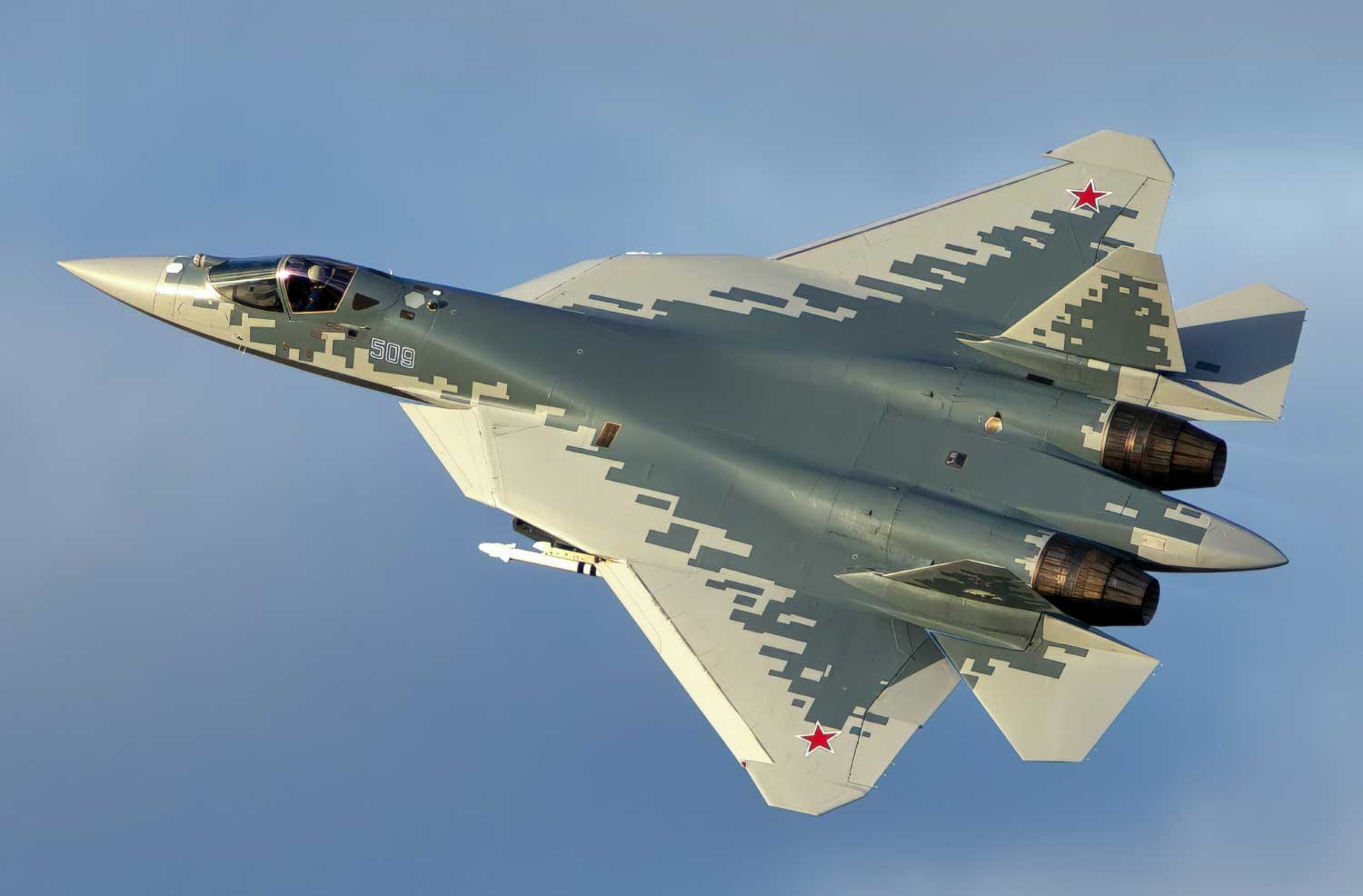
New Delhi, September 2026 : Russia is renewing its pitch for the Su-57 fifth-generation stealth fighter ahead of Prime Minister Narendra Modi’s meeting with Russian President Vladimir Putin on September 11 and the subsequent 18th BRICS Summit in New Delhi. Moscow is believed to be offering an unusually attractive package, including technology transfer and opportunities for local production, but India appears unlikely to revive its interest in the Russian fighter.
The renewed Russian outreach comes at a time when Moscow’s defence industry is facing mounting pressure from Western sanctions and disruptions to traditional export markets following the Ukraine conflict. India, historically one of Russia’s largest defence customers, remains an important potential market for Moscow’s aerospace sector.
Russia’s current pitch reportedly goes beyond the export-oriented Su-57E and encompasses the wider Su-57 family. Moscow has also highlighted the possibility of manufacturing the aircraft in India through Hindustan Aeronautics Limited (HAL), potentially using infrastructure developed for the Su-30MKI programme.
Russian technical teams had earlier assessed Indian manufacturing facilities, including HAL’s Nashik production infrastructure. The proposal would allow India to leverage existing expertise while making additional investments in areas such as composite manufacturing, stealth coatings, advanced sensors and sensor-fusion capabilities.
Russia’s Capability Gap Argument
Moscow’s strongest argument is likely to centre on the Indian Air Force’s fighter squadron shortage. The IAF is currently operating significantly below its authorised strength of 42 squadrons, while several legacy fleets are approaching retirement.
The Jaguar fleet is expected to begin retiring toward the end of the decade, followed by the MiG-29 and Mirage-2000 fleets during the 2030s. This could further widen the gap between the IAF’s operational requirements and available fighter strength.
Russia could therefore position the Su-57 as an interim capability while India develops its own fifth-generation fighter. The Advanced Medium Combat Aircraft (AMCA) programme is expected to take years before achieving operational deployment.
A limited acquisition of Su-57 aircraft could theoretically provide India with a fifth-generation platform sooner and strengthen its capabilities against China’s J-20 stealth fighter.
However, the proposal faces a major obstacle: India’s previous experience with the Russian programme.
The FGFA Legacy
India and Russia had jointly pursued the Fifth Generation Fighter Aircraft (FGFA) programme, based on Russia’s PAK FA, the predecessor of the Su-57. The project began in 2007 but India eventually withdrew in 2018.
The IAF had reportedly raised concerns over several aspects of the aircraft, including its stealth characteristics, engine development and access to critical design information.
Indian assessments had questioned whether the aircraft fully met the IAF’s expectations for a fifth-generation platform, particularly in terms of all-aspect low observability. Concerns were also raised over the availability of the next-generation engine that was expected to provide enhanced performance.
Another contentious issue was access to source codes and sensitive design information. For India, such access is important to independently maintain, upgrade and integrate indigenous weapons and avionics into a combat aircraft.
India had already invested substantially in the FGFA programme before its withdrawal, making a return to a similar arrangement politically and institutionally difficult.
India’s Indigenous Shift
The strategic environment has changed considerably since India exited the FGFA project. New Delhi’s defence modernisation strategy is increasingly centred on domestic design and manufacturing.
The IAF is preparing for the induction of Tejas Mk1A fighters while development of the Tejas Mk2 and AMCA remains a major priority. India is also pursuing extensive modernisation of its Su-30MKI fleet through the Super Sukhoi programme.
These programmes fit more closely with the government’s Atmanirbhar Bharat objective of reducing dependence on imported defence platforms and building domestic aerospace capabilities.
A fresh Su-57 acquisition could also complicate India’s efforts to standardise its future fighter fleet around indigenous platforms and technologies.
Geopolitical Considerations
A Russian fighter purchase would also carry diplomatic implications. India has maintained close defence ties with Moscow while simultaneously deepening strategic and economic engagement with the United States and other Western partners.
Major defence purchases from Russia have previously brought India under scrutiny under the US Countering America’s Adversaries Through Sanctions Act (CAATSA). Washington provided India considerable diplomatic space over its purchase of the S-400 air defence system, but another major Russian acquisition could create fresh friction.
The issue is particularly sensitive as India and the US continue to expand cooperation across trade, technology and strategic security.
For New Delhi, therefore, the decision is not simply about the capabilities of the Su-57. It involves long-term questions about technology independence, fleet planning, industrial policy and strategic autonomy.
Moscow’s Challenge
Russia has continued to develop and deploy the Su-57, while also seeking international customers for the aircraft. The platform has increasingly featured in Moscow’s efforts to demonstrate its advanced aerospace capabilities.
However, India’s priorities have evolved significantly since the FGFA era. New Delhi now wants greater control over technology, domestic manufacturing and future upgrades rather than simply acquiring an imported fifth-generation platform.
The Su-57 may therefore remain an attractive proposition on paper, particularly given the IAF’s fighter shortage. Yet the combination of the FGFA experience, India’s indigenous ambitions and its wider geopolitical balancing makes a major Russian fighter purchase unlikely in the near term.
As Modi and Putin prepare for their bilateral engagement, Moscow’s renewed Su-57 proposal could underline the enduring depth of India-Russia defence ties. But for New Delhi, the future of combat aviation increasingly appears to lie in indigenous programmes rather than reviving a fifth-generation fighter project abandoned years ago.
(Disclaimer :The content of this article is sourced from a news agency and has not been edited by the Mavericknews30 team.)