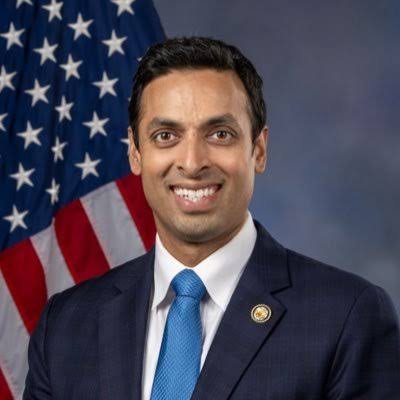
Washington, Aug 25: Indian-American Congressman Suhas Subramanyam has expressed serious concern over the treatment of jailed former Pakistan Prime Minister Imran Khan, saying the developments raise troubling questions about democracy, human rights and the rule of law in the country.
Subramanyam, a Democratic lawmaker, said he received a detailed account of Khan’s condition and circumstances during a meeting with a member of the former prime minister’s family. He said the reports had heightened his concerns about Khan’s wellbeing and access to appropriate medical care.
“The Khans have not been treated properly. They've been treated inhumanely. They deserve the medical attention,” Subramanyam said in an interview.
The Congressman stressed that Khan had come to power after receiving a democratic mandate and argued that his continued detention and reported treatment carried broader implications for Pakistan’s democratic institutions.
“Let's remember that Imran Khan was the democratically elected leader of Pakistan,” Subramanyam said, adding that the situation represented “a bad signal” for democracy and human rights in the country.
Subramanyam also said Pakistan’s strategic relationship with the United States should not prevent Washington from raising concerns about actions by its authorities. He noted that Pakistan remains a US ally and that the United States has a large Pakistani-American community, but argued that Washington should hold its partners accountable when democratic principles and human rights are at stake.
“Even though Pakistan is an ally of the US, and we have a wonderful Pakistani American community here, we need to hold them to task and call out what's going on with our allies included,” he said.
Asked about his immediate priorities, Subramanyam said ensuring that Khan receives adequate medical attention should be the first step. He also called for continued efforts to promote democratic institutions and political freedoms in Pakistan.
“Right now, we just wanna make sure that he gets the medical attention he needs, and that right now, we promote and encourage democracy in Pakistan,” he said.
The Congressman said he would continue raising the issue through letters and public statements, arguing that sustained attention from US lawmakers could help reinforce the importance of democratic governance in Pakistan.
Subramanyam also discussed Pakistan’s emerging role as a mediator between the United States and Iran. He said Islamabad’s involvement in facilitating communication between Washington and Tehran was significant, although he expressed doubts about whether the effort would immediately produce a positive outcome.
“Right now, Pakistan is a mediator between the US and Iran. Those talks have not gone well,” he said, adding that it was nevertheless important to see Pakistan playing such a role.
While acknowledging Pakistan’s status as a US ally, Subramanyam said he continued to have longer-term concerns about the country’s military leadership and political direction. Referring to Pakistan Army chief Asim Munir, he said he remained concerned about “Munir and the regime there”.
The Congressman cautioned Washington against becoming indirectly complicit in actions that could undermine democracy in Pakistan. He argued that the United States should maintain its alliances while also ensuring that democratic values and human rights remain part of its foreign policy.
Subramanyam was also sceptical about the prospects of Pakistan’s diplomatic engagement with Iran producing an immediate breakthrough. He said he was “a little skeptical” that the mediation effort would result in a positive outcome.
Turning to US policy toward Iran, Subramanyam criticised President Donald Trump for not seeking a longer-term strategy from Congress regarding the conflict. He also questioned the financial implications of the administration’s approach, particularly at a time when Americans were facing pressure over domestic spending and social programmes.
He recalled that Congress had previously been told there was insufficient money for healthcare, food assistance and other basic needs, and contrasted those concerns with the large sums now being spent on the Iran conflict.
His remarks reflect growing debate in Washington over Pakistan’s political stability, US-Pakistan relations and the balance between strategic partnerships and American concerns over democracy and human rights.
(Disclaimer :The content of this article is sourced from a news agency and has not been edited by the Mavericknews30 team.)