New Delhi, Aug 2026 : The Indian Army’s Armoured Corps is moving towards a more connected, autonomous and technology-driven battlefield with the development of Manned-Unmanned Teaming (MUM-T) systems. The initiative seeks to integrate human-operated combat platforms with unmanned ground and aerial systems, enabling soldiers and robotic assets to operate as part of a coordinated combat network.
The proposed MUM-T architecture will bring together Unmanned Ground Vehicles (UGVs), Unmanned Aerial Vehicles (UAVs) and a centralised Command and Control Station. By linking these platforms through secure communications, commanders could receive real-time information from multiple sensors and coordinate operations across different battlefield environments.
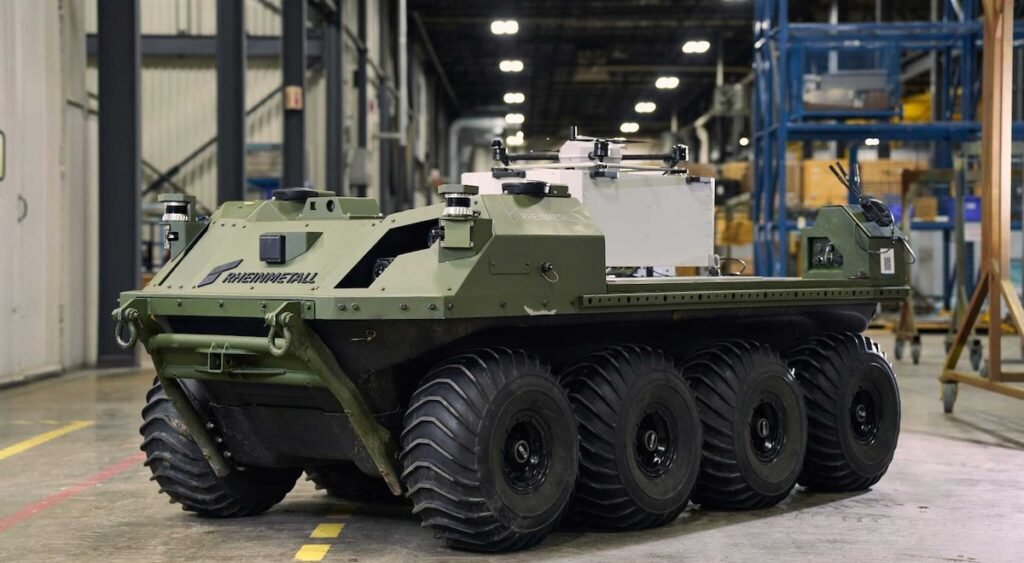
The UGV is expected to form the core of the system and could carry payloads ranging from 500 to 1,000 kilograms. The platform is envisaged to achieve speeds of around 30-40 kilometres per hour and provide an endurance of up to 10-12 hours in a hybrid configuration. Such endurance would be particularly valuable during extended missions in difficult or contested areas.
A key feature of the proposed platform will be autonomous navigation. Technologies such as simultaneous localisation and mapping, obstacle detection and avoidance, and secure communication systems are expected to allow the UGV to navigate complex terrain with limited operator intervention.
The system is also being designed as a multi-role platform capable of carrying different mission-specific payloads. These could include Remote Weapon Stations, Medium Machine Guns and Anti-Tank Guided Missiles. The integration of Intelligence, Surveillance and Reconnaissance equipment would further expand its ability to gather battlefield information and support frontline units.
Integration with UAVs and loitering munitions could provide another layer of operational capability. A UGV working alongside aerial drones could identify threats, transmit battlefield data and support engagement decisions while keeping human operators farther away from high-risk areas.
The MUM-T concept reflects a wider shift in military thinking, in which autonomous and semi-autonomous systems are increasingly being integrated with conventional forces. Rather than completely replacing human personnel, the approach seeks to combine human judgement and decision-making with the endurance, precision and persistence offered by robotic platforms.
For the Armoured Corps, such systems could prove particularly useful in environments where conventional vehicles and personnel face significant risks. Unmanned platforms could undertake reconnaissance, surveillance, logistics or selected combat tasks before manned forces are committed.
The emphasis on hybrid propulsion, secure networking, autonomous mobility and modular payloads is intended to create a flexible platform capable of adapting to multiple mission profiles. Its integration into a broader command-and-control architecture could also improve information sharing and accelerate battlefield decision-making.
The development of MUM-T capabilities forms part of India’s wider defence modernisation drive, which places increasing emphasis on indigenous technology, artificial intelligence, robotics and network-centric warfare.
By combining unmanned ground and aerial platforms with manned combat assets, the Indian Army’s Armoured Corps is seeking to build a force capable of operating in increasingly complex multi-domain environments. The move could enhance situational awareness, improve survivability and reduce risks to soldiers while providing commanders with greater operational flexibility on the battlefield.
(The content of this article is sourced from a news agency and has not been edited by the Mavericknews30 team.)