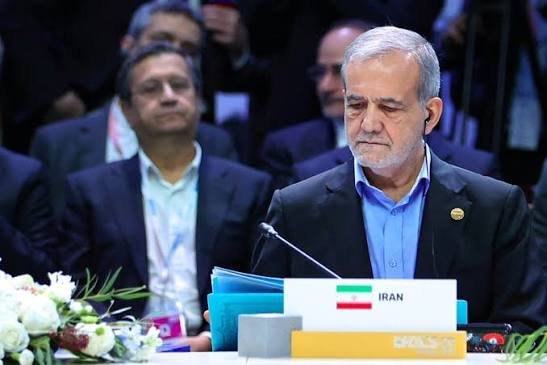
New Delhi, Sept 2026 : Iranian President Masoud Pezeshkian on Friday said Iran would not surrender to what he described as “bullying” and “arrogance” by the United States and Israel, asserting that Tehran would stand firm to protect its national interests amid a fresh escalation of hostilities in West Asia.
Addressing a gathering of religious leaders, intellectuals, academicians and business figures in New Delhi, Pezeshkian outlined Iran’s vision for the Gulf region, stressing the need for peaceful coexistence while accusing foreign powers of attempting to create divisions within Iranian society.
“We will not surrender to oppression. Iran is standing up to Israel and the US because we will not be bullied, and if they push us, we will push them back,” the Iranian President said.
Pezeshkian described US and Israeli forces as “real militants” and referred to a US strike near a primary school in southern Iran that, according to him, killed 168 children.
“They should take on our soldiers instead of targeting hospitals, infrastructure and livelihoods. They think people will surrender because of the lack of supplies but the people of Iran will not surrender,” he said.
His remarks came against the backdrop of escalating tensions across West Asia, including fresh US airstrikes on Iranian targets and mounting economic pressure on Tehran through sanctions imposed by Washington.
The Iranian President accused the United States and Israel of making serious strategic mistakes, comparing their actions to “someone riding a wild horse without reining it in”.
“That will lead them to doom and the fires of hell. God created Iranians, Chinese, Indians and others, and we have to live with each other. We will not surrender to oppression, we will keep supporting the oppressed,” Pezeshkian said.
The event was attended by Iranian Foreign Minister Abbas Araghchi, Kashmiri separatist leader Mirwaiz Umar Farooq, Patanjali Ayurved co-founder and managing director Acharya Balkrishna and Observer Research Foundation Director General Sujan R Chinoy, among others.
Pezeshkian arrived in New Delhi on Friday morning on a three-day visit, primarily to participate in the 18th BRICS Summit being hosted by India.
Ahead of the gathering, the Iranian President held wide-ranging talks with Prime Minister Narendra Modi, with discussions focusing primarily on the evolving situation in West Asia and India-Iran bilateral relations.
Pezeshkian described his talks with Modi as “nice” and said they could pave the way for greater cooperation and stronger relations in areas including trade, technology and culture.
He also highlighted Iran’s strategic geographical position and vast natural resources, saying Tehran was ready to play a strategic role in supplying energy and food to countries across the region.
Earlier, speaking at the BRICS Business Forum, Pezeshkian called for greater use of local currencies in trade among BRICS nations. He also presented Iran’s geographical location, energy resources and transport infrastructure as potential assets for strengthening economic connectivity within the grouping.
The Iranian President said BRICS needed to move beyond its economic potential and develop a more integrated network encompassing trade, investment and joint financing.
Iranian Foreign Minister Araghchi separately described India as a “great emerging country” and praised New Delhi’s leadership of BRICS.
“The BRICS is a very important institution and is playing a very important role. I am sure that India is able to lead the BRICS and the countries that are members of this group in an excellent way,” Araghchi said.
He noted that BRICS members have different views on several issues but share an interest in strengthening the role of national currencies in international trade.
“Inside the BRICS, there are different opinions, but all members of the group believe that national currencies should be strengthened and trade between the member states should be conducted through national currencies,” he said.
Araghchi also said the possibility of creating a single currency for trade among BRICS countries remained under consideration, indicating that discussions on reducing dependence on existing international payment arrangements could continue within the grouping.
Pezeshkian’s visit and remarks come at a time when India is seeking to deepen its engagement with BRICS partners while also maintaining diplomatic ties with countries across the wider West Asian region.
Disclaimer: This article is sourced from a news agency and has not been independently edited by the MaverickNews30 team. The copy has been slightly edited with AI assistance for language and presentation, without altering the original facts.