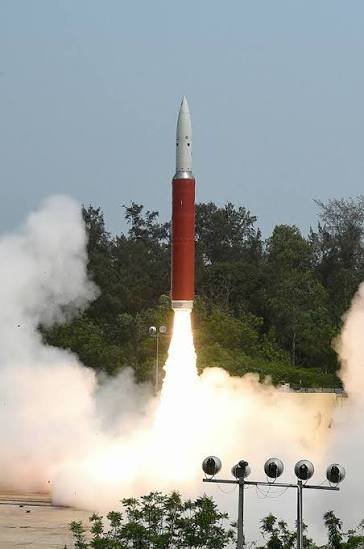
Cannisterised, road-mobile architecture is envisioned to provide rapid satellite replenishment and greater resilience in a contested space environment
New Delhi, Aug 2026 : The Defence Research and Development Organisation (DRDO) is pursuing an ambitious concept known as Project VEDA, or Vehicle for Defence Application, aimed at developing a dedicated launch capability for defence-related space missions. The proposed system represents a shift towards responsive, mobile and survivable space infrastructure, reducing dependence on conventional fixed launch facilities.
According to available defence assessments, VEDA is being associated with the Advanced Systems Laboratory and Research Centre Imarat under the Dr APJ Abdul Kalam Missile Complex. The concept envisages a Defence Satellite Launch Vehicle that could combine technologies derived from India’s missile-development experience with a mobile satellite-launch architecture.
Unlike conventional civilian launch vehicles, which generally require established launch complexes, detailed preparation and payload integration, VEDA is envisaged around solid-propellant stages and a cannisterised configuration. The proposed architecture could allow the launch system to remain mobile and potentially be deployed from dispersed locations, making it more difficult for an adversary to identify and target launch infrastructure.
One of the principal objectives of the concept is rapid launch readiness. Solid-fuel propulsion and pre-integrated systems could potentially reduce the time between receiving an operational requirement and placing a payload into orbit. Some assessments have suggested an order-to-orbit window of approximately 24 to 72 hours, although the actual readiness timeline would depend on the final configuration and operational procedures.
Another important feature is pad-independent deployment. VEDA is envisioned to use Transporter Erector Launcher (TEL) vehicles, allowing the system to operate without permanent dependence on a conventional spaceport. Such mobility could provide greater survivability during a conflict by enabling launch units to relocate between dispersed operating areas.
A responsive launch capability would also have significant implications for satellite replenishment. Modern military operations increasingly depend on space-based communications, navigation, surveillance and intelligence. If an adversary were able to disrupt or disable a critical satellite through kinetic, electronic or cyber means, a rapid replacement capability could help restore essential services.
The concept could also support the deployment of small satellites and satellite clusters. A single launch carrying multiple spacecraft could enable the rapid establishment or replenishment of tactical constellations. Depending on payload configuration, these could potentially support electro-optical, infrared, synthetic aperture radar or signals-intelligence missions.
The broader significance of VEDA lies in its potential contribution to space resilience. Instead of relying exclusively on a limited number of large and expensive satellites, a responsive-launch architecture could support more distributed space assets. Smaller satellites can be deployed in greater numbers, allowing a network to continue functioning even if individual spacecraft are lost or disrupted.
The project is also being discussed in the context of counter-space capabilities. However, specific claims regarding VEDA's potential anti-satellite role, including direct-ascent or co-orbital operations, should be treated as reported or conceptual capabilities unless officially confirmed by the Indian government. Counter-space operations can involve kinetic and non-kinetic methods, including electronic interference and directed-energy technologies, but these remain highly sensitive military capabilities.
VEDA Compared with Global Responsive Launch Concepts
| Parameter | DRDO VEDA | China Kuaizhou | US Rapid-Response Models |
|---|---|---|---|
| Primary concept | Defence-oriented responsive launch | Dual-use rapid satellite launch | Tactical and commercial rapid launch |
| Launch architecture | Proposed mobile, cannisterised TEL | Road-mobile launch platforms | Transportable/modular launch infrastructure |
| Propulsion approach | Solid-propellant architecture envisioned | Solid-propellant-based launch systems | Varies by launch provider |
| Operational emphasis | Defence-space resilience and rapid replenishment | Rapid commercial and government access to orbit | Responsive access to space and tactical missions |
| Mobility | High, under proposed TEL architecture | High | Varies by system |
| Payload class | Reported concept; final specifications subject to development | Varies across Kuaizhou family | Varies by launch vehicle |
| Strategic advantage | Potentially rapid and survivable defence-space access | Mature road-mobile launch model | Strong commercial-industrial ecosystem |
China's Kuaizhou family provides an important international comparison because it has demonstrated the value of mobile launch systems for rapid access to orbit. In the United States, rapid-response space-launch initiatives have increasingly involved cooperation between the government and commercial launch companies, creating additional options for deploying payloads quickly.
VEDA, if developed as envisaged, would give India a more closely integrated defence-oriented alternative. Its potential value would extend beyond simply launching satellites. A mobile launch system could become part of a broader architecture involving satellite constellations, ground stations, secure communications, intelligence networks and space-domain awareness.
The strategic relevance is particularly significant for India because military operations along its northern and western borders increasingly depend on persistent surveillance, communications and real-time intelligence. During a crisis, the ability to rapidly replace a damaged satellite or deploy additional small spacecraft could improve operational continuity.
The project would also complement India's growing emphasis on indigenous space and defence capabilities. By leveraging domestic missile, launch-vehicle, electronics and satellite technologies, a responsive defence-space system could reduce reliance on foreign launch infrastructure during emergencies.
At the doctrinal level, Project VEDA represents a possible transition from a traditional model of space operations towards a resilient and responsive architecture. The emphasis is not simply on placing satellites into orbit but on ensuring that critical space capabilities can be restored, reinforced and maintained during a conflict.
If the proposed architecture progresses successfully, VEDA could become an important component of India's future defence-space ecosystem. Its combination of mobility, rapid deployment and potential satellite replenishment would strengthen the resilience of military space assets and provide India with greater flexibility in an increasingly contested orbital environment.
(The content of this article is sourced from a news agency and has not been edited by the Mavericknews30 team.)