The Purusha Suktam is believed to have been composed around 1500 BCE or earlier. This hymn is part of the Rig Veda, one of the oldest collections of Vedic hymns, which contains 1,028 hymns.
First Verse
🌹 Sahasraśīrṣā Puruṣaḥ Sahasrākṣaḥ Sahasrapāt 🌹
Translation
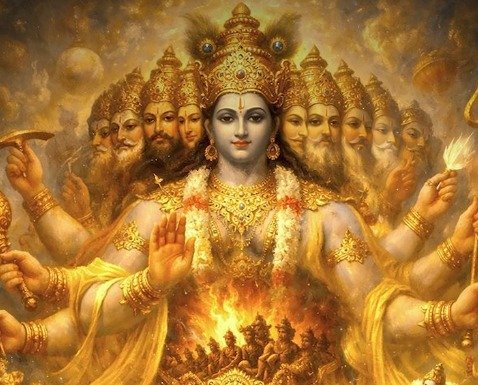
The Purusha (Cosmic Being) has a thousand heads, a thousand eyes and a thousand feet.
Understanding the Deeper Meaning
The first verse of the Purusha Suktam describes the Purusha as having a thousand heads, a thousand eyes and a thousand feet.
From a philosophical perspective, this imagery can be understood as a reminder of human potential and the importance of remaining conscious of our actions, our future and the direction of our lives.
Human beings possess the power of intellect, understanding and action. The reference to a thousand heads and a thousand hands can be interpreted symbolically as representing immense intellectual strength and the capacity to accomplish many things.
We will continue exploring the different meanings and interpretations of the Purusha Suktam in the coming discussions.
The Purusha Suktam holds an important place in various fields of inquiry and interpretation, and its significance should not be overlooked.
There is also a need to revisit prevailing perceptions about India's contributions to mathematics and science. The verses of the Rig Veda, composed thousands of years ago, offer an opportunity to explore how ancient Indian thought used numerical expressions and symbolic imagery. References to a thousand heads, eyes and feet invite further study of the numerical language and philosophical ideas found in Vedic literature.
Vidya Bhawan Astro Research Centre
Jitendra Saxena