
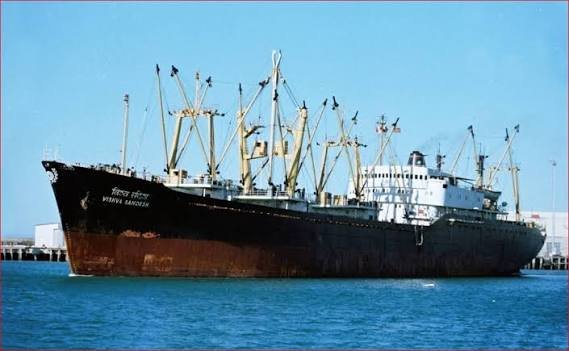
Tehran; September 2026: Iran has expanded its Strait of Hormuz blacklist to 77 ships, adding another 21 vessels including those from Indian State Owned Shipping Corporation Of India (SCI) in less than two weeks and extending its warning to insurers, P&I clubs and classification societies servicing the designated tonnage.
The Persian Gulf Strait Authority said today (Tuesday, 15th) that its non-compliance list had been updated and warned marine insurers, clubs and class societies to refrain from dealing with listed vessels to avoid unspecified consequences.
The latest move takes the list from 56 ships at the beginning of this month to 77. Vessels designated by the Iranian authority can face restrictions on future passages through Hormuz, including fines, detention or confiscation. Ships cooperating with listed tonnage through ship-to-ship transfers or transhipment can also be added. PGSA has not said when or in what circumstances those penalties would be enforced, leaving owners, charterers and service providers facing another layer of uncertainty when fixing Gulf business.
The blacklist has grown rapidly. Iran’s original list contained 45 unique ships spanning VLCCs, product tankers, LNG and LPG carriers, containerships and bulkers. Owners and operators caught in the first round included ADNOC Logistics & Services and Navig8, Bahri, Sinokor, Stolt-Nielsen, Klaveness Combination Carriers, Shipping Corporation of India, Dynacom and GasLog.
At the time, Iran also warned that ships conducting STS operations or transhipment with blacklisted vessels could themselves be designated. The subsequent expansion means another 32 ships have been added since the initial list was published three weeks ago.
The update comes with Hormuz traffic still sharply reduced. Preliminary ship tracking data cited yesterday (Monday – 14th September) showed commodity-vessel crossings falling into single digits per day over the weekend, against a 10-day average of 14, although the figures may miss ships transiting with AIS switched off.
Elsewhere in the Middle East, the picture is moving in the opposite direction, with liner operators accelerating their return to the Red Sea and the Suez Canal despite Houthi advances in the region.
Maersk and Hapag-Lloyd are routing four more Gemini Cooperation services through the Red Sea and Suez Canal, significantly widening their staged return to the shorter Asia-Europe corridor.
Maersk has said today that the AE5, AE11, AE12 and ME2 services will switch from the Cape of Good Hope to trans-Suez routings. Hapag-Lloyd markets the same loops as NE4, SE2, SE1 and IEX, respectively. The partners said the decision followed another assessment of security conditions in the Red Sea and would shorten transit times.
The first announced westbound change will see Antonia Maersk voyage 635W leave Tanjung Pelepas on September 19 on the AE11/SE2 service. Marchen Maersk follows on AE5/NE4 from the Malaysian hub on September 21. The first switched sailing on AE12/SE1 has yet to be announced.
The move marks a substantial acceleration of Gemini’s return to Suez. The first cautious step was unveiled in February this year (2026) when the ME11 service was rerouted through the Red Sea with naval protection. Maersk and Hapag-Lloyd subsequently made AE15 a structural trans-Suez service in July, followed by AE19 in August.
Both carriers are keeping the switch conditional on security conditions. Maersk said further network changes remain dependent on stability in the region and the absence of renewed escalation. These moves leave Evergreen and the Premier Alliance partners ONE, HMM and Yang Ming as the only remaining main carriers that have yet to return to the Red Sea.
The capacity implications of a broader return remain significant. Earlier this year Xeneta estimated that a large-scale move back from the Cape to Suez could release the equivalent of 6% to 8% of global containership capacity currently absorbed by longer voyages.
Team Maverick.