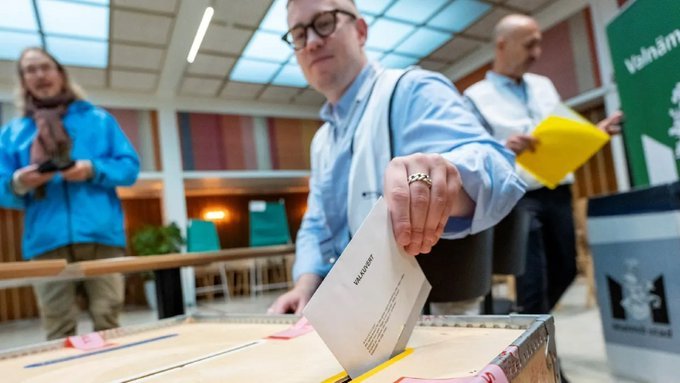
Stockholm, Sept 2026 : Sweden’s national election remained too close to call early Monday, with partial results showing the opposition centre-left bloc holding a narrow one-seat advantage over the governing right-wing coalition led by Prime Minister Ulf Kristersson.
According to the election authority, the bloc headed by Social Democrats leader Magdalena Andersson was projected to secure 175 seats in the 349-member Riksdag, based on results from 5,960 of the country’s 6,312 electoral districts. Kristersson’s right-wing bloc was projected to win 174 seats, with counting continuing.
The extremely tight result means the final outcome may not be known for several days, particularly as overseas ballots still have to be counted. The election is unlikely to significantly alter Sweden’s pro-Western foreign policy or its support for Ukraine, but it could have major consequences for the country’s domestic political direction, particularly on migration.
Kristersson has pursued a tougher approach to immigration during his four years in office, introducing policies aimed at reducing migration and tightening requirements for migrants. The election could determine whether that approach continues or becomes even more restrictive.
“It’s a very tight race, it’s going to be a very long night but I think the Social Democrats have done quite a good election,” said Adonay Endrias Kidane, a doctor and Social Democratic supporter, at the party’s election gathering in central Stockholm.
Kristersson Keeps Hope Alive
Kristersson had trailed Andersson in opinion polls for much of the campaign but narrowed the gap during the final weeks. After voting ended, he said he remained hopeful of assembling a governing majority among the eight political groupings that won seats in parliament.
“Even if tonight’s results hold, I will explore whether it’s possible to find a viable government constellation ... capable of securing support for the fiscal policy Swedish voters have voted for,” Kristersson said.
The prime minister has also broken a longstanding political taboo by pledging to bring the Sweden Democrats, a far-right party with historical links to the neo-Nazi fringe, into government as part of an effort to establish a majority-right coalition.
Supporters of the governing bloc argue that tougher immigration policies and measures targeting criminal gangs have produced positive results. They see an election victory as an endorsement of efforts to reduce immigration and tackle gang violence.
However, critics say the government’s approach has gone too far, particularly policies involving incentives and penalties designed to pressure migrants to adapt more closely to Swedish social and cultural norms or leave the country. Opponents argue that such measures risk undermining civil liberties.
Centre-Left Bloc Faces Internal Differences
Even if Andersson’s bloc emerges victorious, forming a stable government could prove difficult. The centre-left alliance includes parties with significantly different positions on migration, taxation and energy policy.
Andersson herself supports a more restrictive migration policy than some of her potential partners. The bloc also faces disagreements over proposals such as a tax on billionaires and the construction of additional nuclear reactors.
Economic differences could further complicate coalition negotiations. The Left Party, which has its roots in Sweden’s former Communist movement, and the pro-market Centre Party have contrasting views on taxation, spending and economic policy.
The narrow parliamentary arithmetic could therefore make coalition-building as challenging as winning the election itself.
Far Right Under Pressure
The performance of the Sweden Democrats is being closely watched beyond Sweden, particularly by Europe’s growing far-right movement. A strong showing could have strengthened anti-immigration parties elsewhere on the continent following recent electoral gains by the Alternative for Germany.
Far-right parties are also looking ahead to elections in other European countries, including France, where the National Rally is preparing for next year’s presidential contest.
Sweden has traditionally been viewed as one of Europe’s most welcoming countries for immigrants. That approach has changed considerably since Kristersson came to power. His government has abolished permanent residency for refugees, tightened welfare provisions and increased efforts to deport people without legal rights to remain in the country.
The Sweden Democrats acknowledge that their party was partly founded in the 1980s by individuals associated with neo-Nazism and white supremacy. However, party leaders say extremist elements have been removed and have apologised for the organisation’s past.
The party has also proposed banning women from wearing face coverings in public and ending government funding for projects focused on integrating newcomers.
A Nervous Night for Sweden Democrats
Despite the party’s influence on Sweden’s migration debate, preliminary results indicated that the Sweden Democrats could suffer their first decline in both parliamentary seats and vote share during Jimmie Akesson’s more than two decades as leader.
Akesson himself sparked controversy while voting in Rinkeby, near Stockholm, saying the suburb, which has one of Sweden’s largest Swedish-Somali communities, “doesn’t look like Sweden.”
The uncertain result left party officials anxiously awaiting the final count.
“You cannot imagine how nervous I am right now. It feels like my life’s work is hanging in the balance,” said Ludvig Aspling, a Sweden Democrats member of parliament and the party’s immigration spokesperson.
“It is going to be super tight. We still have a chance,” he added.
With only a one-seat difference separating the two major blocs, Sweden now faces potentially lengthy negotiations over the formation of its next government. The final overseas ballots and remaining counts could determine not only who wins the election but also the future direction of Sweden’s migration and domestic policies.
(Disclaimer :The content of this article is sourced from a news agency and has not been edited by the Mavericknews30 team.)