Indigenous rocket artillery programme expands as Army moves towards 10 Pinaka regiments and prepares for next-generation deep-strike capability
New Delhi, Aug 2026 : The Indian Army is accelerating the modernisation of its rocket artillery fleet with the indigenous Pinaka family, strengthening its precision-strike capabilities and reducing dependence on foreign weapon systems. After inducting the guided 75-km Pinaka variant, the Army is now moving towards the next major milestone — the 120-km Long Range Guided Rocket (LRGR), with contracting activity expected to progress by the end of 2026.
The expansion is part of a broader plan to increase the number of operational Pinaka regiments. The Army has already operationalised its seventh regiment, while preparations are underway to make the eighth combat-ready by the end of 2026. Deliveries under existing contracts are continuing, with the immediate objective of taking the fleet to 10 regiments by 2027.
In the longer term, the Army is expected to expand the Pinaka fleet to around 22 regiments. The programme will gradually replace ageing Soviet-origin BM-21 Grad multiple rocket launchers, which are approaching the end of their operational service life.
The guided 75-km Pinaka rockets represent a significant advancement over earlier versions of the system. The precision-guided ammunition combines inertial navigation with satellite-based positioning using GPS and India’s NavIC system, allowing substantially improved accuracy against designated targets. The system is expected to strengthen artillery firepower along strategically sensitive border areas.
The next major development is the 120-km LRGR. The system has already undergone trials, including a December 2025 test that demonstrated precision performance at its maximum stated range. The Defence Acquisition Council has cleared the project for induction, paving the way for the next phase of procurement.
The LRGR is expected to significantly increase the Army’s ability to engage targets at greater distances while retaining the advantages of a mobile rocket artillery system. Its longer range could allow Indian forces to target enemy artillery positions, logistics nodes, troop concentrations and other high-value battlefield assets from greater stand-off distances.
The Pinaka system has evolved considerably since its introduction. The original Pinaka Mk-I had a range of approximately 37-40 km, while the Mk-II increased the range to around 60 km. Guided variants have subsequently extended the effective reach to approximately 75-90 km, combining longer range with improved precision.
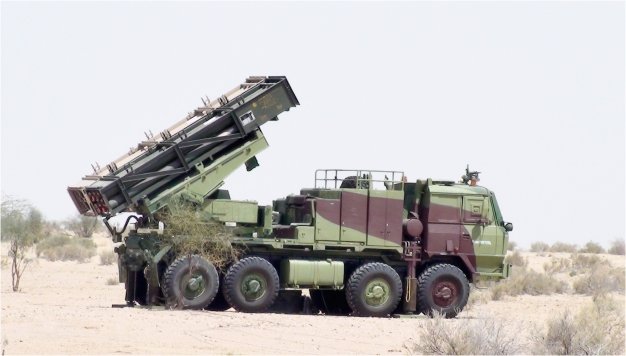
A standard Pinaka regiment comprises three batteries, with six launchers in each battery. A single battery can reportedly fire 72 rockets in around 44 seconds, enabling intense area-saturation fire against enemy positions. The launchers are mounted on high-mobility vehicles, including platforms based on Tatra chassis, allowing units to rapidly deploy, fire and relocate.
The 120-km LRGR is also expected to offer flexibility through different warhead configurations. Reported options include high-explosive pre-fragmented, penetration-cum-blast and thermobaric warheads, among others. Such configurations could allow the system to be adapted for different battlefield requirements.
Indian private-sector companies are playing an increasingly important role in the programme. Tata Advanced Systems has secured contracts related to the overhaul and upgrade of existing Pinaka systems, helping maintain operational readiness and extend the service life of the fleet. Larsen & Toubro Defence is also involved in domestic manufacturing, highlighting the expanding role of private industry in India’s defence production ecosystem.
The Pinaka programme is closely aligned with the government’s Atmanirbhar Bharat initiative, with greater emphasis on indigenous design, manufacturing and supply chains. The growing fleet is expected to strengthen India’s ability to sustain large-scale rocket artillery operations without excessive reliance on imported systems.
The planned induction of the LRGR could mark another significant step in India’s artillery transformation. With contracting targeted for late 2026 and the number of Pinaka regiments continuing to rise, the Army is building a deeper, more mobile and increasingly precision-oriented rocket artillery capability for operations along both its northern and western borders.
(The content of this article is sourced from a news agency and has not been edited by the Mavericknews30 team.)