President praises the rich culture, traditions and social system of tribal communities at Muria Darbar
“I am also a daughter of a Manjhi; I share a deep bond with tribal culture and traditions,” says the President
Preserving cultural heritage and identity alongside education and development is essential
Calls for unity in society to confront challenges such as Naxalism
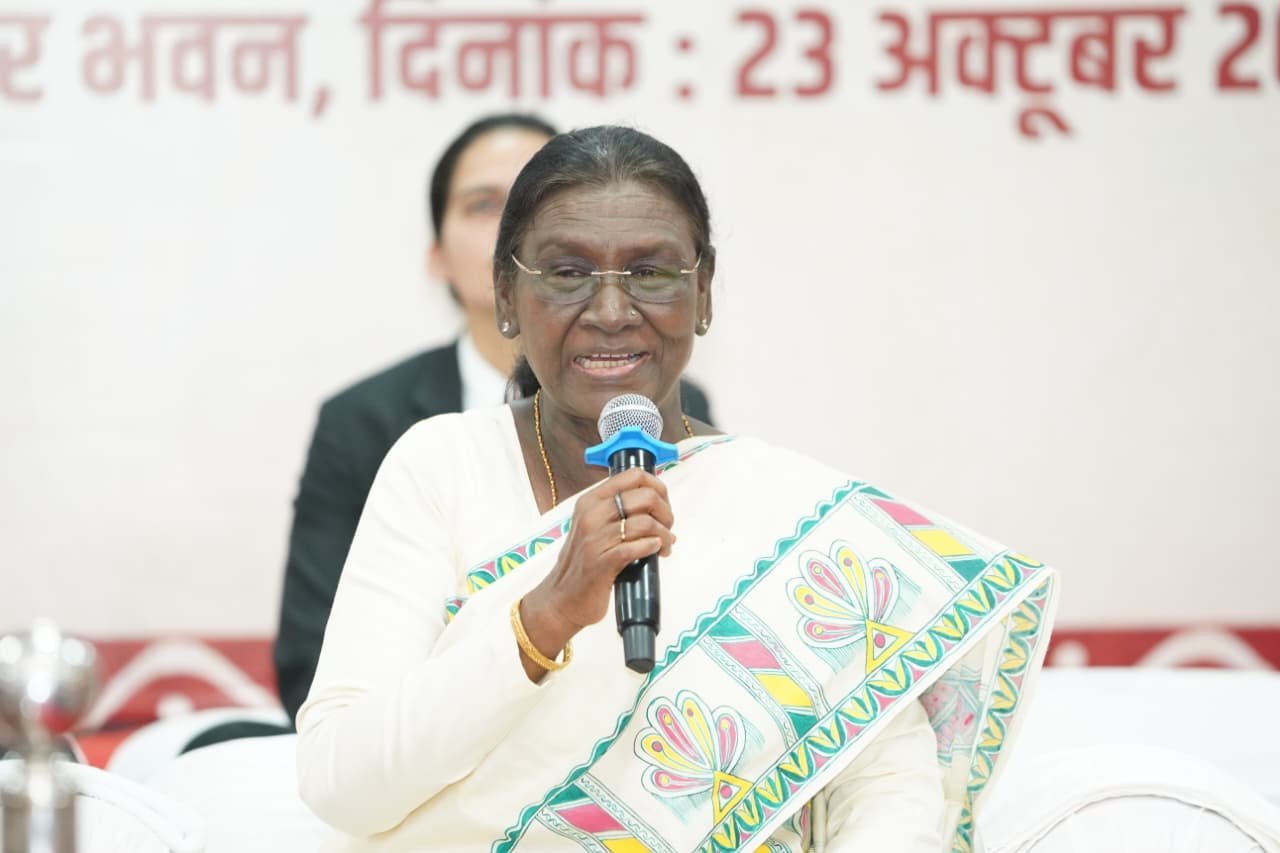
Raipur, October 2026: President Droupadi Murmu praised the rich cultural heritage, traditional social system and collective decision-making practices of tribal communities while addressing the Muria Darbar, organised as part of the historic Bastar Dussehra celebrations. She said the traditional tribal system was an excellent example of social unity, justice, mutual cooperation and good governance.
The President observed that while governance systems, policies and laws change with time, tribal communities have preserved their traditions, social rules and unwritten codes across generations. This traditional system, she said, plays an important role in maintaining peace, harmony, love and a sense of community.
Addressing tribal representatives and traditional leaders at the Muria Darbar, President Murmu thanked them for giving her another opportunity to experience their culture and traditions. Emphasising her personal connection with tribal society, she said, “I, too, come from this tribal culture and tradition. My grandfather was a Manjhi, my father was also a Manjhi, and my brother was a Manjhi as well. I am the daughter of a Manjhi, the daughter of a village head.”
She said that although her family members were no longer present among them, her bond with tribal culture, social institutions and traditions remained as strong as ever.
Traditional Institutions Have Preserved Community Values
The President noted that India had witnessed different systems of governance, from the rule of kings to British colonial rule and, subsequently, democratic governance. While systems of administration and laws had changed, the traditional institutions of tribal communities continued to function through practices passed down from one generation to another, even though these were not necessarily recorded in written documents.
She said tribal communities worship together, organise marriages and other social functions collectively, and celebrate festivals through dance, music and community gatherings. These practices have helped preserve their cultural heritage. She expressed gratitude to tribal communities for keeping these traditions alive.
According to the President, the fundamental objective of culture, traditions, the Constitution and democratic governance is to ensure peace, happiness, harmony and mutual respect in society. In this regard, she said, the traditional social system of tribal communities offered valuable lessons.
Highlighting the traditional justice system, President Murmu said Manjhis and other customary leaders had played an important role in village life. When disputes arose between families over land, property or other matters, people approached the Manjhi, who brought the concerned parties together, heard their views and attempted to resolve the issues through mutual agreement.
She also highlighted the tradition of collective decision-making with the participation of village elders and community leaders. Traditional institutions such as the Peed Pargana and Desh Pargana also played significant roles. When disputes could not be resolved at the village level, they were referred to the Peed Pargana and, where necessary, the Desh Pargana.
Traditional System Reflects Unity and Collective Responsibility
The President recalled that a Peed traditionally comprised around 50 to 52 villages. Community members would hold collective meetings for several days to resolve major disputes. Discussions sometimes continued for seven or eight days, with efforts sustained until a solution was reached.
She said this tradition reflected the unity, collective responsibility and mutual trust that characterised tribal society.
Emphasis on Resolving Disputes Through Dialogue
Comparing customary practices with the modern judicial system, President Murmu observed that people today often approach the police, police stations and courts to resolve disputes. In many cases, legal proceedings can be lengthy and expensive, with some disputes taking 10, 20 or even 30 years to reach a resolution.
She urged communities to resolve disputes, wherever possible and within the framework of the law, through dialogue, mutual understanding and traditional social institutions. She also stressed the need to preserve the historic tradition of the Muria Darbar and pass it on to future generations.
The President noted that under the modern democratic system, the executive, legislature and judiciary have separate responsibilities. In traditional tribal society, however, Manjhis perform several roles relating to community leadership, dispute resolution and collective decision-making.
Spirituality, Nature and Collective Celebrations at the Heart of Tribal Culture
President Murmu said spirituality, community participation and reverence for nature occupied a special place in tribal culture. Villages have long maintained traditions of worshipping their local deities, with community members coming together to pray for prosperity, good health, happiness and collective well-being.
She observed that tribal festivals were not merely religious occasions but also important platforms for strengthening social unity, mutual cooperation and cultural identity. Through collective singing, dancing and celebrations, people share happiness and reinforce community bonds. She described this spirit of togetherness as one of the greatest strengths of tribal culture.
Referring to the history of tribal communities, the President said they had struggled to protect their rights, dignity and existence during the periods of royal and British rule.
Educate Children While Preserving Cultural Heritage
The President urged tribal communities to give special attention to children's education and ensure they receive opportunities to learn, acquire knowledge and progress in life.
She said society must move forward with changing times, adopt positive changes in outlook and embrace new opportunities for development. However, progress should not come at the cost of abandoning one's culture, traditions or social identity.
Emphasising that development and cultural preservation complement each other, she said communities must adopt modern education, new ideas and development opportunities while safeguarding their heritage, customs and social values.
She encouraged tribal communities to remain connected to their roots, respect traditional institutions and familiarise future generations with their cultural heritage. The government, she said, was extending support for the development and welfare of tribal communities and would continue to do so. She called upon them to strengthen themselves through education, social unity and development.
Call to Preserve the Historic Muria Darbar Tradition
President Murmu placed special emphasis on preserving historic and cultural traditions such as the Muria Darbar. She said a community's identity was rooted in its culture, traditions and collective values.
Whether or not these traditions were documented in official records, she said, communities should ensure that their social institutions and cultural heritage remained alive.
The President stressed that the traditional tribal system embodied brotherhood, love, harmony, social justice and good governance. Preserving these values, she said, was a collective responsibility of both present and future generations.
Concluding her address, President Murmu expressed heartfelt gratitude to the tribal people of Bastar for their affection, respect and warm welcome. She said she was delighted to be among them and described their dedication to their culture and traditions as inspiring.
During the event, mementoes were presented to President Droupadi Murmu, Governor Ramen Deka and Chief Minister Vishnu Deo Sai.
Bastar Dussehra Committee Chairman and Member of Parliament Mahesh Kashyap, Vice-Chairman Balram Manjhi, Arjun Manjhi of Farsapal, Shashibhushan Manjhi of Hamirgarh and Gangadhar Manjhi of Kilepal also addressed the gathering and expressed their gratitude to the President for attending the historic Muria Darbar as part of the Bastar Dussehra celebrations.
Among those present were Kamal Chandra Bhanj Deo of the Bastar royal family; Deputy Chief Minister Vijay Sharma; Culture and Tourism Minister Rajesh Agrawal; Forest Minister Kedar Kashyap; Kanker MP Bhojraj Nag; Jagdalpur MLA Kiran Singh Deo; Mayor Sanjay Pandey; Chief Minister's Secretary Rahul Bhagat; Commissioner Doman Singh; Inspector General of Police B.N. Meena; Collector Akash Chhikara; Superintendent of Police Shalabh Sinha; traditional Manjhis and Chhalkis; community representatives, including members and women members of traditional institutions; Naiks, Paiks; members of the Bastar Dussehra Committee; and other distinguished guests.