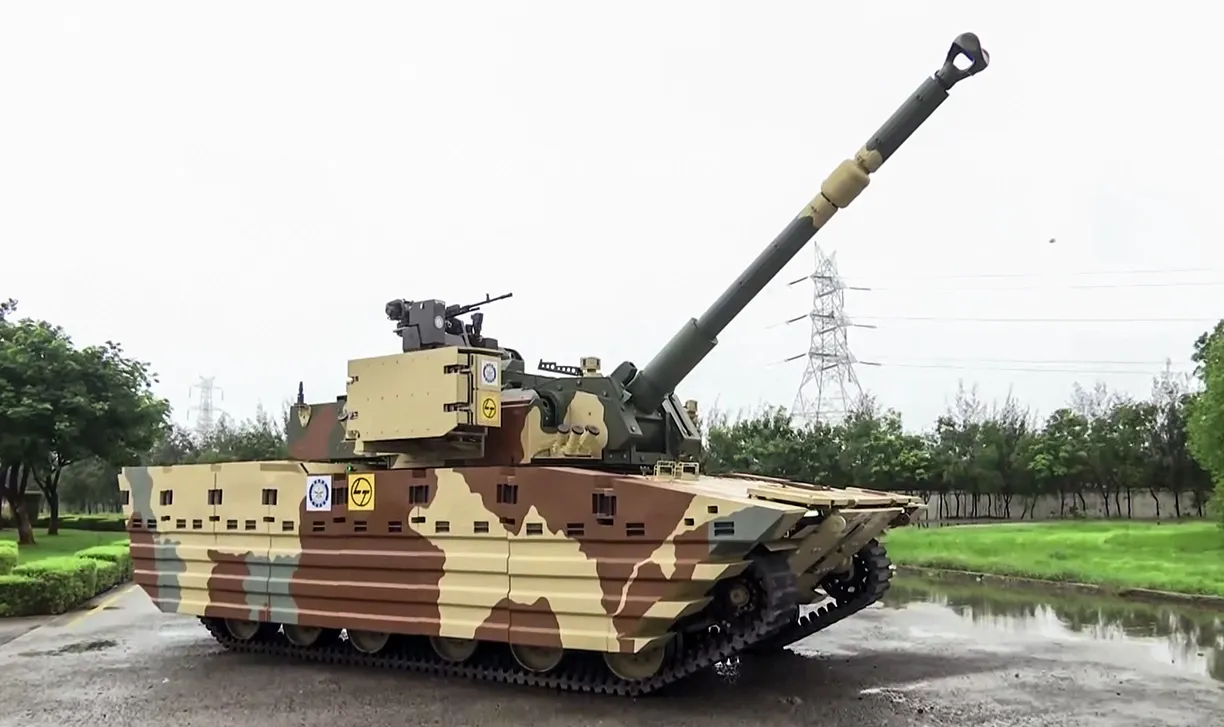
The Indian Army's decision to induct 59 Zorawar light tanks in two configurations has raised questions over whether evolving protection requirements could affect the programme's original focus on mobility, rapid deployment and high-altitude operations. The development also brings back concerns seen in earlier indigenous armoured vehicle programmes, where changing specifications contributed to delays, rising costs and difficulties in achieving economies of scale.
New Delhi, Sept 2026 : The Indian Army's plan to induct 59 Zorawar light tanks in two configurations has drawn attention to the challenge of balancing protection, mobility and weight in a platform designed primarily for high-altitude operations.
According to reports, the first batch of 18 tanks is expected to feature a lower level of protection, while the remaining 41 vehicles are likely to incorporate enhanced protection measures. The later configuration could approach a weight of around 30 tonnes.
The development has prompted questions about whether the Army's protection requirements were fully established before the platform progressed towards production.
The Zorawar was conceived as a highly mobile light tank intended to operate in difficult terrain, particularly at high altitudes. Its design philosophy emphasises rapid deployment, mobility and the ability to operate where heavier main battle tanks face greater logistical and geographical constraints.
Increasing protection inevitably adds weight. Additional weight can affect mobility, transportation, bridge-crossing capability and performance in mountainous terrain. The challenge for the programme, therefore, is to enhance survivability without compromising the operational characteristics that justified the development of a light tank in the first place.
The issue also recalls the experience of India's indigenous Arjun main battle tank programme. Originally conceived as an indigenous main battle tank, Arjun underwent several modifications as additional capabilities and requirements were incorporated during its development. The increase in weight subsequently generated concerns relating to mobility, transportability and infrastructure compatibility.
The Arjun programme also faced difficulties in achieving the large-scale orders initially envisaged. Lower production volumes affected economies of scale and contributed to higher costs per vehicle.
Another example is the Future Infantry Combat Vehicle programme, intended to eventually replace the Army's ageing BMP-2 fleet. The programme has faced difficulties in finalising requirements covering protection, firepower, mobility, networking and other capabilities. Changing expectations have contributed to a prolonged development and procurement process.
Similar challenges have emerged in attempts to identify a suitable mounted artillery gun system. Procurement efforts have been influenced by changing operational priorities, technical requirements and competing platforms, creating uncertainty for both domestic industry and foreign partners.
The broader infantry modernisation effort has also highlighted the difficulty of integrating multiple technologies into a single system. The Future Infantry Soldier as a System initiative envisaged an extensive combination of weapons, communications equipment, sensors, protection systems and battlefield networking capabilities. The breadth of the requirements made implementation complex, with several capabilities eventually being pursued through separate initiatives.
The common issue in such programmes is the difficulty of balancing competing design priorities. Military platforms cannot maximise protection, firepower, mobility, cost-effectiveness and rapid deployment simultaneously.
Greater protection generally requires additional armour and structural reinforcement. Increased weight can demand a more powerful engine and transmission. Changes to major subsystems can then require additional testing and qualification, potentially affecting schedules and production plans.
For an indigenous manufacturer, such changes can have consequences beyond engineering. Components and subsystems available during the development phase may become difficult to source or may cease production if manufacturing orders are delayed for extended periods.
This can create uncertainty for domestic suppliers that need predictable demand to establish production capacity and maintain specialised manufacturing lines.
The Zorawar programme, however, has also demonstrated the ability of India's defence industry to respond rapidly to an urgent operational requirement. The need for a light tank gained renewed importance after the 2020 border crisis in eastern Ladakh exposed the challenges of deploying and sustaining heavy armoured platforms in high-altitude terrain.
The Zorawar programme was subsequently developed at a relatively rapid pace compared with several earlier indigenous armoured vehicle projects. Larsen & Toubro and the Defence Research and Development Organisation have been involved in the development effort, with the tank undergoing testing for operations in demanding environments.
The decision to introduce two protection configurations could be viewed as an attempt to balance immediate operational requirements with enhanced survivability in subsequent vehicles. However, maintaining commonality between the variants will be important if the programme is to avoid unnecessary complexity in logistics, training, maintenance and future upgrades.
The central challenge remains ensuring that the Zorawar retains the characteristics for which it was originally conceived. A light tank that accumulates substantial additional weight may eventually face limitations that undermine some of its intended advantages.
At the same time, survivability remains a fundamental requirement for any modern armoured fighting vehicle. Protection cannot simply be sacrificed for weight reduction, particularly in an environment where anti-tank weapons, drones and other precision systems pose growing threats to armoured formations.
The Zorawar programme therefore highlights a wider procurement dilemma. The Army needs equipment that is sufficiently protected and capable for contemporary combat, while manufacturers require stable and realistic specifications to develop, qualify and produce that equipment efficiently.
For India's indigenous defence industry, predictable requirements and timely procurement decisions can be as important as technological capability. A constantly changing specification can increase development costs, complicate production planning and delay the availability of equipment to operational units.
The Zorawar's progress will consequently be watched not only as a test of India's ability to build a modern light tank, but also as an example of how the country's military procurement system manages evolving battlefield requirements.
The programme's success will ultimately depend on striking a workable balance between protection, mobility, firepower, cost and deployment timelines. For the Army, the objective is to secure a platform capable of meeting the realities of high-altitude warfare. For industry, the challenge is to translate a stable operational requirement into a reliable production programme.
The experience of Zorawar could therefore have implications extending beyond one tank programme. A clearly defined requirement, timely decisions and disciplined management of subsequent modifications could help India avoid some of the procurement difficulties that have affected earlier indigenous armoured vehicle projects.
(Disclaimer :The content of this article is sourced from a news agency and has not been edited by the Mavericknews30 team.)