Is Cuba Capable Of Complicating US Aggression With Its Soviet Era Military?

Havana; May 2026: Cuba’s Revolutionary Armed Forces remain built for territorial defence, relying on Soviet-era ground equipment, layered but aging air defences, limited combat aviation, coastal patrol forces, and mobilisation manpower. Their military value lies less in power projection than in complicating access, absorbing pressure, and raising the cost of any operation near or against the island. The timing matters because US Southern Command commander General Francis Donovan told lawmakers on March 19, 2026, that the US military was not rehearsing an invasion of Cuba, while US senators later introduced a War Powers Resolution after renewed pressure on Havana and the indictment of former Cuban leader Raúl Castro.
Cuba’s defence structure remains organised for homeland defence rather than expeditionary operations. A 2025 profile estimates about 50,000 active armed forces personnel, with mandatory service for men aged 17 to 28, a 24-month obligation in the armed forces or Interior Ministry, and reserve liability for men until age 45. Older open-source military tables give lower regular army figures, around 38,000 active and 39,000 reserve personnel, illustrating the uncertainty that surrounds Cuban force accounting. The important point is functional rather than numerical: the FAR is designed to combine regular units, territorial militias, internal-security forces, dispersed storage sites, and local defence zones. In practical terms, that means Cuba’s military value is concentrated in delaying, absorbing, dispersing, and imposing local costs, not in matching US joint forces in mobility, air power, naval reach, or precision strike.
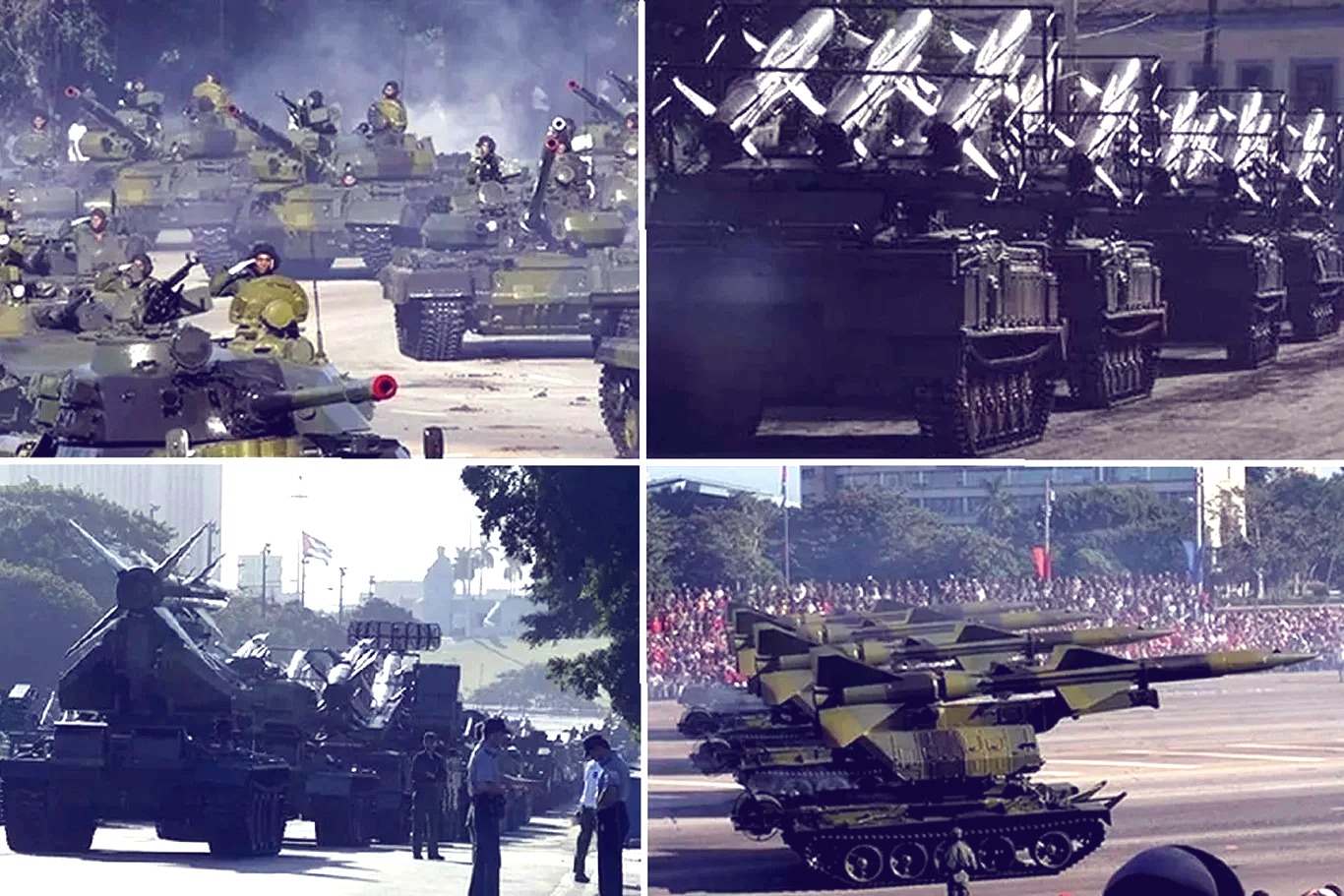
The ground force is still Cuba’s largest military component, but the inventory is old and readiness is the decisive variable. Open-source inventories list about 900 main battle tanks in the army inventory, including 200 T-62 main battle tanks with 115 mm guns and 700 T-55 main battle tanks with 100 mm guns. The same sources list around 50 BMP-1 infantry fighting vehicles, BTR-50P, BTR-60P and BTR-152 armoured personnel carriers, BRDM reconnaissance vehicles, and Cuban conversions such as the BTR-100 and BTR-115. Against US M1A2 SEPv3 Abrams main battle tanks, which pair heavy armour, a 120 mm cannon, digital architecture, advanced optics, and improved protection packages, Cuba’s T-55 and T-62 fleets would be at a major disadvantage in fire control, night fighting, crew protection, ammunition, communications, and sustainment. Their more realistic function would be static defence, road denial, urban fire support, and pre-sited ambushes rather than mobile armoured warfare.
Artillery is more relevant to Cuba’s defensive posture than its tank fleet because it can be dispersed, concealed, and tied to likely landing zones, ports, bridges, airfields, and approach roads. The army inventory includes 40 self-propelled howitzers, split between 20 2S3 152 mm self-propelled howitzers and 20 2S1 122 mm self-propelled howitzers, plus Cuban truck or armoured-vehicle conversions such as Jupiter-series artillery vehicles, BMP-1/D-30 hybrids, and T-55-based systems. It also includes roughly 500 towed artillery pieces, including D-30 122 mm guns and M-46 130 mm guns, about 175 rocket artillery systems such as BM-21 and BM-14 launchers, and more than 700 static antitank guns or defensive artillery positions. Compared with US HIMARS units using three-soldier crews and precision-guided munitions at ranges beyond 180 miles, Cuban fires are less accurate, less mobile, and less integrated with modern intelligence systems; nevertheless, massed unguided fire from prepared sites remains operationally relevant in confined terrain.
Cuba’s air force is the least reliable part of the inventory if judged by sustained combat utility. Historical tables identify MiG-29 Fulcrum, MiG-23 Flogger, and MiG-21 Fishbed fighters, L-39 jet trainers, An-24 and An-26 transports, and Mi-8, Mi-17, Mi-24/Mi-35, and Mi-14 helicopters, but these lists do not establish how many aircraft are currently flyable. The issue is not only aircraft age; it is also pilot flying hours, engine life, radar serviceability, missile stocks, hardened shelters, fuel availability, and ground support. Against US F-35A fighters, which combine stealth, sensor fusion, advanced integrated avionics, and reduced vulnerability in advanced threat environments, Cuban fighters would have limited ability to contest airspace beyond point-defence sorties. Air defence, therefore, carries more weight than combat aviation. Cuba retains S-75, S-125, SA-6, SA-8, SA-9, SA-13, man-portable air defence systems, ZSU-23-4, ZU-23, S-60, and other gun or missile systems, while Cuban S-125 systems have reportedly been upgraded to the Pechora-2BM standard with improved electronics, tracking, and target options.
The Revolutionary Navy is not a force for sea control. Its practical role is coastal surveillance, mine warfare, patrol, port defence, and limited anti-surface action near Cuban waters. Naval inventory tables show the long decline from Cold War Foxtrot submarines and Koni frigates to a smaller inventory centered on Rio Damuji-type converted patrol ships, a Pauk II-class corvette, remnants of Osa missile boat forces, minesweepers, and support craft, with several current entries marked as uncertain. The Rio Damuji conversions are militarised former fishing vessels rather than modern frigates, and their value lies in presence, patrol endurance, and limited weapons carriage, not survivability against US naval aviation or submarines. In comparison, US Arleigh Burke-class destroyers are multi-mission warships equipped for anti-air, anti-submarine, anti-surface, strike, and ballistic missile defence missions through Aegis, phased-array radar, vertical launch cells, and Tomahawk weapons.
The most uncertain new variable is unmanned aircraft. In May 2026, Cuba rejected a report alleging it had acquired more than 300 military drones and had discussed possible attacks on Guantanamo Bay, US vessels, and Key West. The claim has not been independently verified, so drones should be treated as a possible but unproven capability. Even basic unmanned aerial vehicles would matter for reconnaissance, target spotting, harassment, and psychological effect, particularly around Guantanamo Bay and coastal infrastructure, but they would not erase Cuba’s larger weaknesses in air defence networking, electronic warfare, precision strike, and logistics. This is where geography matters. Cuba sits close to Florida, but its own force is spread across an island whose ports, airfields, fuel depots, communications nodes, and air-defence sites would be exposed to surveillance and long-range strike.
The net assessment is that Cuba’s armed forces remain organised, numerous on paper, and dangerous in local defensive conditions, but not technologically comparable to US forces. The FAR’s useful military tools are older tanks used from prepared positions, large volumes of tube and rocket artillery, mobile and static air-defence systems, coastal patrol ships, mines, militia manpower, and knowledge of terrain. Its weaknesses are equally concrete: limited modern aviation, uncertain equipment readiness, old radars, weak long-range maritime capability, fuel constraints, dependence on legacy Soviet calibers, and a small defence-industrial base focused on repair and adaptation rather than new production. Cuba should therefore be assessed not as a peer adversary but as a geographically exposed state with enough residual military capacity to complicate access, create localised risk, and force any opponent to plan for dispersed resistance rather than assume a permissive environment.
Team Maverick




Taiwan Reaffirms South China Sea Claims After Philippines Submits Scarborough Shoal Chart to UN
Taipei, Aug 2026 : Taiwan on Sunday reaffirmed its sovereignty claims over islands in the …
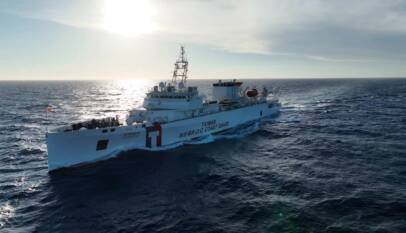
Taiwan Reaffirms South China Sea Claims After Philippines Submits Scarborough Shoal Chart to UN
Taipei, Aug 2026 : Taiwan on Sunday reaffirmed its sovereignty claims over islands in …