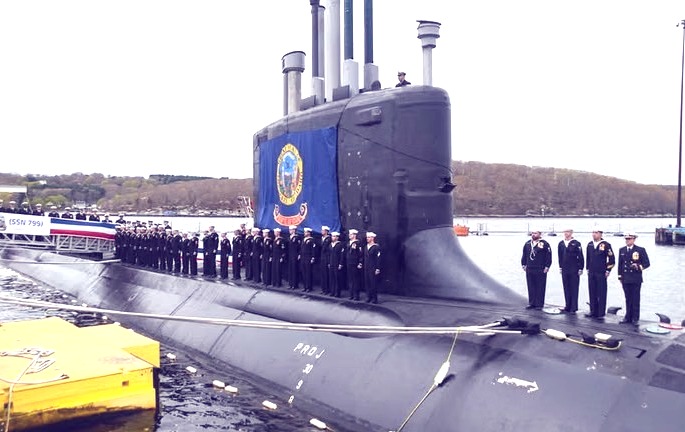
US Navy Flags Concern About Submarine Production; Falling Far Below Expectations.

Washington DC; April 2026: Unlike the Australian Department of Defence, the United States Department of War, publishes real data that allows Congress and the public to assess the Department’s performance in spending the gazillions of taxpayer dollars it is entrusted with.
For example, rather than saying, ‘Trust us, the submarines will arrive on time’, while claiming that any schedule or budget figures can’t be provided owing to security issues, as is the Australian Defence way, the US DoW actually publishes data in its annual budget documentation that gives its latest best estimate on the delivery date of individual submarines under construction. 500 pages of cost, schedule, discussion and justification down to sub component details covering Columbia class ballistic subs to Virginias, aircraft carriers, new battleships and even tender vessels. That’s just in the documentation to support the US Navy’s shipbuilding discussions with Congress.
However, it doesn’t mean it’s predictions will be always correct, but there is sufficient data there to see how its previous predictions have panned out.
Over the past few years Strategic Analysis Australia has been tracking this data, which is collated and reproduced below in Table 1. The data, starting with the FY17 budget and extending to the FY27 budget request, which was just released, gives us a decade’s worth of data points with the September 2021 AUKUS announcement sitting roughly in the middle of that timespan.
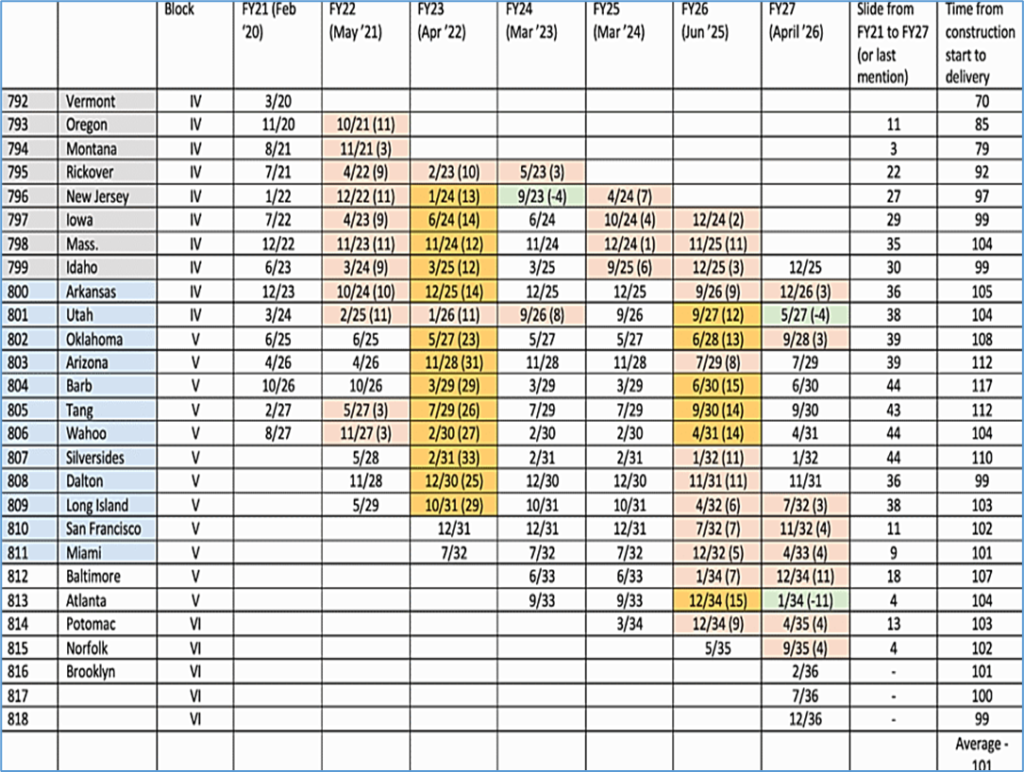
Table notes: US DoW, Navy Shipbuilding and Conversion Justification Books.
- Grey fill – delivered boats;
- Blue fill – boats under construction;
- Green fill – schedule recovery since previous budget;
- Pink fill – schedule slippage under one year since previous budget;
- Orange fill – schedule slippage over one year since previous budget.
The data shows how estimated delivery dates have changed (numbers in parentheses show estimated construction time slippage since the previous budget). This allows us to determine schedule slippage from year to year and consequently the total schedule slippage for each boat (second column from the right).
The DoW also provides a time in months from start of construction to delivery (right-most column). Although for boats yet to be delivered or even to start construction that is only an estimate; one thing that is clear from the data is that delays generally occur once boats have started construction, not before.
This data allows us to consider whether the US government’s investment (supplemented by Australian AUKUS contributions) in the US submarine industrial base is resulting in any gains on the ground, either in shortening submarine build times or reducing schedule delays.
Construction times still growing –
We’ll refer to boats by their SSN number, which is less confusing than using their names and easy to find in the table or even the US Government source document if you wish to really burrow in. The last six Block III boats (to 791) averaged 65 months (slightly less than five and a half years) for construction. That gets us to the start of our table below. From that point, things went downhill very quickly. The first Block IV boats (792-799) averaged around 91 months (seven years, seven months) or over two years longer. And the final three have averaged over 101 months, or well over eight years.
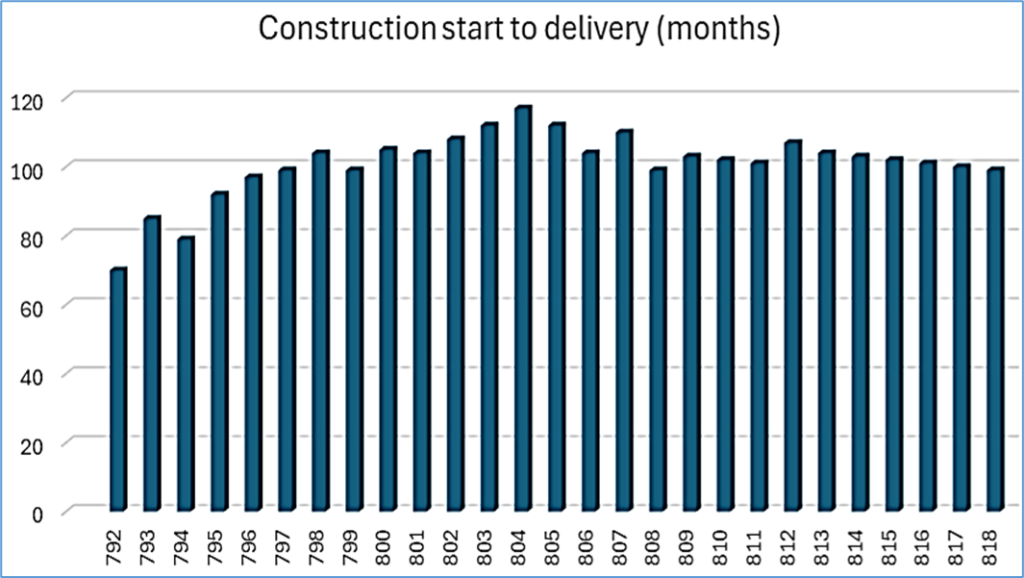
The next 12 boats (800-811) have started construction. Other than the first two, they are Block V boats, which are much larger than Block III and IV boats at around 10,200 tons compared to 7,900 tons. Their average predicted construction time is 106 months (8 years, 10 months), with the longest, 804, peaking at 117 months.
The next seven boats in the budget papers (812-818) have not yet started construction and the last few are not yet even in contract, so we should regard their anticipated schedules with some caution. Their schedules indicate a gradually improving trajectory, but it is still 102 months (eight years and six months).
That is, despite the additional investment in the submarine industrial base, those submarines would still average around three years longer than the Block III boats delivered nearly 20 years earlier.
What caused the blowout in schedule? There are numerous studies into this. Certainly, underinvestment in the US submarine industrial base, i.e., decreased or stagnating production capacity, is one factor. But increased demand is key. The Block V design 30% bigger than Block IV, however the biggest driver is the Colombia-class SSBNs, the very large boats carrying inter-continental ballistic missiles that provide the US’s strategic deterrent.
The first Colombia was laid down in June 2022 with the second following in August 2025. Each Colombia is roughly 21,000 tons, around twice the size of a Block V Virginia and three times the size of a Block IV Virginia. This injected massive pressure into the US submarine construction programs. And as US officials have stated many times, the Colombia is the US Navy’s highest priority. It’s not surprising that the Virginia program’s build schedule has suffered as a result.
The Pentagon is still not on top of schedule –
When we scan across financial years, we can see how schedule estimates have changed over time and assess whether the DoD is getting better at estimating schedule. Considering the increasing build times discussed above, it’s not surprising that we see delays reported in many years. In FY20, 13 of 15 boats had delayed schedules compared to the previous year (the two exceptions had not actually started construction). The subsequent year, FY21, it was 14 of 15. In FY23 15 of 17 boats had delayed schedules, with an average additional delay of 21 months, over a year and a half, with some over two and a half years.
The trials and tribulations of the Virginia program’s schedule are not news. The question is whether it has improved since AUKUS was announced in September 2021. The first post-AUKUS budget was FY23 with its serious additional delays, but since the budget came out only six months after the announcement, it would be unfair to somehow associate a lack of improvement with AUKUS. FY24 and FY25 seemed to indicate things were stabilising, with only a small number of relatively small additional delays in each. But the program may simply have been denying the facts on the ground, because in FY26 there was a return to form with 18 of 19 boats reporting delays—the only exception again being one boat that had not yet started construction.
Nevertheless, the news in the FY27 budget documentation that was just released may indicate some improvement. Eight Virginias show additional delays, but only in the order of three or four months. That looks like progress, but FY24 and FY25 also looked good until the really bad news in FY26.
When we compile the annual slippages, the net result is that 10 of the 12 boats currently under construction have aggregated delays of between 36 and 44 months. Again, the two exceptions are boats that have only just started construction.
So, it’s still taking a long time to build individual boats and even boats planned to be delivered a decade from now are still anticipated to take over eight years to build. The slow build of individual boats may be offset by building more boats simultaneously. Of course, the two factors are related; if you are trying to push more boats through a pipeline that is not expanding – or full with higher priority Columbia class construction — then it will inevitably mean resources are spread across more boats resulting in longer construction time.
Output, past and planned –
Table 2 shows SSN deliveries. Over the past 10 years, 14 boats have been delivered, an average of 1.4 boats per year. Over the 11 years starting now in 2026, 20 boats are planned to be delivered, an average of 1.8 boats per year. And from 2030, an average of 2.1 boats will be delivered, close to the magic number of 2.3 that gives the US Navy its desired two boats per year while compensating for the boats that are to handed over to Australia from 2032. That may be progress, but it’s achingly slow—and there’s still plenty of time for those future boats to suffer delays. Based on precedent, delays only become apparent once construction starts and the boats planned for delivery in the mid-2030s have not yet started construction.
Table 2: SSN deliveries, past and planned, 2016-2026 –
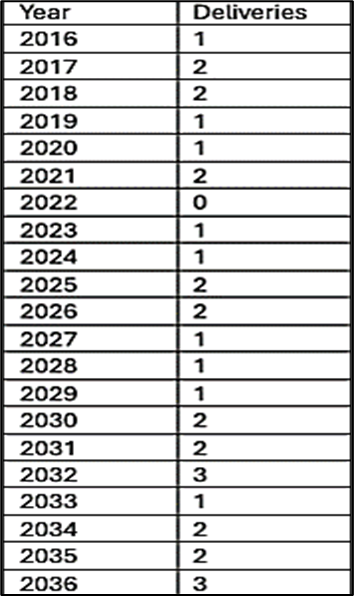
A key point to note is that all the boats that are planned to be delivered up until 2033 were ordered by 2019, that is, before AUKUS even existed; they were part of the US Navy’s pre-AUKUS plan.
Put another way, according the US Navy’s own data, there will not be any more Virginia-class submarines in existence in 2032 than there would have had AUKUS never occurred.
For the AUKUS sceptics, that suggests that any boats provided to Australia will be a net loss to the US Navy and the US president of the day will not be able to certify to Congress that handing boats over won’t reduce USN capability. For the AUKUS supporters, there are ways to get around this; the then president might say that in the longer term it improves overall alliance capability so it’s worth a short term hit. AUKUS is ultimately a political construct.
But regardless of who owns the Virginias, based on the latest data from the US DoD, we will be into the late 2030s before there will be any more Virginias in existence than there would have been had AUKUS never happened. Despite officials’ assurances that all is well and even high level statements about AUKUS being “full steam ahead” (Donald Trump, repeated by many) or King Charles telling the US Congress that AUKUS is ‘the most ambitious submarine programme in history’, the facts as laid out by the US Navy are quite sobering.
Team Maverick.



Telangana’s Abhi Chandra Clinches Two Medals at Special Olympics Nationals
Dehradun, July 2026 : Determination, discipline and an unyielding passion for sport define…

Telangana’s Abhi Chandra Clinches Two Medals at Special Olympics Nationals
Dehradun, July 2026 : Determination, discipline and an unyielding passion for sport defined the …