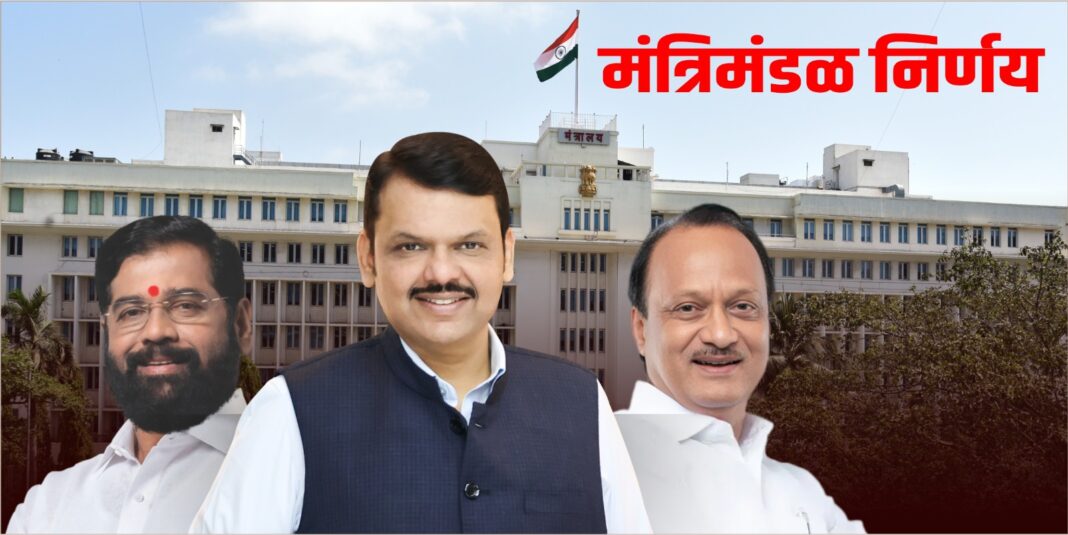
Maharashtra Cabinet Decisions

Effective Implementation of Welfare Schemes for Denotified and Nomadic Tribes
Ease of Access for IDs, Certificates, and Documents
In today’s Cabinet meeting chaired by Chief Minister Devendra Fadnavis, approval was granted for procedures to provide identification cards, government certificates, and access to various schemes for citizens of Denotified and Nomadic Tribes (DNTs and NTs). This will ensure effective implementation of welfare schemes for these communities.
In 1871, the British government declared some tribes as “criminal.” After independence, in 1952, this law was repealed, and they were declared as “Denotified Tribes.” Nomadic Tribes are groups traditionally leading a migratory lifestyle without permanent settlements. Maharashtra has a significant DNT and NT population. Because of their nomadic lifestyle, a simplified mechanism was necessary to ensure delivery of welfare benefits.
Now, processes will be simplified for these communities to obtain necessary ID cards, certificates, and scheme benefits.
Earlier, caste certificates were issued merely on the basis of self-declarations or Gram Sevak (village secretary) attestations, which carried risks of misuse. Henceforth, caste certificates will only be issued after verification by competent local authorities (Tahsildar or Sub-Divisional Officer) and local inquiries.
Special camps will be organized in villages and urban areas to issue IDs, certificates, and to extend benefits of various schemes including Shravan Bal Yojana, Sanjay Gandhi Niradhar Yojana, Ladki Bahin Yojana, Skill Development and Self-Employment Scheme, Scholarships, Farmer IDs under Agristack, Integrated Ayushman Bharat, PM Jan Aarogya Yojana, Mahatma Jyotiba Phule Jan Aarogya Yojana, PM Kisan, and others.
Committees will be set up at state, district, and taluka levels for coordination and monitoring. An award campaign will recognize best-performing villages, talukas, municipalities, municipal corporations, and districts annually.
Approval for Nagpur–Gondia Access Expressway
Travel Time to Reduce from 3 Hours to Just Over 1 Hour
The Cabinet approved the planning and implementation of the Nagpur–Gondia Access Expressway by the Maharashtra State Road Development Corporation (MSRDC), including land acquisition.
Currently, travel between Nagpur and Gondia takes over 3 hours. The new expressway will cut the distance by 15 km and reduce travel time to about 1 hour 15 minutes. The 162.577 km highway will pass through 10 talukas and 115 villages in Nagpur, Bhandara, and Gondia districts, featuring 26 flyovers, 8 animal underpasses, 15 large and 63 small bridges, and 71 canal crossings. Interchanges will be built at 8 locations including Gavsi, Pachgaon, Thana, Rotary, Panzra, Paldongri, Lohari, and Savri.
The project extends the 701 km Nagpur–Mumbai Samruddhi Expressway up to Gondia. Administrative approval was granted for ₹3,162.18 crore for land acquisition. The expressway will connect remote, backward, and tribal areas to Nagpur and Mumbai, boosting development, industry, and job creation.
Maharashtra Occupational Safety, Health & Working Conditions Rules, 2025
The Cabinet approved sending the draft of Maharashtra Occupational Safety, Health and Working Conditions (OSHWC) Rules, 2025 to the central government for concurrence. These rules are part of the state’s Labour Codes reforms, aligned with central labour laws.
The draft covers worker safety, women’s working hours and security, housing facilities, maintenance, education for workers’ children, recreation, and healthcare provisions. This will also improve the state’s “Ease of Doing Business” climate, encouraging investment and job creation.
The Labour Codes consolidate 29 central labour laws into 4 codes: Code on Wages (2019), Code on Industrial Relations (2020), Code on Social Security (2020), and Code on OSHWC (2020). Maharashtra has already approved draft rules for Wages and Industrial Relations; drafts for Social Security are under public consultation.
Approval of ₹402.90 Crore Loan for Rajgad Cooperative Sugar Factory
The Cabinet approved submission of a proposal to the National Cooperative Development Corporation for ₹402.90 crore working capital loan for Rajgad Cooperative Sugar Factory in Bhor taluka, Pune district.
The loan will fund modernization and expansion of the sugar unit, setting up a distillery, co-generation plant, and bio-CBG plant (₹327.25 crore), repayment of bank loans (₹67.23 crore), and repairs/maintenance (₹8.42 crore). The factory must obtain central and pollution control approvals before loan sanction.
Additionally, approval was granted for ₹39.88 crore term loan from the Maharashtra State Cooperative Bank to Kedareshwar Cooperative Sugar Factory, Shevgaon taluka, Ahmednagar district, with government guarantee and conditions for legal compliance.
Sale of Yashwant Sugar Factory Land to Pune APMC
The Cabinet approved the sale of 99.27 acres of Yashwant Cooperative Sugar Factory land in Haveli taluka, Pune, to the Pune Agricultural Produce Market Committee (APMC) for use as a sub-market yard.
The land, taken over by Maharashtra State Cooperative Bank under SARFAESI Act, will be sold at ₹231.25 crore as per Ready Reckoner rates. The land must be used strictly for market yard purposes and cannot be diverted.
Conversion of Three Weirs into Barrages in Beed District
Approval was granted to convert three Kolhapur-type weirs on Sindphana River at Nimgaon, Brahmanath Yelamb, and Takalgaon (Hingni) in Beed district into barrages.
- Nimgaon barrage: 0.76 MCM capacity, irrigating 158 hectares; cost ₹22.08 crore.
- Brahmanath Yelamb barrage: 0.54 MCM capacity, irrigating 102 hectares; cost ₹17.30 crore.
- Takalgaon barrage: 0.72 MCM capacity, irrigating 116 hectares; cost ₹19.66 crore.
The old weirs had deteriorated, causing flood control issues. Conversion will enhance storage and irrigation potential.
Establishment of Senior Civil Judge Court at Ashti, Beed District
The Cabinet approved establishing a Senior Division Civil Judge Court at Ashti, Beed district, as per Bombay High Court’s recommendation. Approval was granted for 25 posts (21 regular and 4 contractual) for the new court.
Amendments to Maharashtra Public Trusts Act, 1950
The Cabinet approved amendments to strengthen the Maharashtra Public Trusts Act, 1950, including stricter penalties for violations, comprehensive definition of “trustee,” and provisions to prevent false claims over trust properties.
Key changes:
- Enhanced punishments under Sections 66A and 66B, up to 1 year imprisonment or ₹2 lakh fine.
- Introduction of time limits for appeals against Charity Commissioner or Assistant Commissioner orders.
- Mandatory inclusion of trust deed copies for firm registration.
- Removal of contradictory provisions in Section 50(B).
Extension of Special Amnesty Scheme for Nazul Lands in Nagpur and Amravati
The Cabinet extended by one year the Special Amnesty Scheme for Nazul lands (leased government lands) given for residential use in Nagpur and Amravati divisions.
The scheme, initially based on a Divisional Commissioner’s committee report, is extended from August 1, 2025 to July 31, 2026. It applies only to Nazul lands leased for residential use. After expiry, provisions of earlier government decisions (Dec 23, 2015 & Mar 2, 2019) will apply.






CM Yogi directs action on 2,200 proposals: Budget to be released by July 15, projects to be launched on the ground from August 15
CM takes a tough stand during PWD review, warns of action over delays in pending projects …
CM Yogi directs action on 2,200 proposals: Budget to be released by July 15, projects to be launched on the ground from August 15
CM takes a tough stand during PWD review, warns of action over delays in …