A dearth of manpower in Ukraine is impeding its retaliation against Russia.

As Russian troops close in on the strategically crucial city of Pokrovsk in eastern Ukraine, the country’s growing manpower shortages are becoming more and more apparent. Ukrainian President Volodymyr Zelenskyy stated this week that Ukrainian troops on the Pokrovsk front are currently outnumbered eight to one by the Russian army, highlighting the scale of the problem.
After three and a half years of heroic and exceptionally bloody resistance, the fear is that Ukraine may now be approaching the point when the country no longer has enough fighters to effectively defend the front lines of Europe’s largest war since World War II.
Ukraine’s mobilisation challenges are no secret and have been steadily mounting for much of the war. During the initial days of the full-scale invasion in early 2022, an unprecedented flood of volunteers made it possible to dramatically expand the size of the Ukrainian armed forces to around one million troops. However, as the conflict has dragged on into a fourth year amid unprecedented casualties and escalating problems with desertion, this initial flow has slowed to a relative trickle.
Individual units have responded by launching their own slick advertising campaigns to attract fresh recruits, while military mobilisation officials have become notorious for dragging eligible men off the streets straight to military bases. The mobilisation issue has been exaggerated by President Zelenskyy’s reluctance to lower the age for compulsory military service from twenty-five to eighteen.
This has led to criticism from Ukraine’s Western partners, who have argued that it is unrealistic to wage a major war while exempting so many young Ukrainians from mobilisation. Rather than take the politically dangerous decision to reduce the conscription age, Zelenskyy has backed an incentive scheme to attract volunteers in the eighteen to twenty-five age bracket. However, the initiative has so far failed to fill the gaps in Ukraine’s decimated front line units.
The recent decision to lift international travel restrictions on young Ukrainian men aged eighteen to twenty-two has further complicated Ukraine’s manpower problems. Around 100,000 Ukrainian males have left the country since restrictions were eased around two months ago, as per media sources.
This exodus deprives the country of potential future army recruits and has created a range of more immediate personnel issues that are already reverberating throughout the Ukrainian economy. While some of these men may plan on returning to Ukraine, experience since 2022 suggests that many will seek to settle elsewhere in the European Union.
On the other side of the border, Russia is also facing difficulties in replenishing its invasion force amid catastrophic losses in Ukraine that has multiplied the death toll from every other Kremlin war since 1945. Putin initially sought to address this problem by launching a partial mobilisation in September 2022, but the move proved hugely unpopular and led to around one million young Russians fleeing the country. Instead, the Kremlin has introduced a system a lavish financial incentives including huge enlistment bounties and generous monthly salaries in order to attract volunteers willing to join the invasion of Ukraine. While it has proved necessary to repeatedly increase the sums on offer, this approach has made it possible to secure around thirty thousand new recruits per month.
Based on the current trajectory of the war, Russia’s manpower advantage over Ukraine will only grow wider over time. This is already making itself felt along the approximately one thousand kilometers of the front, with Russian forces exploiting gaps in Ukraine’s defenses and edging forward at multiple points. While Putin’s troops have so far been unable to achieve any major breakthroughs, Russia’s territorial gains are slowly but surely adding up.
The most intensive fighting is currently taking place in the Donetsk region, where Russia seeks to complete the capture of Pokrovsk. If Putin’s commanders succeed in taking the city, it will be seen by many as vindication of the Kremlin strategy to grind out victory by relying on the sheer size of the Russian army. Putin has long believed that he can win the war by outlasting the overwhelming Ukraine. He will see Ukraine’s increasingly chronic shortage of soldiers as the strongest indication yet that time is on his side.
For Zelenskyy, there are no easy options. Lowering the mobilisation age would generate a new wave of recruits but could also pose a significant threat to Ukrainian national morale. Reforming the terms of military service to provide greater rotation guarantees while also adopting a more meritocratic strategy to appoint army commanders those who may help restore flagging public confidence and attract more volunteers, but this would take time that Ukraine quite frankly no longer possesses.
For now, the battle-hardened but exhausted and outnumbered Ukrainian army has little choice but to remain in a defensive posture. Ukraine’s commanders must be prepared to cede ground in necessity in order to preserve precious fighting strength, while looking for opportunities to maximise enemy casualties. The goal should be to withstand the Russian onslaught until a combination of punishing front line losses, escalating long-range strikes, and deepening economic woes finally forces Putin to the negotiating table.
Team Maverick

Govt. to formulate policy to provide relief in encroachment cases involving poor and landless families: CM
Chief Minister Thakur Sukhvinder Singh Sukhu today laid the foundation stone of the new Mu…
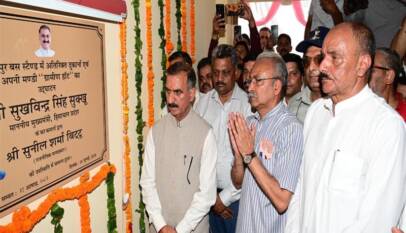
Govt. to formulate policy to provide relief in encroachment cases involving poor and landless families: CM
Chief Minister Thakur Sukhvinder Singh Sukhu today laid the foundation stone of the new …