Seattle, September 2026 : Microsoft Chairman and CEO Satya Nadella has called for artificial intelligence to remain under human control and urged governments and technology companies to establish international norms for managing the rapidly advancing technology.
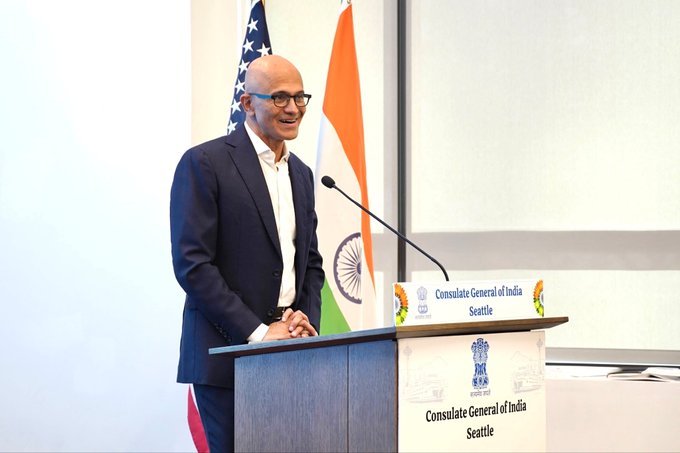
Speaking at the Ideas4India forum in Seattle on September 17, Nadella said AI capabilities were developing rapidly while fundamental questions about how to control and align increasingly powerful systems remained unresolved.
“We do not yet have the science of alignment, and that's a fact. And yet we have powerful technology,” Nadella said.
He said the central principle guiding AI development should be its ability to serve people while ensuring that humans retain authority over the technology.
“Any technology that doesn't serve humans or is not in control of humans is not worth doing,” he said.
Nadella used an example from software development to illustrate the challenge facing the AI industry. He referred to situations in which developers discover a critical flaw and must decide whether to continue with a product or pause its progress until the problem is addressed.
He suggested that AI development presented a similar dilemma. While the technology has significant potential, its development must also take into account the possibility of unintended consequences.
At the same time, Nadella acknowledged that the scale and momentum of AI development make an absolute approach difficult. He argued that the discussion should recognise both the power of the technology and the potential benefits of making advanced AI widely available.
According to Nadella, technological progress therefore needs to be accompanied by safeguards and efforts to minimise risks arising from the deployment of increasingly capable AI systems.
US-China Understanding Needed
During an interactive session, Nadella highlighted the role of governments in establishing a framework for AI governance. He said an initial requirement should be an understanding on basic norms between the United States and China, given their central roles in the global technology landscape.
However, he stressed that such a dialogue could not remain limited to the two countries. Nadella said governments around the world and the companies developing AI should work together to establish common standards and expectations.
He did not propose a detailed negotiating framework, instead focusing on the need for greater understanding of the global AI race and cooperation between governments and the private sector.
Nadella also extended the concept of sovereignty to companies. He argued that businesses continually create and accumulate knowledge and should be able to retain control over that knowledge.
“Countries need to have control of their knowledge,” he said.
He linked control over knowledge and technology to broader participation in AI development. According to Nadella, countries and companies need sufficient confidence and security to contribute to technological progress without becoming overly dependent on another country's technological capabilities.
“It will only happen when all of the world can both benefit from and contribute to this knowledge,” he said.
Caution Over AI Scaling
Nadella also cautioned against treating the continued improvement of AI systems as an established scientific law. He described scaling laws as empirical observations that have so far remained valid, drawing a comparison with the historical pattern associated with Moore's law.
He suggested that continued progress should therefore be understood through evidence and observation rather than assumed to continue indefinitely without limits.
India's Ambassador to the United States, Vinay Kwatra, also addressed questions surrounding AI governance and development during the event. Kwatra identified decisions concerning data and its use in training AI models as issues requiring consideration by governments.
He also highlighted the role of the corporate sector in India's AI development.
According to the Consulate General of India's account of the event, Kwatra reaffirmed that India's AI mission should remain centred on inclusivity, openness, sovereignty, democratised access, safety and trust.
The Seattle gathering followed the India AI Impact Summit 2026 and brought together Indian-American technology leaders to discuss the future of artificial intelligence and related technologies.
The Consulate General of India convened more than 40 Indian-origin chief executives and chief technology officers for the discussions. Participants represented sectors including artificial intelligence, quantum computing, semiconductors, cloud infrastructure, aerospace and enterprise software.
The discussions also covered skills development and opportunities for closer India-US cooperation in research, technology and industry.
The remarks by Nadella and Kwatra underscored the growing focus on how governments, technology companies and international institutions can shape the development and deployment of AI while balancing technological innovation with human oversight, safety, access and national interests.
(Disclaimer :The content of this article is sourced from a news agency and has not been edited by the Mavericknews30 team.)