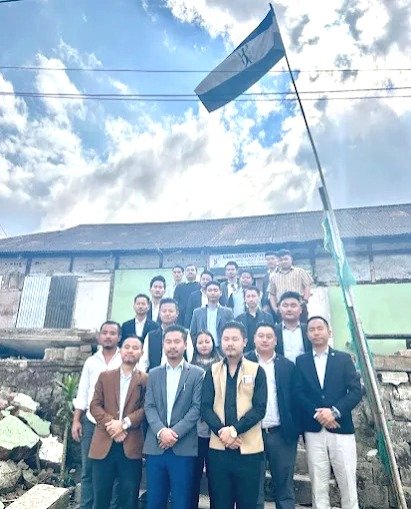
Dimapur; November 2026: The All Nagaland College Students' Union (ANCSU) has urged eligible private and theological colleges in Nagaland to abstain from receiving the existing Grant-in-Aid (GIA) until the government enhances the provision, renewing its demand for a larger share of the annual allocation to reach institutions.
In a reminder to the minister of Higher Education and Tourism, the union stated that only 45% of the annual GIA allocation of INR 2.65 crore reaches eligible colleges, while more than 54% is retained by the department for its activities and other purposes. The ANCSU has maintained that the existing distribution undermined the objective of the grant, which is to strengthen infrastructure and student welfare in institutions operating under severe financial constraints.
Seeking immediate intervention, the ANCSU called for enhancement of the grant to eligible private and theological colleges and warned that it would not remain a “mere spectator” to the continued neglect of colleges and the student community. It has appealed to eligible colleges to collectively uphold the demand and refrain from accepting the existing grant until the provision was suitably enhanced.
Earlier, on the 18th of August this year (2026) - ANCSU has expressed serious concern over the manner in which the Grant-in-Aid (GIA) under the Higher Education department is being allocated, retained and disbursed to eligible private and theological colleges and other organisations engaged in student welfare activities. According to the union, an annual provision of INR 2.65 crore is received from the state government under the GIA scheme. However, the actual disbursement to eligible colleges and institutions has remained substantially below the total provision, ANCSU stated in a press release.
The union stated that during the financial year 2025–26, only INR 1.21 crore was disbursed to colleges and other eligible institutions on a category-wise basis, accounting for approximately 46% of the total provision. The remaining amount, it said, was retained by the department for its activities and other purposes.
While acknowledging and appreciating the government’s continued financial support to private and theological colleges and other eligible organisations, the union said the pattern of disbursement was a matter of concern. “The fundamental purpose of Grant-in-Aid is to provide financial assistance to eligible institutions and organisations to strengthen higher education, institutional development and student welfare”, ANCSU had then stated.
Furthermore, it has stated that when a substantial portion of the sanctioned provision is retained while less than half reaches the intended institutions, the objective of the financial assistance is considerably undermined, while additionally pointed out that GIA remains the only source of financial assistance for many private and theological colleges to undertake institutional development. It said these institutions have played an important role in expanding access to higher education across Nagaland, particularly in areas where government institutions remain limited.
“Private and theological colleges contribute significantly to human resource development and continue to serve thousands of students despite considerable financial and infrastructural constraints”, the union had said.
ANCSU appealed to the Higher Education department to undertake a comprehensive review of the GIA mechanism and enhance the grant at the earliest, particularly with regard to allocation, retention and disbursement to private and theological colleges. The union also urged the department to ensure that the available GIA provision is utilised transparently and judiciously, primarily in accordance with its intended purpose.
“Grant-in-Aid must ultimately translate into tangible benefits for education and students. The funds provided for this purpose should not merely remain as a departmental provision or be utilised in a manner that defeats the sole objective of the GIA”, ANCSU said. It stated that financial assistance should reach the institutions and organisations for which it is intended and enable them to improve classrooms, laboratories, libraries, digital facilities, learning resources, student-support systems and other welfare activities.
The union had maintained that strengthening the financial foundation of private and theological colleges and other eligible organisations is not merely an institutional requirement but an investment in the future of higher education and the student community in Nagaland. ANCSU expressed hope that the government would respond positively to its concerns and take necessary corrective measures in the larger interest of students and the advancement of higher education in the state.
Team Maverick.