
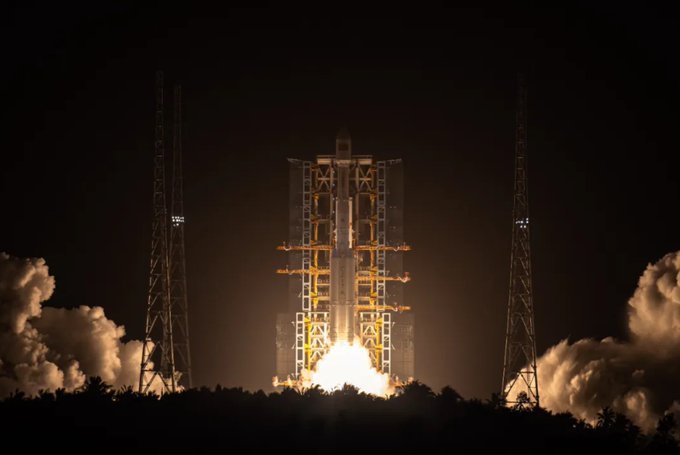
New Delhi, Aug 2026 : A Chinese Long March 7A rocket exploded into a massive fireball shortly after launch, destroying the communications satellite it was carrying, according to a report that said an investigation is now underway to determine the cause of the failure.
The incident occurred on Monday night at the Wenchang Space Launch Site on Hainan Island and represents a rare setback for a rocket regarded as one of the workhorses of China’s space programme. Video footage of the launch showed the rocket breaking apart approximately 85 seconds after liftoff.
According to a report by CNN, the Long March 7A appeared to suffer a major failure during its ascent before erupting into a large fireball. The incident resulted in the loss of the Zhongxing-4B, also known as ChinaSat-4B, which was intended to be placed into orbit.
The satellite was designed to provide radio, television and other communications services to users around the world, according to Chinese state media.
China’s state news agency Xinhua confirmed the launch failure around three hours after the explosion, stating that the rocket had “experienced an anomaly during flight”. However, the incident reportedly received limited attention in China’s state-controlled media compared with successful space launches.
The explosion also triggered discussion on Chinese social media platforms, including Xiaohongshu and Douyin. According to the report, much of the available launch footage appeared to originate from state-affiliated sources, while videos posted by private users were reportedly removed or became difficult to find through searches.
The failure comes at a time when China is rapidly expanding its space programme and pursuing ambitious long-term goals under President Xi Jinping. Beijing has set its sights on becoming a global leader in space science by 2050, with major programmes focused on lunar exploration, satellite technology and advanced launch systems.
China is also engaged in an increasingly intense space competition with the United States. The rivalry extends across several areas, including reusable rocket technology, lunar exploration and satellite launches, as both countries seek to strengthen their capabilities in space.
The Long March 7A was developed by the China Academy of Launch Vehicle Technology, a subsidiary of the state-owned China Aerospace Science and Technology Corporation (CASC). The rocket had been considered a reliable component of China’s launch fleet.
Monday’s mission was the 18th flight of the Long March 7A. Prior to the latest incident, the rocket had experienced only one previous failure, during its maiden launch in 2020.
The latest failure is therefore expected to draw close attention from Chinese space authorities as they investigate the cause and assess whether any technical modifications are required before future missions.
The incident also highlights the inherent risks associated with China’s increasingly ambitious launch schedule. With Beijing planning more frequent satellite deployments and preparing for increasingly complex missions, maintaining reliability across its launch vehicles will remain critical.
For now, the loss of the Zhongxing-4B satellite represents a setback for both the commercial communications mission and the Long March 7A programme. The findings of the ongoing investigation are expected to determine the nature of the technical problem and the steps required to prevent a recurrence.