Chief Minister Dr. Mohan Yadav has said that Prime Minister Shri Narendra Modi has consistently promoted India's knowledge tradition, preservation of ancient heritage, scientific research and innovation. In Madhya Pradesh too, significant initiatives have been undertaken to give a new direction to the scientific study of ancient civilisations and archaeological heritage. With the establishment of the Dr. Vishnu Shridhar Wakankar Luminescence Dating Laboratory in the state capital, it will now be possible to scientifically examine and determine the age of archaeological materials dating back up to 10 lakh years.
Chief Minister Dr. Yadav said that a Deep Tech Research and Innovation Park would be developed on approximately 100 acres of land in Ujjain. This would open up new opportunities in science, research, innovation and emerging technologies. Ujjain is not merely a religious city but has also been an important centre of science, industry, art, culture and civilisation. Since ancient times, the city has held a distinguished place in the fields of timekeeping and astronomy. By connecting the state's scientific heritage with modern science and technology, Ujjain is being developed as a Science City.
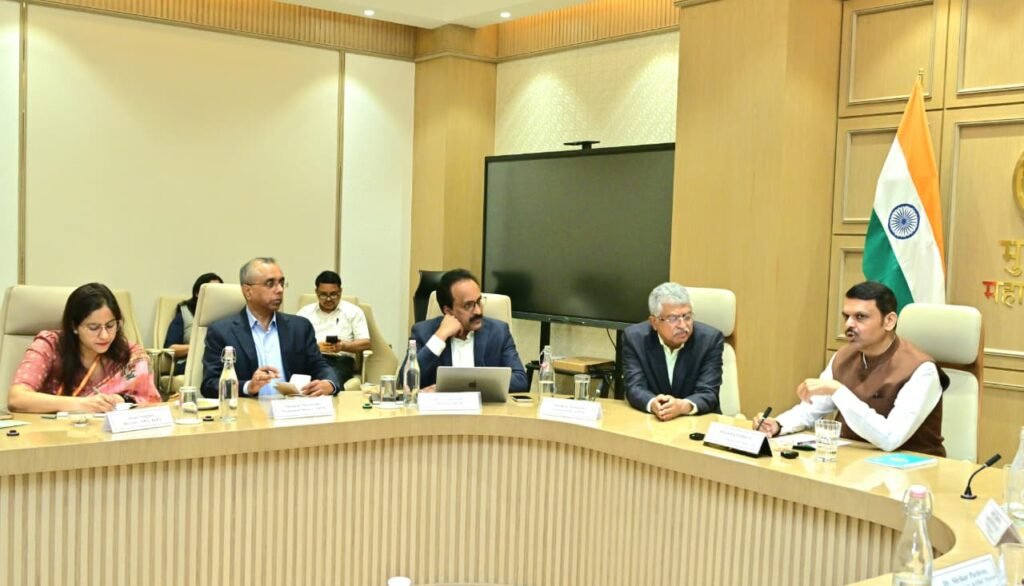
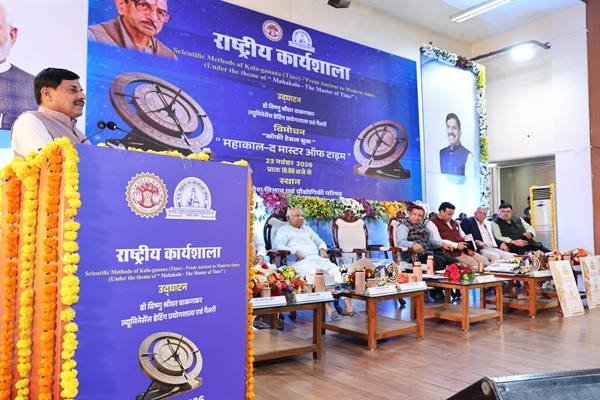
Chief Minister Dr. Yadav was addressing a national workshop on the theme ‘Mahakal: The Master of Time’, organised under the broader theme ‘Scientific Methods of Chronology from Ancient to Modern Times’, at the Science Bhawan of the Madhya Pradesh Council of Science and Technology (MAPCAST) in Bhopal on Monday.
Chief Minister Dr. Yadav inaugurated the state's first Dr. Vishnu Shridhar Wakankar Luminescence Dating Laboratory and the Dr. Vishnu Shridhar Wakankar Gallery, established at MAPCAST. An MoU was exchanged between MAPCAST and Dhanush Quantum Technology Limited to promote skill development and innovation. Chief Minister Dr. Yadav also released a coffee table publication based on the international conference on ‘Mahakal: The Master of Time’ and a poster for the Research Scholars' Conclave organised by the Dattopant Thengadi National Institute of Research. A film highlighting the Dr. Vishnu Shridhar Wakankar Luminescence Dating Laboratory and Gallery was also screened on the occasion.
Padma Shri Dr. Wakankar Gave New Direction to Study of Indian Archaeology and Civilisations
Chief Minister Dr. Yadav said that Padma Shri Dr. Vishnu Shridhar Wakankar was a renowned archaeologist, painter and historian. Despite limited resources and challenging circumstances, he made significant contributions to advancing the study of Indian archaeology and ancient civilisations. His research and contributions brought India's ancient civilisation global recognition.
Chief Minister Dr. Yadav paid tribute to Dr. Wakankar and recalled his meetings with the eminent archaeologist during his student days, as well as their discussions on various subjects. He said that Dr. Wakankar had a broad perspective on social and political issues, in addition to his contributions to archaeology and scientific discoveries.
The State Government has also honoured his legacy by naming the Ratapani Sanctuary, located near Bhopal, as the Dr. Vishnu Shridhar Wakankar National Park.
Efforts Underway to Develop Bhopal as a Knowledge City
Chief Minister Dr. Mohan Yadav said that Ujjain has been a major centre of timekeeping and astronomy since ancient times. The legacy of Vikramaditya, the Indian system of time calculation and ancient knowledge are being integrated with modern science to take them forward. The Vikramaditya Research Chair is also being developed as an academic and research institution.
The Deep Tech Research and Innovation Park will encourage research and innovation in emerging technologies. Greater opportunities for development will emerge as research and scientific pursuits expand. The State Government is committed to promoting scientific research, innovation and India's knowledge tradition.
Chief Minister Dr. Yadav said that the State Government has also formulated a Space Tech Policy to encourage research and innovation in space science. Ujjain is evolving not only as a religious and industrial city but also as a Science City, while efforts are underway to develop Bhopal as a Knowledge City.
Ancient Knowledge Tradition to Be Advanced with a Modern Scientific Perspective
Chief Minister Dr. Yadav said that a Vedic Clock has been developed through the Vikramaditya Research Chair. The Vikramaditya Mahanaatya has also been staged across the country. Steps are now being taken to develop the Vikramaditya Research Chair into the Vikramaditya Academy. These initiatives will help advance the state's ancient knowledge tradition with a modern scientific perspective.
Ujjain to Emerge as a New Centre of Science and Technology
Additional Chief Secretary, Industries, Shri Neeraj Mandloi informed that the Deep Tech Research and Innovation Park would be developed on approximately 100 acres of land in Ujjain at a cost of Rs. 237 crore. IIT Indore will play an important role as its technical and research partner.
The park will have integrated facilities for research, technological development, patents, startUps, incubation and technology commercialisation. It will provide young people with opportunities to progress from research to start-ups and entrepreneurship and take their innovations to the market.
Research and development activities at the park will focus on four major domains: astronomy and space studies; Indian Knowledge Systems; agricultural technology and climate research; and emerging technologies, including Artificial Intelligence, Machine Learning, Quantum Computing and Blockchain.
Under the Indian Knowledge Systems domain, research will be encouraged through the study and digitisation of manuscripts, time calculation, traditional timekeeping systems and the application of modern technology. Efforts will also be made to present ancient knowledge in new formats through technologies such as Artificial Intelligence and Virtual Reality.
Ujjain's scientific and historical significance is associated with the Surya Siddhanta, the Tropic of Cancer, the observatories established by Maharaja Sawai Jai Singh and the legacy of Vikramaditya. By connecting this heritage with modern research and innovation, Ujjain will be developed as a new centre of science and technology.
In the Indian Tradition of Time Calculation, Time Is Linked Not Merely to Measurement but Also to Life, Nature and Civilisation: Shri Suresh Soni
Thinker and social worker Shri Suresh Soni, while recalling Dr. Vishnu Shridhar Wakankar, said that he was a born archaeologist. He observed that in the Indian tradition of time calculation, time has never been merely a unit of measurement but has been intrinsically connected with life, nature and civilisation.
Ancient Indian scholars developed concepts of time ranging from the smallest to the largest units. There is a need to carry this tradition forward through modern scientific research and evidence.
Describing the inauguration of the Dr. Vishnu Shridhar Wakankar Luminescence Dating Laboratory as an important initiative, Shri Soni said that the Deep Tech Research and Innovation Park would serve as a significant bridge between ancient and modern knowledge traditions. The proposed development of specialised domains named after eminent figures such as Varahamihira, Sandipani, Balarama and Aryabhata would be an important step towards integrating India's knowledge tradition with scientific research.
Ujjain Should Be Re-established as the World's Centre of Timekeeping Through Eevidence, Experiments and Research
Shri Soni said that the Indian calendar system, with its provisions for Shukla and Krishna Paksha, months, seasons and Adhik Maas, establishes harmony between time and nature. To re-establish Ujjain as the world's centre of timekeeping, efforts should be based on scientific reasoning, evidence, experiments and research. He said that the cycle of time continues infinitely, during which different civilisations emerge and disappear over successive ages. Indian religious scriptures contain detailed explanations of time calculation, a concept acknowledged by several scientists across the world. He observed that a distinctive feature of Indian timekeeping is its ability to identify and understand events occurring across different periods. In the Indian tradition, time calculation is not merely a mechanical process; even the pulsation of the human body has been associated with the concept of time. In contemporary times, our connection with the passage of time is gradually diminishing, and there is a need to revive it.
MAPCAST Has Awarded 250 Young Scientist Fellowships: Dr. Kothari
Director General of MAPCAST Dr. Anil Kothari said that the Council is consistently working to connect science and technology with societal needs while promoting research, innovation, traditional knowledge, environmental conservation and socio-economic development. He said that making Ujjain a focal point of timekeeping is one of the Council's key objectives. He informed that Madhya Pradesh ranks first in the country in the use of remote sensing technology under the PM Fasal Bima Yojana.
Over the past year, MAPCAST has supported more than 128 research projects, organised over 84 seminars, conferences and lectures, provided 12 international travel grants and awarded 250 young scientist fellowships. In addition, more than 566 science outreach programmes have been conducted.
CM Dr. Yadav's Interest in Science Will Help Promote Scientific Temper in the State
National Organising Secretary of Vigyan Bharati Shri Shivkumar Sharma said that Chief Minister Dr. Yadav's keen interest in science and his engagement in discussions on scientific subjects would help promote scientific temper in the state. He highlighted the significance of the Dongla and Mahakal centres, as well as the calculation of latitude and longitude. Shri Sharma said that ancient and modern science complement each other. The findings of this workshop would provide direction to future research and initiatives.
Scientific Study of the Ramayana and Mahabharata Is Essential
CSIR Bhatnagar Fellow and former Vice-Chancellor of Deccan College, Pune, Shri Vasant Shinde said that the establishment of the Luminescence Dating Laboratory was an important initiative for advancing scientific research in Madhya Pradesh.
Shri Shinde emphasised the need for scientific studies of historical and cultural subjects such as the Ramayana and Mahabharata. He said that dating results should be studied in conjunction with archaeological and cultural evidence. The continued operation and development of laboratories would provide long-term benefits to research activities.
MoU to Promote Research, Innovation and Technological Collaboration in Quantum Computing
In the presence of Chief Minister Dr. Yadav, an MoU was exchanged between the Madhya Pradesh Council of Science and Technology (MAPCAST) and Dhanush Quantum Technologies Private Limited to promote deep-tech research, innovation and advanced technologies in the field of quantum computing.
The initiative is an important step towards strengthening research and development in quantum computing in the state and encouraging research, development, innovation and commercial applications of emerging advanced technologies through the proposed Deep Tech Research and Innovation Park.
The collaboration will facilitate research and development in quantum technologies, exchange of technical expertise, capacity building, skill development, promotion of start-ups and innovation, and cooperation between academic and industrial institutions.
This partnership will help establish a robust ecosystem for emerging deep-tech technologies in the state and position Madhya Pradesh as an important centre for research and innovation in future-oriented advanced technologies.
Dr. Wakankar Luminescence Dating Laboratory Equipped with Modern Instruments and Scientific Technologies
A film screened during the inauguration highlighted that the Dr. Vishnu Shridhar Wakankar Luminescence Dating Laboratory at MAPCAST is equipped with modern instruments and advanced scientific technologies. The laboratory will facilitate the scientific dating of materials up to one million years old.
Luminescence dating technology will help determine the age of archaeological sites and remains, establish the period of geological layer formation, and reconstruct ancient climates and the chronology of civilisations.
The technique scientifically estimates the period for which quartz and other minerals have remained buried after being exposed to light or heat. It can be used to study various samples, including sediments, feldspar, gypsum, carbonates, pottery and fire-affected stones.
The laboratory will undertake sample collection and research in collaboration with the Archaeological Survey of India, the State Archaeology Department and other scientific institutions. This will provide a new scientific direction to research in archaeology, geoarchaeology, earth sciences and the study of ancient civilisations.
The workshop will bring together eminent scientists, archaeologists and experts from across the country to deliberate on the integration of India's traditional system of time calculation, ancient astronomical knowledge and modern scientific technologies.
Adviser to the Government of India Dr. Ganti S. Murthy, Cultural Adviser and Director of Veer Bharat Nyas Shri Shriram Tiwari, along with a large number of faculty members, research scholars and students, were present on the occasion.