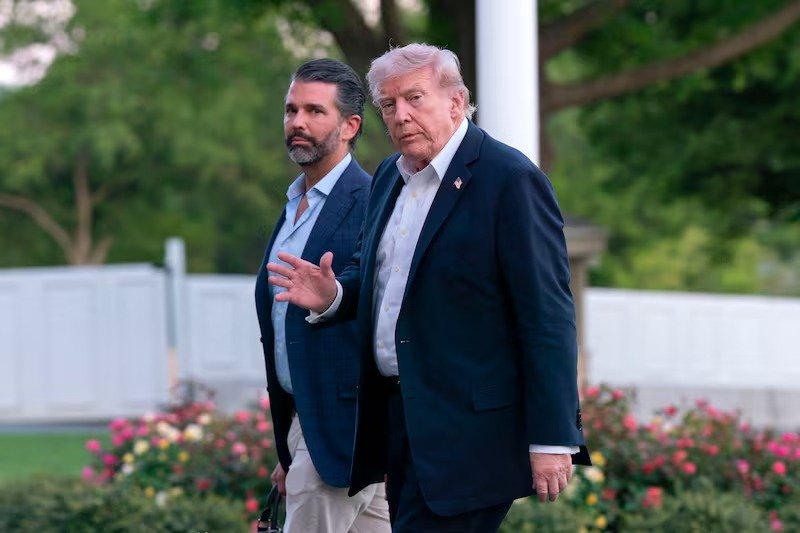
WASHINGTON, Oct 2026: Donald Trump Jr., the eldest son of US President Donald Trump, reportedly opposed the military campaign against Iran from the outset and privately conveyed his concerns to his father, according to a report published by The Atlantic. The report says Trump Jr. was against drawing the United States into another prolonged conflict in the Middle East, reflecting his longstanding scepticism towards foreign military intervention.
According to people familiar with his views, Trump Jr. expressed his objections during private conversations and made his position known to the president. However, he has not publicly launched a campaign against his father's Iran policy or openly criticised the administration over the military operation.
A spokesperson for Trump Jr. declined to comment on the report. The account is based on sources familiar with private discussions and should not be interpreted as a formal public declaration by Trump Jr. against the war. The available information also does not establish whether the reported disagreement has affected his relationship with the president.
The development has drawn attention to differences within the Trump family and the broader Republican political movement over the US military campaign against Iran.
Trump Jr's Opposition Reflects Longstanding Scepticism of Foreign Wars
Donald Trump Jr. has long been associated with a political approach sceptical of American military involvement in overseas conflicts. His reported opposition to the Iran war is consistent with the argument that Washington should prioritise domestic concerns and avoid becoming entangled in another extended Middle Eastern conflict.
During the 2024 US presidential election campaign, Trump Jr. presented his father as a leader capable of confronting international threats without committing the country to another major war. That message formed part of the broader America First political agenda, which emphasised national interests and questioned the costs of prolonged overseas military engagements.
His earlier public remarks on Iran have resurfaced following the reported private disagreement.
In April 2024, after Iran launched missile and drone attacks against Israel, Trump Jr. praised his father's leadership on social media. He argued that Trump's strength and resolve could help the United States confront international threats without being drawn into a full-scale war with Iran.
The subsequent US military campaign has created a contrast between that earlier political message and the administration's current actions. Nevertheless, Trump Jr.'s reported private objections do not establish that he has withdrawn his political support for his father.
America First Movement Divided Over Iran Military Action
The reported disagreement highlights a wider debate within the Republican Party and the Make America Great Again (MAGA) movement over the meaning of the America First policy.
One section of the movement argues that avoiding new foreign wars should remain a central principle of US foreign policy. Supporters of this position warn that prolonged military operations can drain public resources, increase economic uncertainty and divert attention from domestic priorities.
Others argue that American military involvement may be necessary to protect Israel, address security threats posed by Iran and defend US strategic interests in the region.
These competing perspectives became particularly visible in June 2025, when the possibility of American military intervention against Iran prompted debate among conservative commentators and political figures.
Tucker Carlson, Marjorie Taylor Greene and other prominent conservative voices expressed concerns about escalation and the prospect of a wider regional conflict. Their objections reflected fears that military action could lead to a prolonged American commitment rather than a limited operation.
Vice President JD Vance also defended the president amid disagreements within the conservative coalition. The debate demonstrated that support for Trump's domestic political agenda does not necessarily translate into uniform agreement on overseas military intervention.
The reported position of Trump Jr. adds another dimension to these differences, although he has not publicly joined the campaign against his father's Iran policy.
Pew Research Survey Shows Widespread Opposition to Trump's Handling of Iran War
Public opinion in the United States also indicates considerable dissatisfaction with the administration's handling of the conflict.
According to a Pew Research Center survey published on October 8, 2026, 65 per cent of American adults disapproved of the way President Trump was handling US military action against Iran, while 33 per cent approved. The survey was conducted between September 28 and October 4 among 5,062 US adults.
The survey also found that approval among Republicans and Republican-leaning independents had declined. In March, 69 per cent of respondents in this group approved of Trump's handling of the conflict. By October, the proportion had fallen to 63 per cent.
The figures suggest that concerns about the war extend beyond the president's political opponents. However, Republican support remains substantial, and the findings do not indicate that the party's backing for Trump has disappeared.
The survey further highlighted uncertainty about the duration of the military campaign. Nearly half of respondents, 47 per cent, expected the US military action against Iran to continue for more than another year, while 30 per cent anticipated it would last between six months and a year.
These expectations underscore public concerns about the possibility of a prolonged conflict and its consequences for American security, public spending and the domestic economy.
Energy Prices and Economic Concerns Add to Political Pressure
The Iran conflict has also become an economic issue as disruptions to energy supplies and uncertainty in international markets place pressure on fuel prices.
Diesel availability and prices have emerged as areas of concern for policymakers and market analysts. Although arrangements to obtain additional diesel supplies from Russia have been discussed, analysts have cautioned that increased availability alone may not guarantee a substantial reduction in prices.
Production capacity, transportation constraints and the volume of supplies reaching international markets will remain important factors. Consequently, changes in fuel prices cannot be attributed to a single political decision without considering broader market conditions.
Higher energy costs can affect transportation, household budgets and business operations, making the economic consequences of the conflict an important part of the domestic political debate.
For the Trump administration, these concerns add to questions about the objectives, duration and eventual outcome of the military campaign.
No Confirmed Policy Shift or Public Break by Trump Jr
The report of Donald Trump Jr.'s private opposition comes amid growing debate over US foreign policy, the future of the Iran conflict and the meaning of the America First agenda.
However, the reported disagreement does not establish that President Trump intends to change course, that a rift has developed within the family or that the military campaign will be altered.
For now, the available information points to privately expressed reservations rather than an open political break. Trump Jr. has not publicly announced opposition to the war, and his spokesperson has declined to comment on the reported conversations.
Any assessment of his position will depend on further direct statements or additional information about the discussions.
The episode nevertheless illustrates the competing priorities confronting the Trump administration: responding to security concerns in the Middle East while addressing domestic expectations that the United States avoid another prolonged overseas war.
(Disclaimer :The content of this article is sourced from a news agency and has not been edited by the Mavericknews30 team.)