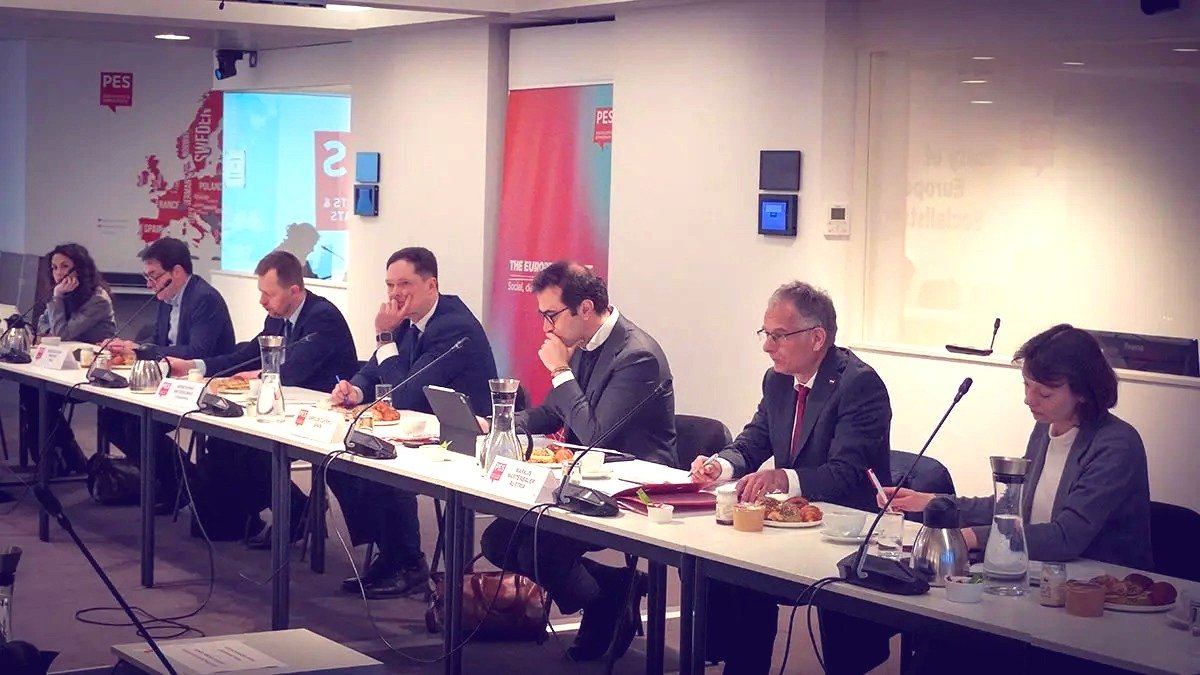
November 2026: Today (Friday – 27th November 2026; IST), economy and finance ministers from the Party of European Socialists adopted a joint declaration reaffirming that fair and effective taxation is a cornerstone of the European social model. They called for stronger European action against tax fraud, evasion, and avoidance to safeguard public finances, tackle inequalities and improve productivity.
The declaration “Closing the tax loopholes: Combating fraud, evasion and avoidance” was signed by:
·Lars Klingbeil, Chair of the SPD, Federal Minister of Finance, Germany, Chair of the PES ECOFIN Network;
·Markus Marterbauer, Federal Minister of Finance, Austria;
·Carlos Cuerpo, Minister of Economy, Trade and Business, Spain;
·Biljana Borzan, Vice- President for Sustainable Economy and Single Market, S&D Group in the European Parliament;
·Aurore Lalucq, Chair of the PES Financial and Economic Network, S&D MEP, PES.
Declaration of the Economic And Finance Ministers –
Fair and effective taxation is a cornerstone of our economies and societies. It is the backbone of the European social model, and a prerequisite for strong, resilient, and inclusive economies. Citizens and companies’ taxes finance the public goods that underpin our prosperity: quality public services including health, education and pensions, infrastructure, and investments in green, digital and social priorities. It is essential to fight inequality and promote equal opportunities for all.
On the other hand, tax evasion, tax avoidance, and fraud undermine the fairness of our tax systems and erode citizens’ trust in democratic institutions. They distort competition within the Single Market, and they undermine public finances by creating a tax compliance gap worth billions of euros. Tax justice and tax transparency are key to democracy and the foundation of the social contract. The ECOFIN has always been at the forefront of the fight to strengthen EU-level coordination and harmonisation, and international cooperation. We have contributed in enabling the European Union’s progress in combating tax evasion, tax avoidance, and aggressive tax planning. Despite these efforts, challenges remain. At a time when Europe must mobilise substantial resources to address economic resilience and climate change, strengthen social cohesion and security, ensuring that everyone contributes their fair share is more important than ever.
As PES ECOFIN ministers, we promote initiatives that ensure growth and competitiveness, hand in hand with equity and sustainability. We consider coordination and harmonisation to be the most effective ways of simplifying the system, providing clarity, certainty and efficiency for companies operating across Europe.
Whilst streamlining the EU tax framework, we must prevent any dilution of fundamental EU tax legislation; simplification must not result in deregulation. Tax avoidance, evasion and fraud remain structural challenges that must be addressed through robust action.
As ECOFIN ministers, we commit to advancing a strong European agenda to combat harmful tax practices and financial crime by reinforcing our action in the following areas:
1. Strengthening Tax Enforcement and Cooperation:
We reaffirm our strong stance of zero tolerance towards the shadow economy and related illicit activities and emphasise the importance of coordinated action and robust institutional mechanisms to support Member States in effectively tackling tax fraud. Missing Trader Intra Community (MTIC) fraud alone has caused considerable cumulative losses in the EU and is widely considered a significant contributor to the VAT compliance gap. Stronger enforcement and cooperation are urgently needed.
To achieve this, we will:
·Improve information exchange and cooperation between Eurofisc, the European Public Prosecutor’s Office (EPPO), and the European Anti-Fraud Office (OLAF).
·Encourage the Commission to engage with interested Member States to explore opportunities for enhanced cooperation on certain tax policy matters in cases where unanimity is not attainable.
·Take forward the proposed temporary extension of the possibilities for Member States to apply the Reverse Charge Mechanism (RCM) in VAT, to combat VAT carousel or MTIC fraud, recognising that, in the absence of a definitive EU VAT system, vulnerabilities remain.
2. Ending Corporate Profit Shifting:
Corporate profit shifting continues to erode EU public revenues and undermine fair competition. Multinational corporations have opportunities to shift profits and reduce their taxes, while only a limited number of Member States systematically measure the resulting revenue losses. The digitalised and globalised economy further amplifies these risks.
At the same time, the implementation of the global minimum tax through the EU Minimum Tax Directive marks a major step forward in addressing base erosion and profit shifting (BEPS). By reducing incentives for profit shifting and aggressive tax planning, it strengthens the resilience of Member States’ corporate tax bases, helps protect public revenues, and supports fair competition in the Single Market. Continued effective and consistent implementation, alongside monitoring of its impact, will be essential to maximise these benefits.
To contribute to addressing these challenges, we will:
·Promote taxation of multinational corporations within the EU by advancing steps towards a harmonised corporate tax base and measures to ensure a fair allocation of taxing rights among EU Member States, while considering the need to foster EU competitiveness and the wider global context.
·Support further work on the EU framework for withholding taxes on dividends, interest and royalties, including, where appropriate, targeted improvements to the Parent-Subsidiary Directive and the Interest and Royalties Directive, with the aim of enhancing legal certainty, reducing administrative burdens and preventing tax abuse, while safeguarding Member States’ taxing rights, minimum effective taxation and European tax bases.
·Push for an EU-wide contribution instrument to address windfall corporate profits in times of crisis, in particular windfall profit taxation, targeted at sectors such as energy during periods of exceptional market conditions and market distortions. It should be designed in a proportionate manner to protect the integrity of the Single Market while catering for the diversity of national situations, in order to reduce opportunities for profit relocation within the EU, provide legal and investment certainty, strengthen tax fairness, and help mitigate inflationary pressures.
·Consider a coordinated EU approach to adequately tax certain revenues generated by large digital companies at the European level, should no agreement be reached under the OECD/G20 Inclusive Framework work on base erosion and profit shifting (BEPS).
3. Addressing Loopholes in Taxation of High Net-Worth Individuals:
All members of society should pay their fair share of taxation, relative to their economic capacities. In 2023, the poorest 50% and the richest 0.001% of people held the same share of the total wealth in the EU i.e.,3.4%. Meanwhile, around 80% of tax revenue in the EU comes from taxes that fall primarily on ordinary citizens. Structural shortcomings in the EU tax framework and downward tax competition between Member States allow high-net-worth individuals to minimise their liabilities through aggressive tax planning.
To tackle these practices, reduce unfair concentration of wealth, and ensure productive circulation of capital within the economy, we will:
·Assess whether existing frameworks, including the Code of Conduct Group, are adequate to address evolving forms of harmful tax competition.
·Promote convergence on key aspects of capital gains and wealth taxation at EU level, to limit potential capital flight as well as contribute to preventing double taxation.
·Encourage discussion on EU-level engagement in the field of taxation of high-net worth individuals, premised on the G20 discussions launched by the Brazilian Presidency in 2024, and consider a European initiative to support the implementation of a wealth tax on ultra-high net worth individuals in Member States.
4. Reducing burdens while supporting effectiveness and fairness:
As ECOFIN ministers, we support the objective of modernising the EU tax framework. Stronger coordination and consistent implementation are essential, without weakening established standards. Member States should apply European provisions consistently and address divergences in transposition. The Tax Omnibus should clarify legal concepts, remove overlaps, and ensure consistency across legislation. It is important to strike a balance between reducing burdens and ensuring that measures remain effective and fair.
To this end, we will modernise the EU tax acquis while ensuring fairness by:
·Preserving essential elements of the EU tax framework, opposing the weakening of existing protection systems against aggressive tax planning.
·Supporting common technical standards and tools (level 2 measures) at EU level; supporting interpretation and enforcement through EU recommendations, best practices, or binding instruments; calling for uniform guidance from the Commission to ensure harmonised Member State implementation, for instance of the general anti-tax avoidance rule (GAAR).
·Expanding the Directive on Administrative Cooperation (DAC) by covering automatic exchange of information on capital gains and real estate assets. We take note of the DAC recast proposal including, in the context of the ongoing negotiations, acknowledge the consolidation into a single directive and the integration into DAC1 of the OECD agreement on beneficial ownership information on real estate.
5. Strengthening International Cooperation:
The European Union has already made significant progress by thoroughly implementing international standards agreed at OECD level. This has improved corporate and financial transparency, enhanced the exchange of information, promoted good tax governance, and ensured a minimum level of effective taxation.
Building on these achievements, we will deepen our engagement in international tax cooperation through the following actions:
·Reiterate our support for the BEPS OECD/G20 Inclusive Framework, including full backing for the effective implementation of OECD Pillar Two, and reaffirming commitment to the constructive dialogue on the taxation of the digital economy.
·Strengthen effective tax rules for high-net-worth individuals, including through wealth taxes. We should build on the forthcoming United Nations Framework Convention on International Tax Cooperation, while ensuring consistency and avoiding overlaps with existing OECD work.
As ECOFIN ministers, we are committed to closing tax loopholes and combating fraud, evasion, and aggressive tax planning as a matter of tax justice. By strengthening enforcement and coordination, and ensuring fair taxation of corporations, high-net-worth individuals, and the digital economy, we aim to create a resilient, competitive, and socially just European society for all Europeans.
Team Maverick.