Turkish President reiterates long-standing position on Kashmir; India maintains that Jammu and Kashmir is an integral part of the country and outstanding issues with Pakistan must be addressed bilaterally
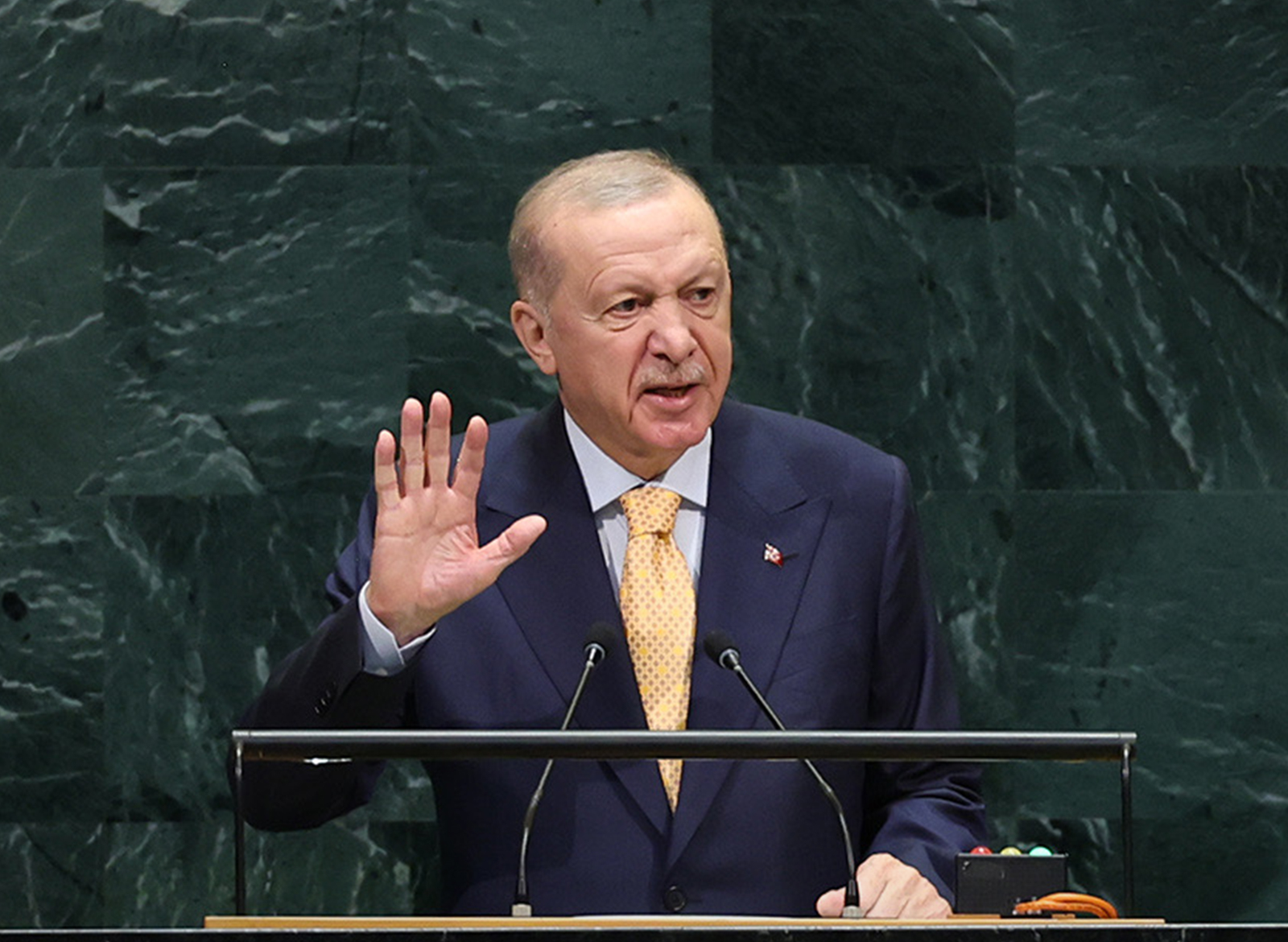
New York, September 2026 : Turkish President Recep Tayyip Erdogan once again raised the Kashmir issue during his address to the 81st session of the United Nations General Assembly in New York on Tuesday, calling for disputes in South Asia, including Kashmir, to be addressed through dialogue within the framework of the UN Charter and relevant resolutions.
“In South Asia, it is important that all disputes, including the Kashmir issue, be addressed through dialogue within the framework of the United Nations Charter and of relevant resolutions,” Erdogan said during his address.
The remarks came in the presence of Pakistan Prime Minister Shehbaz Sharif and marked another instance of the Turkish president referring to Kashmir at the UNGA. Erdogan has raised the issue on several previous occasions, making it a recurring element of his statements on South Asian affairs.
Erdogan Reiterates Position on Kashmir
Erdogan’s latest comments reflected Turkey’s established position of calling for dialogue on the Kashmir issue. Ankara has previously advocated diplomatic engagement between India and Pakistan and referred to UN resolutions while discussing the dispute.
The Turkish president had also spoken about Kashmir during earlier UNGA sessions. His comments were particularly prominent in 2019, after India announced changes to the constitutional status of Jammu and Kashmir. He again referred to the issue in 2021 and returned to it during his 2025 UNGA address, when he welcomed the India-Pakistan ceasefire and called for a resolution based on UN resolutions.
His latest remarks therefore represent a continuation of a position Turkey has articulated over several years rather than a new policy announcement.
India’s Position Remains Unchanged
New Delhi has consistently rejected third-party involvement in matters concerning Jammu and Kashmir. India maintains that Jammu and Kashmir and Ladakh are integral and inalienable parts of the country and that outstanding issues with Pakistan should be addressed through direct bilateral dialogue.
India has also objected to references to Kashmir by foreign leaders and governments, arguing that such comments do not take into account New Delhi’s position on sovereignty and territorial integrity.
Following similar remarks by Erdogan in 2025, India lodged a strong protest and reiterated that its position on Jammu and Kashmir was clear. New Delhi has maintained that there is no scope for third-party mediation in matters between India and Pakistan.
The latest comments are consequently likely to be viewed in New Delhi in the context of Ankara’s repeated interventions on the issue.
Kashmir Remains Sensitive Diplomatic Issue
The Kashmir dispute has remained a longstanding point of contention between India and Pakistan and continues to feature in international diplomatic discussions.
India and Pakistan have differing positions on the region, while India has repeatedly emphasised that bilateral mechanisms are the appropriate means of addressing outstanding matters between the two countries.
Erdogan’s reference to the UN Charter and relevant resolutions reflects Turkey’s stated preference for a diplomatic approach. India, however, has consistently maintained that external intervention is not acceptable and that its bilateral relationship with Pakistan should not be internationalised.
The issue has also featured in broader diplomatic exchanges involving Turkey and India. Erdogan’s earlier statements on Kashmir have periodically drawn criticism from New Delhi, with Indian officials urging Ankara to respect India’s sovereignty and avoid commenting on matters that India regards as internal or bilateral.
Gaza and UN Reforms Also Feature in Speech
Kashmir was only one of several international issues addressed by Erdogan during his UNGA speech. The Turkish president also spoke extensively about the situation in Gaza and called for stronger international action on the Palestinian issue.
He reiterated Turkey’s support for Palestinian statehood and criticised the humanitarian situation in Gaza. Erdogan also called for reforms to the United Nations Security Council, arguing that the global institution needs to become more representative and effective in addressing international conflicts and security challenges.
His speech therefore covered a wide range of geopolitical issues, with the Middle East, the United Nations system and regional conflicts forming significant parts of his address.
A Recurring Diplomatic Difference
The latest reference to Kashmir adds another point of difference between Ankara and New Delhi. While Turkey has continued to advocate dialogue and has referred to the UN framework when discussing the issue, India has consistently emphasised bilateral engagement and rejected third-party mediation.
For Ankara, the latest statement continues a diplomatic position that Erdogan has expressed at international forums over several years. For New Delhi, the Kashmir issue remains closely linked to its sovereignty and territorial integrity, with India maintaining that the matter does not require external mediation.
Erdogan’s latest remarks have consequently brought Kashmir back into the diplomatic spotlight at the UN General Assembly, even as governments continue to pursue dialogue on wider regional and international security issues.
The statement also comes at a time of heightened diplomatic activity around South Asia, with India, Pakistan and other countries continuing to engage on regional security and stability. Against this backdrop, the divergent positions of Turkey and India on Kashmir remain an established feature of their bilateral diplomatic relationship.