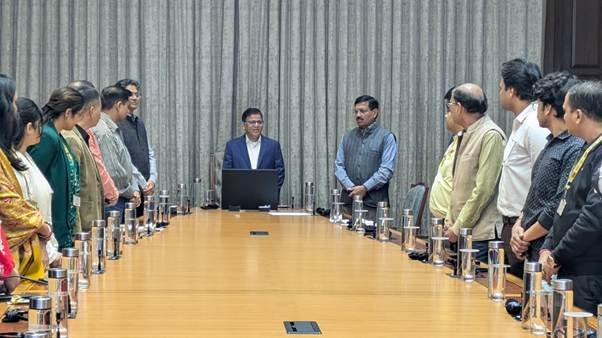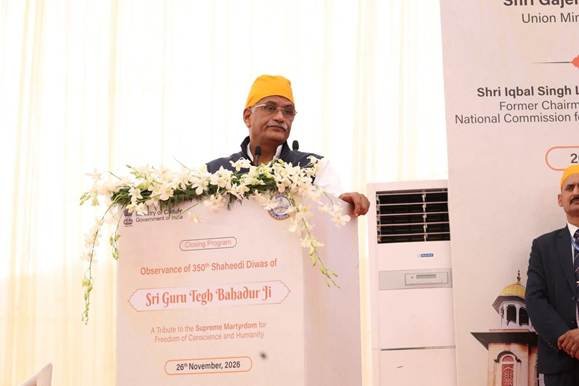
The Ministry of Culture organised the closing programme of the year-long observance of the 350th Shaheedi Diwas of Sri Guru Tegh Bahadur Ji at the Centre for Cultural Resources and Training (CCRT) Campus, Dwarka, New Delhi. The programme commemorated the supreme martyrdom of Guru Tegh Bahadur Ji for the freedom of conscience, religious freedom and the welfare of humanity.
The year-long commemoration of the 350th Shaheedi Diwas of Sri Guru Tegh Bahadur Ji was observed from 24 November 2025 to 24 November 2026. Inaugurated by the Hon’ble Prime Minister Shri Narendra Modi at Kurukshetra, Haryana, the commemoration marked the beginning of a series of programmes across the country to highlight Guru Sahib's life, teachings and supreme martyrdom. As part of the commemoration, a commemorative coin and postage stamp were also released in honour of Sri Guru Tegh Bahadur Ji.
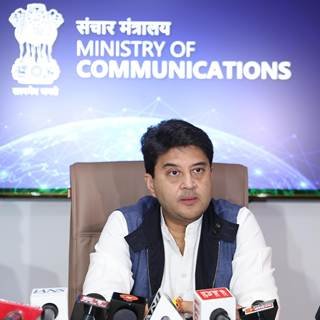
The closing ceremony was graced by Union Minister for Culture and Tourism Shri Gajendra Singh Shekhawat, who attended as the Chief Guest. Shri Iqbal Singh Lalpura, Former Chairman, National Commission for Minorities, and Shri Amar Preet Singh, Former Chief of the Air Staff, Indian Air Force, were the Guests of Honour. Senior officials of the Ministry and other distinguished dignitaries were also present on the occasion.
The programme featured Shabad Kirtan, an exhibition and a short film highlighting the life, teachings and supreme martyrdom of Sri Guru Tegh Bahadur Ji. These presentations provided an opportunity to reflect on his message of compassion, courage, human dignity and respect for freedom of conscience.
Addressing the gathering, Union Minister Shri Gajendra Singh Shekhawat said that the occasion marked not merely the conclusion of a programme, but the culmination of a year-long campaign of remembrance, reverence, reflection and public awareness dedicated to Sri Guru Tegh Bahadur Ji. He emphasised that the purpose of the observance was to draw inspiration from Guru Sahib's life and teachings and enable the present generation to understand, adopt and carry forward his ideals.
He further emphasised that human achievement cannot be measured only through material accomplishments. The true purpose of human life and progress is to build a society where the freedom and dignity of every individual are protected and upheld. He said that the teachings of Guru Tegh Bahadur Ji continue to guide society towards these values and remain relevant for generations to come.
Shri Amar Preet Singh, Former Chief of the Air Staff, Indian Air Force, highlighted that Sri Guru Tegh Bahadur Ji dedicated his entire life to protect the rights and freedom of belief of others. He observed that while individuals generally strive to safeguard their own faith and beliefs, Guru Tegh Bahadur Ji devoted his life to protecting the beliefs and freedom of others. He noted that this makes Guru Ji's martyrdom truly extraordinary and an enduring example of selflessness and courage.
Shri Iqbal Singh Lalpura, Former Chairman, National Commission for Minorities, appreciated the efforts of the Ministry of Culture in organising the year-long observance and taking the teachings of Sri Guru Tegh Bahadur Ji to people across the country.
Shri Samar Nanda, Joint Secretary, Ministry of Culture, spoke about the various programmes organised by the Ministry across different states to take the life, teachings and philosophy of Sri Guru Tegh Bahadur Ji to people across the country. He highlighted how these programmes brought scholars, artists, religious organisations and local communities together on a common platform to share and reflect on Guru Sahib's ideals.
He further informed that the Centre for Cultural Resources and Training (CCRT) organised educational and cultural programmes in schools to engage students with the life and teachings of Guru Tegh Bahadur Ji. As part of this initiative, workshops were conducted in 220 schools, with the participation of around 68,000 students. These efforts were aimed at introducing the younger generation to Guru Sahib's message of compassion, selflessness, fearlessness, service and the welfare of all.
Through these initiatives, the Ministry of Culture reaffirmed its commitment to preserving and promoting India's rich spiritual and cultural heritage and taking the timeless teachings of great spiritual leaders to future generations.